





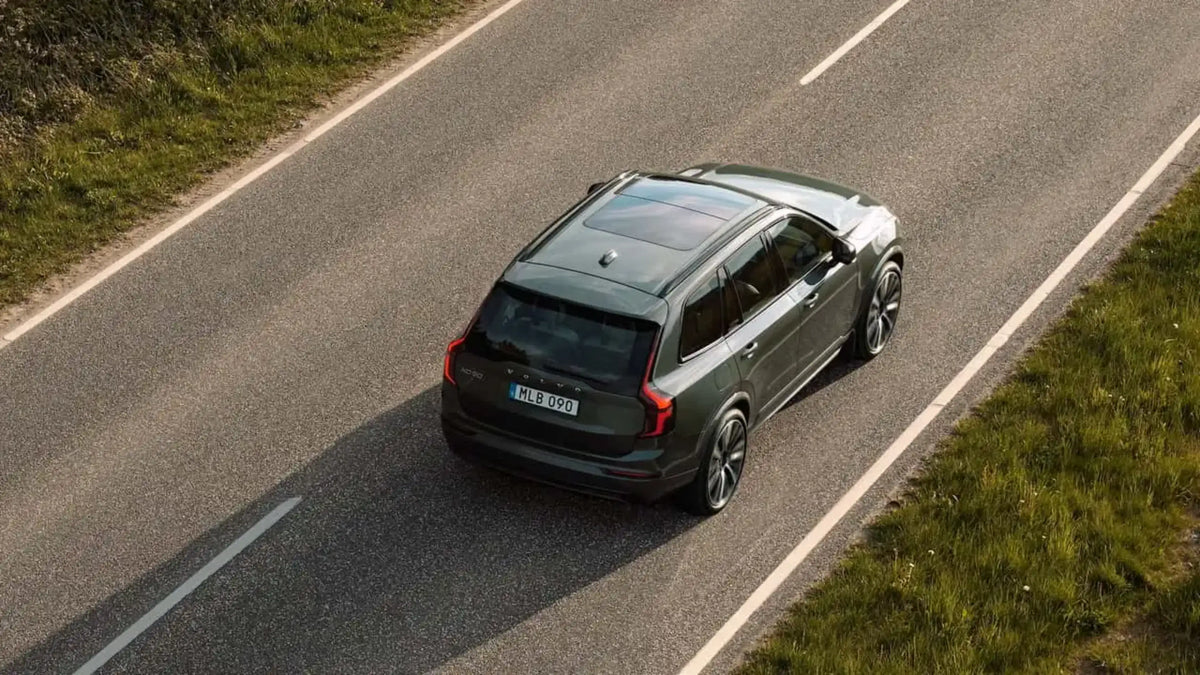
Volvo’s 2028 XC60 and XC90 plug-in hybrids will more than double their electric-only driving range, reaching up to 78 miles in the XC60 and 73 miles in the XC90. The improvement comes mainly from a much larger 37.9-kWh usable battery, while both SUVs retain all-wheel drive and a combined output of 455 horsepower. Photo by: Volvo
Electric Range More Than Doubles
The biggest change for the 2028 models is battery capacity.
The XC60 PHEV is expected to travel up to 78 miles on electricity, compared with about 35 miles for the current version. The larger XC90 PHEV increases from roughly 32 miles to 73 miles of electric range.
That gives both SUVs enough battery capacity to cover many everyday trips without starting the gasoline engine.
Volvo says the median round-trip distance for its U.S. customers is approximately 22 miles, while most drive less than 30 miles per day. Based on those figures, a fully charged XC60 or XC90 could complete several typical daily trips before requiring another charge.
For longer journeys, the gasoline engine remains available. Volvo lists combined gasoline-and-electric driving ranges of approximately 590 miles for the XC60 and 560 miles for the XC90.
The strategy reflects Volvo’s broader emphasis on plug-in hybrids alongside fully electric vehicles, giving buyers another option between conventional combustion models and battery-only EVs.
A 37.9-kWh Battery Drives the Improvement
Both updated SUVs use 37.9 kWh of usable battery capacity, up from 18.8 kWh in the previous versions.
The powertrain continues to combine a turbocharged four-cylinder gasoline engine with electric drive components. Total system output remains 455 hp, and all-wheel drive continues as standard equipment.
Despite the battery capacity roughly doubling, Volvo says charging time will increase only modestly.
On a Level 2 charging connection, the battery can be replenished in less than six hours, according to the automaker. Volvo also says a suitable 16-amp charging setup can complete the process in approximately four hours.
The company has not announced whether the updated XC60 and XC90 PHEVs will support DC fast charging.
That separates them from some newer plug-in hybrids that combine longer electric range with public fast-charging capability. However, Volvo’s approach appears focused primarily on overnight or routine home charging.
XC60 Also Receives Exterior Updates
The XC60, Volvo’s best-selling model, receives several styling revisions alongside the powertrain changes.
The front end adopts a smaller, more rectangular grille and redesigned headlamps. Volvo has also updated the signature Thor’s Hammer daytime running lights.
Changes at the rear include revised taillamps and a cleaner tailgate treatment, while the overall proportions remain largely familiar.
The XC90’s main update is its significantly longer electric range rather than a major redesign.
Volvo positions the two plug-in hybrids alongside the fully electric EX60, giving customers several electrified options within its midsize SUV lineup.
Longer-Range PHEVs Are Becoming More Common
Plug-in hybrids have gradually moved toward larger batteries and longer electric-only driving distances.
The Mercedes-Benz GLC 350e, for example, offers up to 54 miles of electric range from a 24.8-kWh battery. The 2026 Toyota RAV4 PHEV also reaches approximately 54 miles with a 22.7-kWh pack.
Both models can use DC fast charging. The Mercedes can reach about 60 kW, while the Toyota supports up to 50 kW, with both capable of approximately 10% to 80% charging in around 30 minutes under suitable conditions.
Volvo’s 2028 SUVs take a different approach by prioritizing significantly greater battery capacity and electric range.
The practical benefit, however, depends on charging behavior. A plug-in hybrid delivers its greatest fuel-saving advantage when owners recharge regularly. If the battery is rarely charged, the vehicle still carries the extra weight of its electric components while relying more heavily on gasoline.
That makes the new 73- to 78-mile electric range especially relevant for drivers with access to regular home or workplace charging. For those users, the 2028 XC60 and XC90 could complete a large share of routine driving on electricity while retaining gasoline power for longer trips. Photo by: Volvo
FAQ
How far can the 2028 Volvo XC60 PHEV drive on electricity?
The 2028 Volvo XC60 plug-in hybrid is rated for up to 78 miles of electric-only driving. That is more than double the approximately 35-mile range of the current model.
What is the electric range of the 2028 Volvo XC90 PHEV?
The updated XC90 PHEV can travel up to 73 miles on battery power. The current version provides roughly 32 miles of electric range.
How large is the new Volvo PHEV battery?
Both SUVs use a 37.9-kWh usable battery, compared with 18.8 kWh previously. The larger pack is the main reason for the substantial range increase.
How long will the new XC60 and XC90 PHEVs take to charge?
Volvo says Level 2 charging will take less than six hours. With a suitable 16-amp setup, charging can take approximately four hours.
How much power do the 2028 Volvo PHEVs make?
Both models continue to produce 455 horsepower from their combined gasoline-electric powertrains. Standard all-wheel drive also remains part of the package.
Recommend Reading: Volvo EV Sedan and Wagon May Return in 2028


Share:
Volkswagen EV Sets New Efficiency Records