





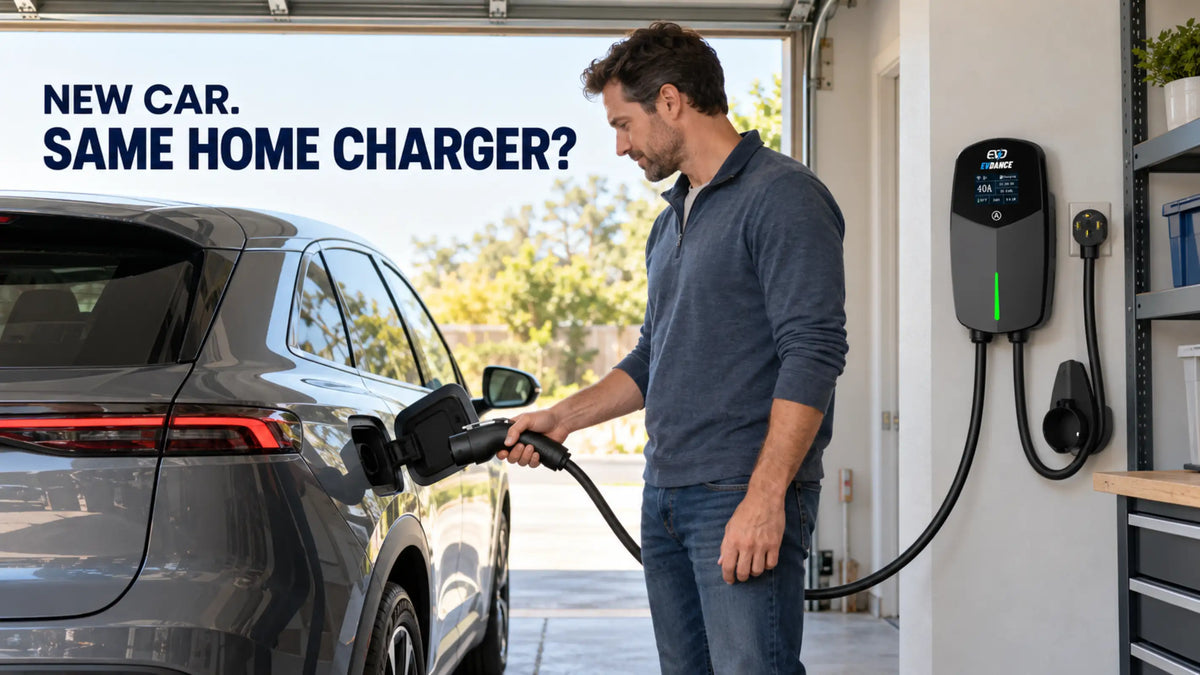
In many cases, yes. An existing home EV charger can continue working after you change cars if the connector is compatible, the charging speed meets your daily needs and the cable reaches the new charge port safely.
A new vehicle may use a different connector or support a higher AC charging rate. Neither difference automatically means the charger already installed at home must be replaced.
Does the Connector Fit the New Car?
Start by checking the connector on the existing charger and the charging inlet on the new vehicle. Two common connections for home AC charging in North America are SAE J1772 and NACS, which is standardized as SAE J3400.
If the charger and vehicle use the same connection, they can connect directly. When the connections differ, a compatible AC adapter may allow the existing charger to remain in use.
The adapter must match the direction of the connection. A J1772 charger connected to a NACS vehicle requires a J1772-to-NACS adapter. A NACS charger connected to a J1772 vehicle requires the opposite configuration, such as a purpose-built NACS-to-J1772 AC charging adapter.
An AC adapter should not be confused with a CCS1 or NACS DC fast-charging adapter. It also should not be assumed to work in both directions. Confirm compatibility with the vehicle, charger and adapter instructions. The SAE J3400/1 standard covers safety and OEM-qualified designation for adapters used between defined charging connections.

Will the Existing Charging Speed Be Enough?
A new vehicle can use an existing charger even when it supports a higher maximum AC charging rate. A car capable of accepting 11.5kW can still charge from a 7.68kW charger; it will simply charge at the lower available rate.
The practical question is whether the existing charger can replace the energy used each day before the next drive. If it can, upgrading solely to reach the vehicle’s maximum AC rate may not noticeably improve the owner’s routine.
Do not increase the charging current simply because the new car supports more power. The charger and complete home electrical setup must support the selected current.
Can the Cable Reach the New Charge Port?
Charge-port position varies between vehicles. The previous car may have placed the inlet near the left rear, while the new one may locate it on the opposite side, near the front wheel or at the front of the vehicle.
Park the new car in its normal position and check the cable route. The connector should reach without pulling the cable tight or leaving it beneath a tire, through a closing garage door or across a frequently used walkway.
Reversing the parking direction may solve the problem, but the new position should still leave enough room to enter the vehicle and move safely around the charging area. The cable should follow broad, relaxed curves rather than remain under tension.
If the cable reaches only through an awkward route, repositioning compatible charging equipment or selecting a charger with a more suitable cable length may provide a better long-term arrangement.
What Charging Settings Need to Be Updated?
Compatible hardware does not guarantee that the new vehicle will follow the schedule previously used with the old car.
Check the new vehicle’s charge limit, preferred charging hours, departure time and location-based settings. Some vehicles apply a schedule only at a saved home location, so these settings may need to be created again.
If the charger also uses an app, make sure its schedule does not conflict with the schedule stored in the vehicle. For example, the charger may permit charging at midnight while the vehicle is set to wait until 2 a.m.
Drivers enrolled in a utility charging program may also need to register the replacement vehicle or reconnect the relevant account. Old vehicle access and notifications should be removed when they are no longer needed.
When Does the Charger Actually Need to Be Replaced?
Replacing the charger may make sense when:
-
No suitable connection is available for the new vehicle
-
The existing speed cannot restore normal daily energy use during the available parking time
-
The cable cannot reach the new charge port safely
-
The charger is damaged, unreliable or no longer supported
-
A utility or home energy-management program requires different equipment
A higher charging limit on the new vehicle is not, by itself, a reason to replace a working charger. The U.S. Department of Energy explains that suitable home charging depends on factors including daily travel, available charging time and vehicle requirements.
If the charger connects correctly, reaches the new charge port and restores enough energy before the next drive, it can usually remain in service after the vehicle changes.
Recommended Reading: EV Charging Speed Explained with Real Examples


Share:
Home EV Charging for Renters: What to Confirm Before You Plug In