





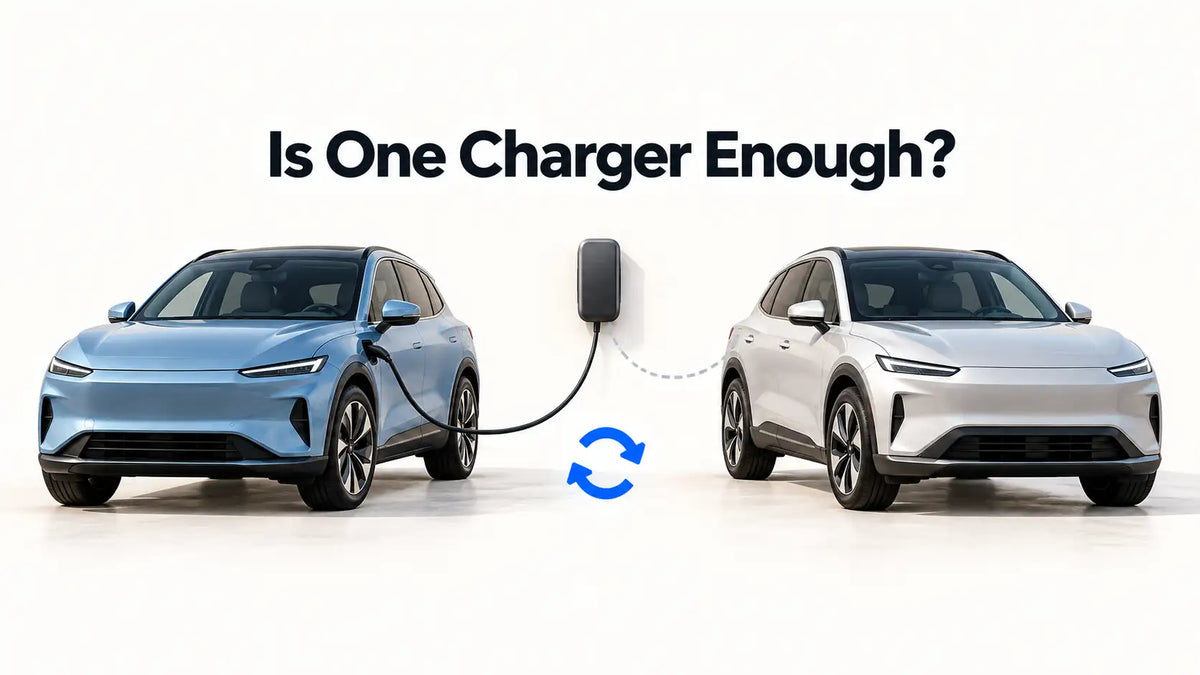
Two EVs do not always require two Level 2 chargers. Many households can share one charger by considering how far each vehicle traveled, when each driver will leave and how much energy each vehicle needs before the next trip.
A second charging setup becomes more useful when both vehicles regularly return with low batteries and need substantial charging during the same overnight period.
Two Cars Rarely Need a Full Charge Every Night
Home charging should replace the energy each vehicle used, not refill both batteries from empty every night. A vehicle driven 15 miles during the day usually needs much less charging than one driven 70 miles.
This difference often makes sharing possible. The higher-mileage vehicle can use the main Level 2 charger more frequently, while the second vehicle may charge on alternate nights or after the first vehicle has received enough energy.
Battery size alone does not determine priority. Daily mileage and the next planned trip are more useful because they show how much energy each vehicle actually needs.
Charge the Car That Needs Power First
The first charging position should normally go to the vehicle with the lowest available range, the earliest departure or the longest trip planned for the following day.
For example, if one driver returns from a long commute and leaves again at 6:30 a.m., that vehicle may need the charger first. A second vehicle that traveled only a short distance and will remain home until the afternoon can wait.
The two vehicles do not need equal charging time every night. Priorities can change from day to day according to actual use.

One Level 2 Charger Can Serve Both Cars
Sharing is simplest when both vehicles park close enough to the charger and the connector can reach either charging port without an extension cable.
Some households alternate vehicles by night. Others connect the higher-mileage vehicle after arriving home, then move the vehicle-side connector to the second car before going to bed. The first session should be stopped or completed before the connector is removed.
This does not require unplugging the EVSE from the wall each time. Repeatedly removing the wall plug simply to change vehicles adds unnecessary handling at the receptacle. Only the vehicle connector normally needs to move between cars.
Cable length and charging-port location still matter. The cable should reach both vehicles without being pulled tight, placed beneath a tire or routed through a garage door or main walking path.
Level 1 Can Support the Lower-Mileage Vehicle
The second car may not need Level 2 charging at all. Level 1 can be practical for a vehicle with low daily mileage, a long parking period or a smaller plug-in hybrid battery.
In this arrangement, the higher-mileage vehicle uses the Level 2 charger while the lower-mileage vehicle charges more slowly from a suitable 120V circuit. A 12A/16A portable charger for Level 1 and Level 2 charging can support this type of flexible setup when its voltage, plug, current and connector configuration match the available power source and vehicle.
The important question is whether the slower connection can restore the energy used during a normal day before the vehicle is needed again. If it can, installing two higher-output charging points may not provide a meaningful everyday benefit.
Avoid Uncontrolled Circuit Sharing
Two outlets in the same garage do not necessarily provide two independent sources of charging capacity. They may be connected to the same branch circuit or limited by the home’s available electrical service.
Do not connect two EV chargers through an ordinary splitter or adapter and assume they can operate together. A basic splitter does not coordinate the total current in the way a properly designed load-management system can.
Lowering the current on one charger also does not prove that the complete setup is suitable. The breaker, wiring, receptacles and combined load must support the arrangement. If the circuit layout or available capacity is uncertain, it should be checked by a qualified electrician.
A Second Charger Helps When Schedules Overlap
One shared charger becomes less convenient when both vehicles regularly travel long distances, arrive with low batteries and need to leave early the next morning.
A second charging point may also make sense when the vehicles cannot park within reach of the same cable or when moving the connector every evening disrupts the household’s routine.
Before adding another charger, confirm whether the home can support two units operating at the same time. Depending on the available electrical capacity, the solution may involve a second circuit or a controlled system that divides power between the two vehicles.
The U.S. Department of Energy recommends matching home charging equipment and installation to the available electrical service and applicable local requirements.
Build the Plan Around Daily Use
One home charger may be enough for two EVs when their daily mileage and departure times are different. The practical goal is to give each vehicle the energy it needs before its next trip—not to provide both cars with the highest possible charging rate every night.
Start with charging priority, available parking time and safe electrical capacity. If those factors repeatedly create conflicts, a second charger or managed charging system may then become worthwhile.
Recommended Reading: Can You Use a Portable EV Charger Every Day?


Share:
Does Your PHEV Need Level 2 Charging?