





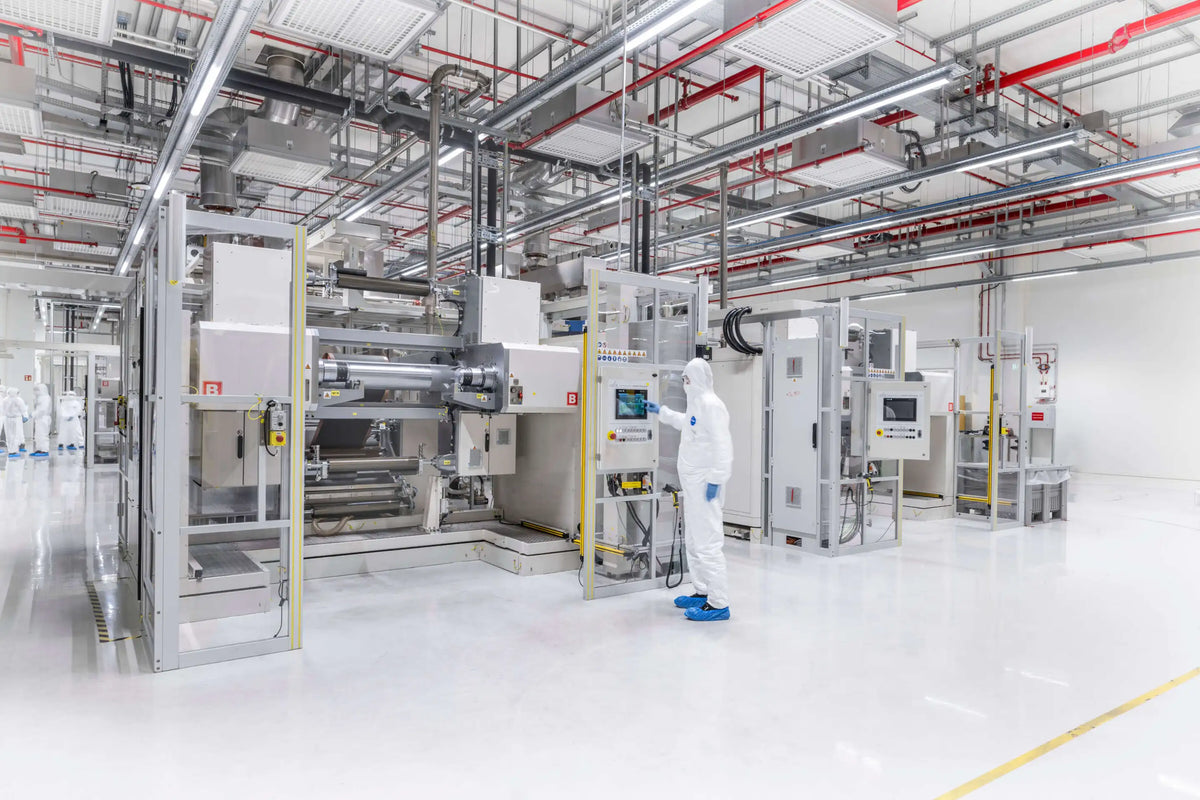
Volkswagen is expanding its partnership with Chinese battery maker Gotion to build more lithium iron phosphate battery capacity in Europe. The plan includes new joint ventures in Spain, Slovakia and Morocco as Volkswagen prepares lower-cost battery technology for future mass-market electric vehicles. Photo by: Volkswagen
Volkswagen Builds a Larger LFP Battery Network
Volkswagen Group has announced a broader battery partnership with Gotion High-Tech, creating three joint ventures intended to strengthen local production of lithium iron phosphate, or LFP, batteries.
The strategy supports Volkswagen’s effort to reduce battery costs as it develops more affordable electric vehicles. LFP chemistry is generally less expensive than nickel-rich alternatives and is increasingly used in mainstream EVs because of its durability, thermal stability and improving energy density.
Volkswagen expects demand for this chemistry to increase sharply in Europe. The company estimates that LFP batteries currently account for about 10% of the European market, but their share could rise to 40% to 60% by 2030.
Despite that expected growth, Europe currently has limited large-scale LFP cell manufacturing. Volkswagen says the new agreements are designed to establish more of that supply chain within the region instead of relying almost entirely on imports.
Spain Will Become a Major LFP Cell Production Hub
The largest transaction involves Volkswagen battery subsidiary PowerCo and its plant in Valencia, Spain.
Under the agreement, Gotion will invest approximately $1.25 billion for a 49% ownership stake in the facility. PowerCo and Gotion will jointly operate the plant, which Volkswagen plans to develop into an important European manufacturing center for LFP versions of its unified battery cell.
The Valencia factory is expected to reach a production capacity of about 29.1 GWh per year, according to financial disclosures connected with the partnership.
Volkswagen’s unified cell strategy is intended to simplify battery production across multiple brands and vehicle segments. Rather than designing completely different cell formats for each battery chemistry, PowerCo’s prismatic design can support several chemistries while maintaining a common physical format.
That approach could eventually allow Volkswagen to use LFP cells in lower-cost vehicles while reserving higher-energy chemistries for models where performance or range is a greater priority.
Slovakia and Morocco Extend the Supply Chain
Volkswagen is also committing roughly $535 million through 2030 to additional projects involving Gotion.
Part of that investment will give Volkswagen a 49% stake in Gotion’s battery plant in Slovakia. The facility is expected to have annual capacity of approximately 8.4 GWh and will manufacture LFP cells for both electric vehicles and stationary energy-storage systems.
The two companies also plan to establish a new operation in Morocco. Rather than assembling complete battery cells, the Morocco facility will focus on producing LFP cathode material, an important upstream component in the battery manufacturing process.
Together, the three projects cover more than final cell assembly. Spain will serve as the main unified-cell manufacturing location, Slovakia will add additional battery production, and Morocco will contribute raw battery material processing.
That broader structure is intended to give Volkswagen greater control over both costs and supply as LFP demand rises.
LFP Fits Volkswagen’s Lower-Cost EV Strategy
The battery investment comes as Volkswagen restructures several parts of its global business. The automaker is reducing jobs, cutting complexity from its model range and reviewing manufacturing capacity while facing stronger competition, particularly from lower-cost Chinese EV manufacturers.
At the same time, Volkswagen continues to expand its electric lineup. Lower-cost battery chemistry is likely to become increasingly important if the company wants to bring EV prices closer to comparable combustion models.
LFP cells are particularly suited to entry-level and high-volume electric cars because they use iron and phosphate instead of more expensive nickel and cobalt-heavy cathode materials. Their lower energy density has historically limited driving range, but improvements in cell design have reduced that disadvantage.
Other automakers are pursuing similar strategies outside China. Ford has licensed LFP technology from CATL for battery production in Michigan, while Gotion is also developing manufacturing capacity in the United States.
Volkswagen’s latest agreements show that Europe is following the same direction. Rather than depending solely on imported LFP cells, the group wants regional manufacturing to support future EV production.
The exact Volkswagen models that will receive the new European-made LFP cells have not been announced. However, the company describes the chemistry as an important component of its strategy for affordable, high-volume electric vehicles, making it likely to play a larger role across the group during the second half of the decade. Photo by: Volkswagen
FAQ
Why is Volkswagen investing in LFP batteries?
Volkswagen sees LFP chemistry as a lower-cost option for mass-market electric vehicles. The technology can reduce battery expenses while offering strong durability and sufficient performance for many mainstream EVs.
Where will Volkswagen produce LFP batteries in Europe?
Volkswagen and Gotion plan battery operations in Spain and Slovakia. The Valencia plant will become a major LFP unified-cell production site, while the Slovakian facility will manufacture cells for vehicles and energy storage.
How much capacity will the Valencia battery factory have?
The PowerCo-Gotion plant in Valencia is expected to reach approximately 29.1 GWh of annual battery production capacity.
What will the Morocco facility produce?
The planned Morocco project will manufacture cathode material for LFP batteries. This gives the partnership a role earlier in the battery supply chain rather than focusing only on finished cells.
How large could the European LFP battery market become?
Volkswagen estimates that LFP batteries could represent 40% to 60% of Europe’s battery market by 2030, compared with around 10% today.
Recommend Reading: Bentley Torcal EV Offers 375 Miles of Range


Share:
New US Fuel Economy Rules Set 34.9 MPG Target