





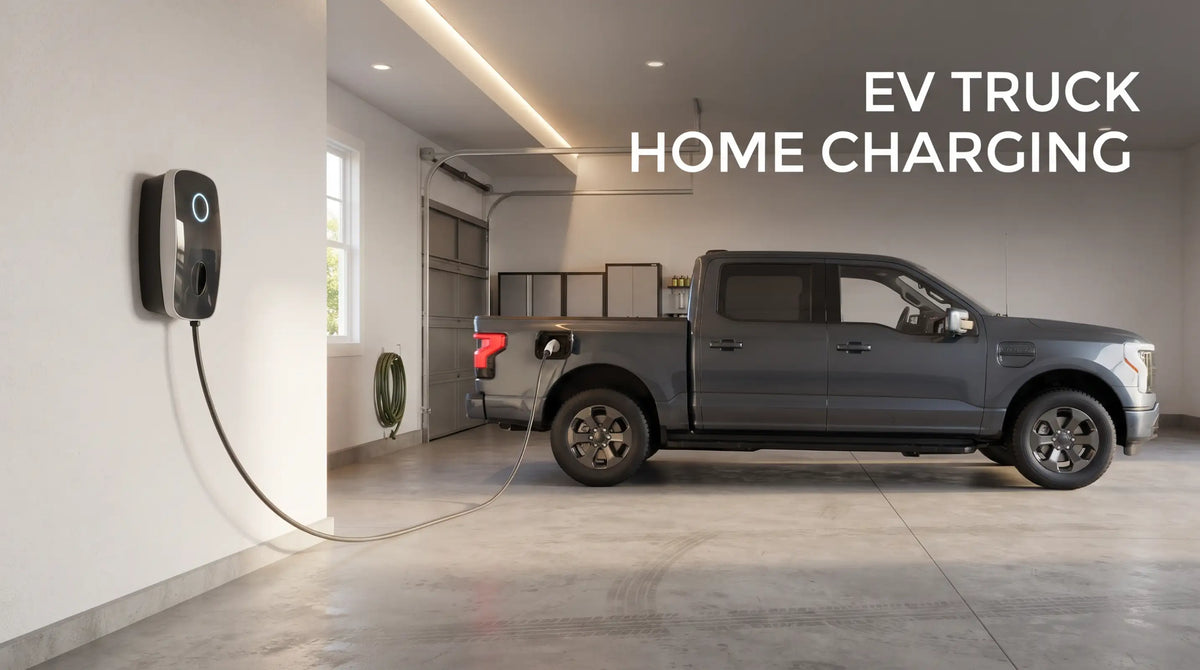
Electric trucks can use considerably more energy than smaller EVs, making overnight charging speed more important for drivers with long commutes, towing duties or frequent work trips.
However, the charger with the highest amp rating is not automatically the best choice. The truck’s AC charging limit, connector, daily energy use and need for home backup features all affect the decision.
High Output Only Helps When the Truck Can Use It
A 48A charger can provide approximately 11.5kW at 240V, while a 50A charger can provide up to 12kW. An 80A unit can reach 19.2kW, but only a compatible vehicle and electrical installation can use that full output.
For example, Ford lists an 11.2kW Level 2 peak charging rate for the 2025 F-150 Lightning. Tesla lists Cybertruck charging at up to 11.5kW and 48A through its Wall Connector. Installing a higher-rated charger would not make these trucks exceed their onboard AC limits.
Higher output is most valuable when the truck supports it and regularly needs to recover a large amount of energy within a short charging period.
Five Wall Chargers at a Glance
| Wall charger | Maximum output | Vehicle connection | Cable | Listed price |
|---|---|---|---|---|
| EVDANCE 50A Hardwired Charger | 50A / 12kW | NACS or J1772 versions | 25 ft | From $389.95 |
| Tesla Universal Wall Connector | 48A / 11.5kW | NACS with integrated J1772 adapter | 24 ft | $600 |
| Rivian Wall Charger | 48A / 11.5kW | NACS or J1772 versions | 24 ft | $800 |
| Ford Charge Station Pro | 80A / 19.2kW | CCS1 | 25 ft | $1,310 |
| GM Energy PowerShift Charger | 80A / 19.2kW | GM PowerShift connection | 25 ft | $1,399 promotional price |
Manufacturer prices and promotions can change, and installation is not included. The Ford and GM products also include specialized vehicle and home-energy functions that are not directly comparable with a conventional AC wall charger.
EVDANCE 50A Is Available for NACS and J1772 Trucks
The EVDANCE 50A hardwired NACS charger provides adjustable output up to 12kW and includes a 25-foot cable. A separate J1772 version is available for compatible trucks.
Both versions include Wi-Fi, Bluetooth, a 3.5-inch TFT display and a three-year warranty. The NACS version suits vehicles such as Cybertruck and newer NACS-equipped Rivian models, while the J1772 version can serve trucks with J1772-based AC charging.
This is the most affordable high-output option in the comparison. It focuses on everyday AC charging rather than vehicle-to-home backup, which may suit drivers who want a fixed 50A charger without purchasing a complete manufacturer-specific energy system.
Tesla and Rivian Offer 48A Brand Integration
The Tesla Universal Wall Connector delivers up to 48A and includes an integrated J1772 adapter. That allows it to charge NACS vehicles directly while also supporting J1772 vehicles without keeping a separate adapter beside the charger.
Tesla app integration provides scheduling, energy monitoring and access control. The charger can also support Powershare home backup with Cybertruck, but that function requires a compatible home setup and additional Tesla equipment.
The Rivian Wall Charger also supplies up to 48A. Its NACS version is designed for 2026 and newer Rivian vehicles, while Rivian continues to list a J1772 version for earlier models. It offers a straightforward native option for owners who prefer Rivian-branded equipment and software support.
Ford and GM Add 80A and Home Backup Options
The Ford Charge Station Pro is rated for up to 80A and uses a CCS1 connector. Its main advantage is integration with compatible F-150 Lightning home-backup equipment rather than charging speed alone.
Ford’s own comparison shows that the 2025 F-150 Lightning may not use the charger’s complete 80A capacity. The vehicle’s onboard charger and model year therefore need to be checked before treating 19.2kW as the expected charging rate.
The GM Energy PowerShift Charger also provides up to 80A and 19.2kW. When paired with the GM Energy V2H Enablement Kit, it can support home backup from compatible Silverado EV, Sierra EV and other GM vehicles.
NACS-native GM vehicles may require the specific GM PowerShift AC Charging Adapter. The charger and V2H hardware should therefore be treated as part of a GM energy system rather than a universal 80A wall charger. 
Which Wall Charger Fits Your Electric Truck?
The EVDANCE 50A model is the clearest value-focused option for drivers who want high-output AC charging, a screen and a native NACS or J1772 connector without entering an OEM home-energy ecosystem.
Tesla’s Universal Wall Connector makes more sense for a household that may charge both NACS and J1772 vehicles. Rivian’s charger offers a native brand solution for R1T owners, but model year determines whether the NACS or J1772 version is appropriate.
Ford Charge Station Pro and GM Energy PowerShift are more specialized. Their higher prices are easier to justify when the owner needs their supported home-backup functions or has a truck capable of using more than 11.5kW.
Before purchasing any hardwired charger, confirm the truck’s AC charging limit, connector and charge-port position. A licensed electrician should determine whether the home can support the selected output and where the charger should be installed so its cable reaches the truck without tension.
Recommend Reading: NEMA 14-50 Outlet vs Hardwired EV Charger: Which Is the Better Choice?


Share:
EVDANCE vs ChargePoint: 50A Charger Comparison