





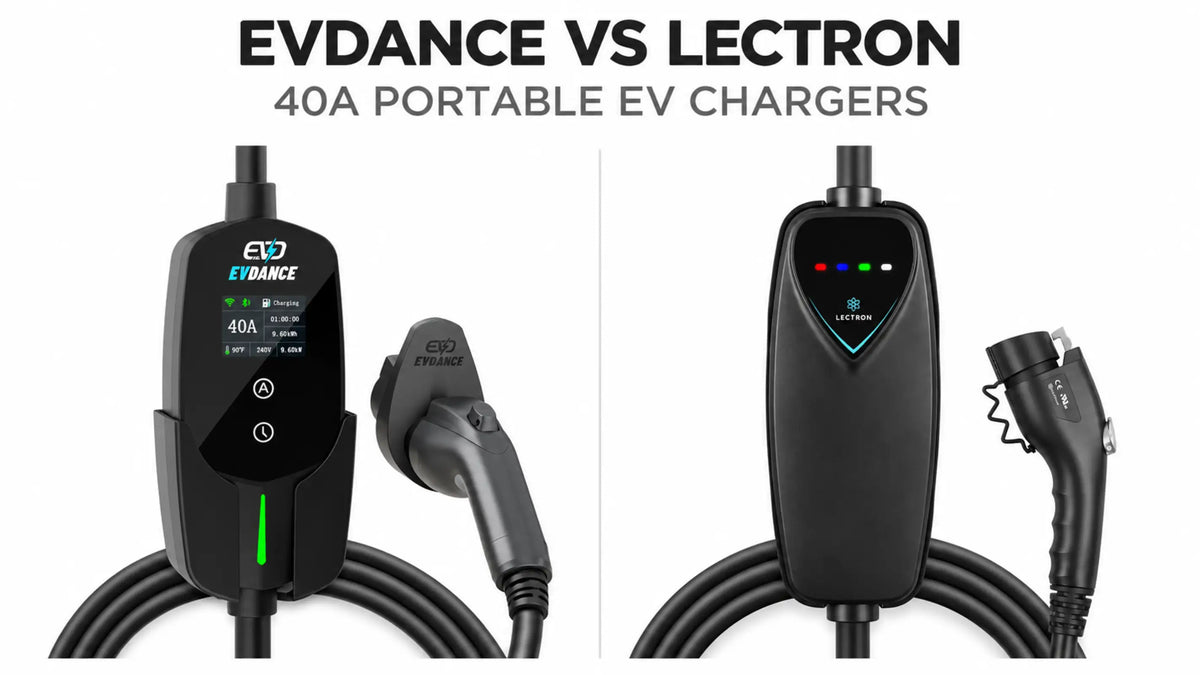
The EVDANCE Flux 40A J1772 portable charger and Lectron Portable Level 2 J1772 EV Charger are closely matched in their basic charging specifications. Both use a NEMA 14-50 input plug and provide up to 40A or 9.6kW from a suitable 240V electrical setup.
This comparison focuses on their J1772 versions. Both brands also offer native NACS models for compatible vehicles.
Their differences become clearer in daily use. EVDANCE focuses on cable reach, detailed on-device information and local controls, while Lectron places more emphasis on app-based management and longer warranty coverage.
Charging Output
Both chargers provide the same maximum available power. The actual charging rate depends on the vehicle’s onboard charger and the electrical circuit supplying the EVSE.
If a vehicle accepts less than 9.6kW of AC power, both chargers will operate within that vehicle limit. With maximum output being equal, the more meaningful differences are cable length, charging controls, enclosure rating, price and warranty.
EVDANCE Flux 40A vs Lectron 40A at a Glance
| Feature | EVDANCE Flux 40A | Lectron 40A |
|---|---|---|
| Wi-Fi version price | $249.95 | $269.99 |
| Cable length | 25 ft | 16 ft |
| Local interface | 2.4-inch TFT display | Status indicators |
| Charging controls | Control box and app | Mainly app-based |
| Control box rating | IP66 | IP65 |
| Warranty | 1 year | 2-year limited warranty |
Prices may change.
EVDANCE provides more cable reach and information on the control box. Lectron offers the longer limited warranty.
Display and Charging Controls
The EVDANCE control box has a 2.4-inch TFT display that shows charging status, selected current, charging time, energy delivered, voltage, real-time current, power and temperature.
Drivers can select the charging current and set a delayed start of 1–12 hours directly on the control box. The Wi-Fi version also supports app-based monitoring and scheduling.
Lectron’s Wi-Fi model uses its app for charging schedules, session monitoring and other connected functions. Indicators on the charger provide basic operating-status information.
The two products therefore take different approaches to control. EVDANCE combines physical controls with app functions, while Lectron relies more heavily on the connected experience.
Cable Length and Portability
EVDANCE includes a 25-foot cable, while the Lectron model has a 16-foot cable. The nine-foot difference affects how much freedom the driver has when positioning the vehicle.
A longer cable can help when the outlet and charging port are on opposite sides of the parking area. It also provides more flexibility when switching between forward and reverse parking or using the charger at another property.
Lectron’s shorter cable may be sufficient for a fixed garage arrangement with an outlet close to the vehicle. It also leaves less unused cable to arrange after charging.
For drivers expecting to use the charger in more than one parking configuration, EVDANCE provides the more flexible cable length.
Weather Protection and Certification
The EVDANCE control box carries an IP66 rating, compared with the IP65 rating published for Lectron. Both ratings indicate protection against dust and water exposure, with EVDANCE carrying the higher published enclosure rating.
The difference is relevant for a portable charger that may be used in a garage, driveway or at different properties rather than remaining in one fixed indoor location.
Both brands publish third-party safety certification information. EVDANCE offers an ETL Listed version of the Flux charger, while Lectron publishes UL 2594 and UL 2231 certification information for its product.
Certification can vary between product versions. Buyers should confirm the certification listed for the exact connector and connectivity option being ordered.
Price, Warranty, and Overall Value
The EVDANCE Wi-Fi version is listed at $249.95, while the comparable Lectron Wi-Fi version is listed at $269.99. EVDANCE combines the lower listed price with a longer cable, detailed display and controls on the charger itself.
Lectron provides a two-year limited warranty. EVDANCE currently lists a one-year warranty for this portable charger, giving Lectron the advantage in warranty length.
Choose EVDANCE for:
-
A 25-foot cable
-
Detailed charging information on the control box
-
Local current selection and delayed start
-
A higher published enclosure rating
-
A lower listed Wi-Fi price
Choose Lectron for:
-
A two-year limited warranty
-
A shorter cable for a compact charging area
-
An app-centered charging experience
Both chargers provide the same maximum output. EVDANCE offers the stronger feature-to-price balance for drivers who value cable reach and direct control, while Lectron may fit buyers who place greater importance on the additional warranty year.
Recommended Reading: EV Charging Speed Explained with Real Examples


Share:
Can Someone Unplug Your EV While It’s Charging?