





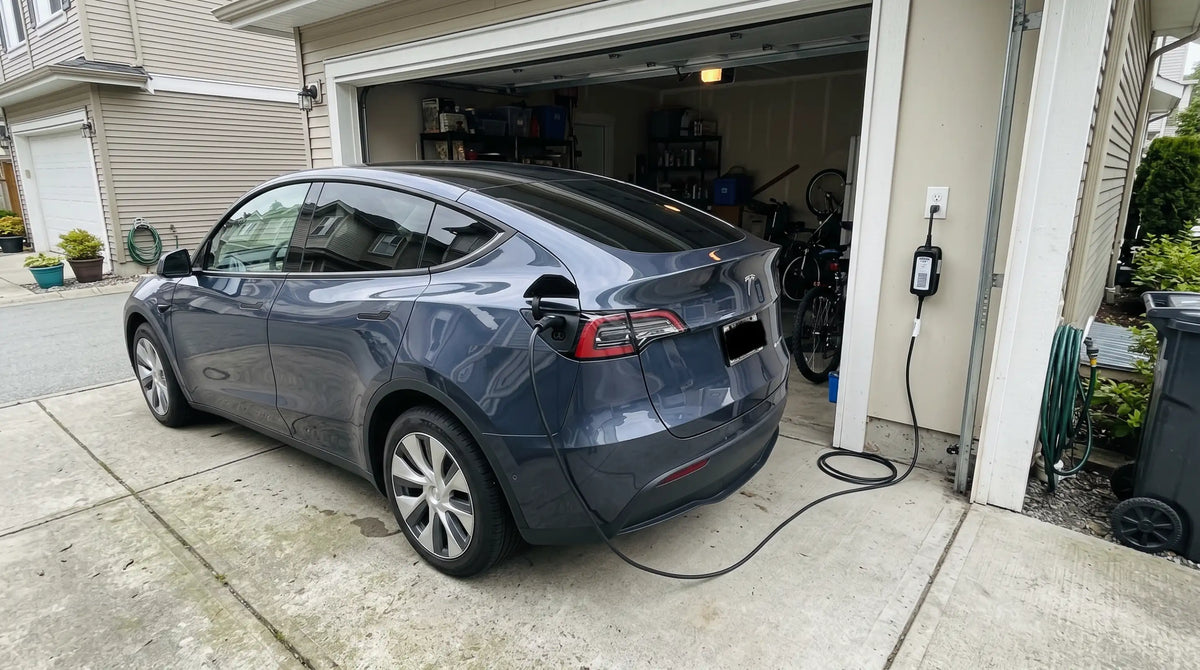
Renters can charge an EV at home, but an available outlet is only the starting point. Before plugging in regularly, confirm that the parking space, property rules, electricity account and electrical setup all support vehicle charging.
A suitable arrangement does not always require a permanent wall charger. Some renters can meet their needs with an approved 120V outlet, while others may need written permission and professional electrical work before using 240V charging.
Confirm the Parking Space and Property Rules
Begin with the space where the vehicle will normally park. The charging cable should reach the vehicle without crossing another tenant’s space, a shared driveway, a public sidewalk, a garage door or a frequently used walking route.
Also consider the location of the vehicle’s charging port. An outlet may appear close enough until the car is parked in its usual position. Reversing into the space might solve the problem, but that option should be practical and permitted.
Do not assume that access to an outlet automatically includes permission to charge an EV. Review the lease and ask the landlord or property manager whether vehicle charging is allowed from that location. Written approval is preferable when the arrangement involves shared space, electricity or equipment.
Find Out Who Controls the Outlet and Pays for the Power
A garage or outdoor outlet is not always connected to the renter’s electricity meter. In a divided house, accessory dwelling unit or shared garage, it could be supplied through another unit or a common-area account.
Confirm which meter serves the outlet and whether electricity is included in the rent. Even when utilities are included, regular EV charging may fall outside the property owner’s original expectations.
If electricity is shared, the renter and landlord should agree on how charging costs will be handled. This could involve a fixed monthly amount, charger records or another method accepted by both parties.
The agreement does not need to be complicated, but it should identify who can use the outlet and who pays for the electricity. That is more reliable than waiting for a higher utility bill to reveal that the outlet was connected to the wrong account.
Check Whether the Existing Outlet Is Suitable
An outlet that occasionally powers a vacuum or small tool is not automatically suitable for an EV charging session lasting several hours. EV charging creates a sustained electrical load, so the condition and capacity of the complete circuit matter.
Renters can check the accessible surface of the receptacle and review any information provided by the landlord. Do not use an outlet that is loose, cracked, corroded, discolored or unusually warm. Do not remove the outlet cover or open the electrical panel to investigate the wiring.
Other equipment connected to the same circuit also matters. A refrigerator, freezer, heater or power tool may share the circuit even if it is plugged into a different-looking outlet elsewhere in the garage.
The U.S. Department of Energy’s home-charging guidance notes that Level 1 charging can meet many drivers’ daily needs when a suitable outlet on a dedicated branch circuit is available near the parking location. If the circuit arrangement is unknown, the owner and renter should arrange an assessment by a qualified electrician.
Decide Whether 120V Charging Is Enough
Renters do not always need a new 240V installation. A suitable 120V outlet may provide enough energy when the vehicle covers moderate daily mileage and remains parked overnight.
The important question is not how long it would take to fill the entire battery. Instead, estimate how much energy must be restored after a normal day and compare that with the available charging time.
For example, 120V charging at 12A provides approximately 1.44kW. Over ten hours, the theoretical wall-side energy would be about 14.4kWh before charging losses and energy used by the vehicle. That could cover a daily energy need of 8–10kWh, although the actual result depends on the vehicle and conditions.
A 12A/16A dual-voltage portable EV charger can remain useful when the available power changes between approved locations. However, dual-voltage capability does not make every outlet suitable. The charger’s supported plug configuration, selected current and available circuit must still match.
If 120V cannot restore the normal daily energy use before the next departure, then a permitted 240V installation or a dependable alternative charging location becomes more relevant.

Get Approval Before Adding 240V Charging
A renter should not add a receptacle, replace a breaker, alter wiring or install a wall-mounted charger without the property owner’s written approval.
Before work begins, the renter and landlord should decide who will select the electrician, pay for the assessment and installation, obtain any required permits and arrange the final inspection. They should also determine who will own the outlet, wiring and charging equipment afterward.
Installation cost can vary considerably because the existing panel, wiring distance, parking location, permitting and required upgrades differ between properties. The DOE’s charging infrastructure installation guidance identifies site conditions, wiring upgrades, trenching, labor and permits as factors that can change the final cost.
Tenant rights are not identical across the United States. Some jurisdictions have laws allowing tenants to request or install charging equipment under defined conditions, while costs, insurance, restoration and approval requirements can still apply. The Alternative Fuels Data Center laws and incentives database provides current state-specific information, but renters should also check local rules and their lease.
A right to request charging equipment is not the same as permission to perform electrical work independently. Any installation must still follow applicable requirements and be completed by qualified professionals.
Plan for the End of the Lease
Decide what happens at move-out before paying for equipment or installation. A portable charger can normally move with the renter, but a new circuit, receptacle or hardwired charger may be treated as part of the property.
The written agreement should state whether permanently installed equipment remains, whether removal is allowed and who pays to restore the property. It should also address what happens if the lease ends sooner than expected.
Keep copies of the landlord’s approval, installation invoice, permit or inspection record and charger documentation. These records help show what was installed, who authorized it and whether the work should remain after the tenancy ends.
Before the first regular charging session, confirm five points:
-
The vehicle has an approved and practical parking space.
-
The outlet is connected to the correct electricity account.
-
The property owner has approved charging and any installation work.
-
The outlet, circuit and charging current are suitable for the equipment.
-
Electricity costs and move-out responsibilities are documented.
For renters, the best charging setup is not necessarily the fastest or most permanent one. It is the arrangement that reliably covers daily driving while remaining electrically suitable, properly authorized and clearly assigned.
Recommend Reading: Can One Portable EV Charger Work on 120V and 240V?


Share:
Can You Charge an EV at an RV Park? TT-30 vs NEMA 14-50