





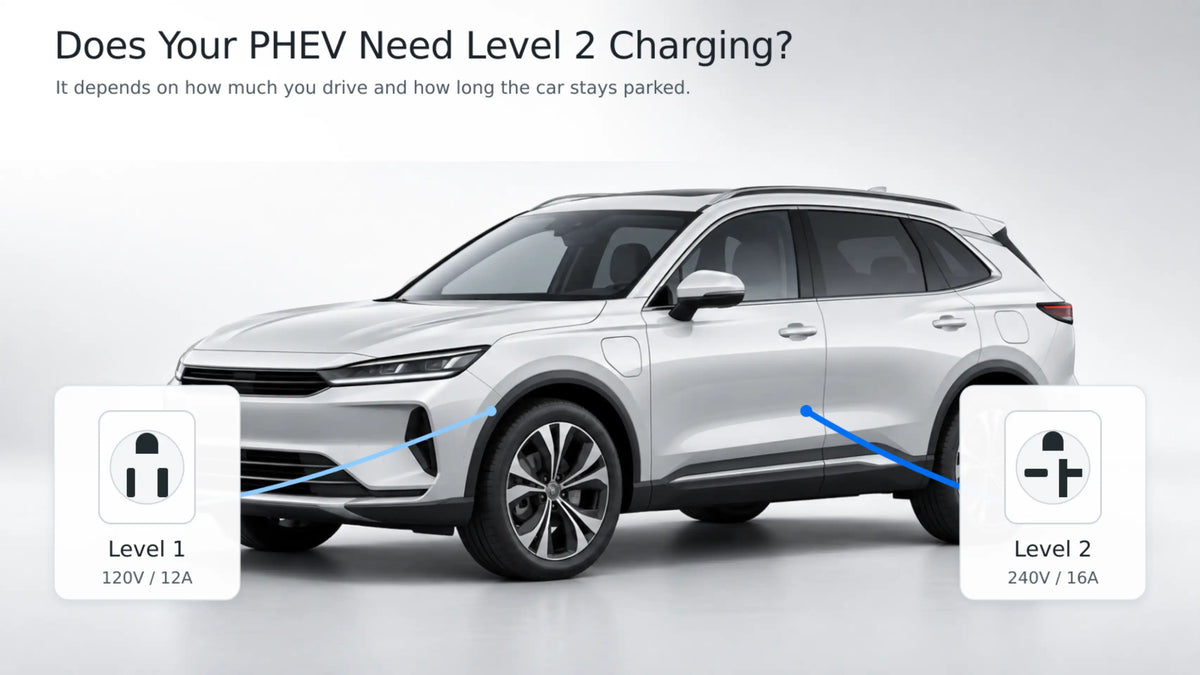
Level 2 charging is useful when your PHEV does not remain parked long enough for Level 1 to replace the energy used that day.
If Level 1 can recharge the vehicle before your next trip, upgrading may not be necessary. The decision mainly depends on how much you drive, how long the vehicle stays parked and how quickly the PHEV can accept AC power.

Level 1 May Be Enough for Many PHEVs
PHEVs generally have smaller batteries than fully electric vehicles. This means many can recover their daily electric use from a 120V outlet while parked overnight.
A typical 12A Level 1 setup provides approximately 1.44kW at 120V. It charges more slowly than Level 2, but speed is not always the most important factor. If the vehicle finishes charging several hours before the next trip, faster equipment may provide little practical benefit.
The U.S. Department of Energy notes that Level 1 charging can recharge a smaller PHEV overnight. Level 2 becomes more useful when the available charging time is shorter or the vehicle needs more energy between trips.
How Much Energy Does Your PHEV Use Each Day?
Do not base the decision only on the vehicle’s total battery capacity. Most drivers do not fully drain and recharge the battery every day.
Instead, estimate how much energy the vehicle normally uses between charging sessions. A PHEV that uses 8kWh during a daily commute only needs to restore about 8kWh, even if its battery holds more.
At an ideal 1.44kW Level 1 input, supplying 8kWh would take at least:
8kWh ÷ 1.44kW = approximately 5.6 hours
Actual charging will take longer because of charging losses, temperature control and other vehicle energy use. However, this example shows why Level 1 may still cover a moderate daily commute.
How Long Does Your PHEV Stay Parked?
Charging time should be compared with the number of hours the vehicle is normally available to charge.
A PHEV parked from 7 p.m. until 7 a.m. has about 12 hours available. Level 1 may be sufficient if it can replace the day’s energy during that time.
The situation changes when the vehicle arrives late, leaves early or makes several trips in one day. Level 2 can restore more energy during a shorter stop, making it easier to begin the next trip with more electric range.
Check How Fast Your PHEV Can Charge
Every PHEV has a maximum AC charging rate set by its onboard charger. The vehicle will not accept more power than that limit, regardless of the charger’s maximum output.
For example, installing a 40A charger will not make a PHEV charge at 9.6kW if the vehicle can accept only 3.3kW. A lower-output Level 2 charger could provide the same actual charging speed in that situation.
Check the owner’s manual or vehicle specifications before selecting a charger. The useful output is the lowest limit among the electrical circuit, charging equipment and vehicle.
When Does a PHEV Need Level 2 Charging?
Level 2 charging becomes more useful when Level 1 regularly fails to restore the battery before the next trip. This may happen when the driver travels farther each day, has fewer hours at home or wants to recharge between separate trips.
At 240V and 16A, a Level 2 charger can provide approximately 3.84kW. Using the same 8kWh example, the theoretical charging time becomes:
8kWh ÷ 3.84kW = approximately 2.1 hours
Level 2 may also help drivers use more electric miles and less gasoline. A PHEV can continue driving after its usable battery charge is depleted, but more frequent or faster charging can keep more everyday trips within its electric range.

Choose the Charging Setup That Fits Your Routine
Start with Level 1 if it consistently restores the energy you use before the next departure. Consider Level 2 when charging regularly runs into the next trip or when your schedule leaves only a few hours to plug in.
Drivers who need both options can use a 12A/16A dual-voltage portable EV charger with its supported 120V and 240V configurations. This provides Level 1 flexibility where suitable 120V power is available and Level 2 charging from a compatible 240V source.
The outlet, circuit and selected current must support the charging setup. A higher output is worthwhile only when the vehicle can use it and the shorter charging time improves the driver’s actual routine.
Recommended Reading: EV Charging Speed Explained with Real Examples


Share:
Can One Portable EV Charger Work on 120V and 240V?