





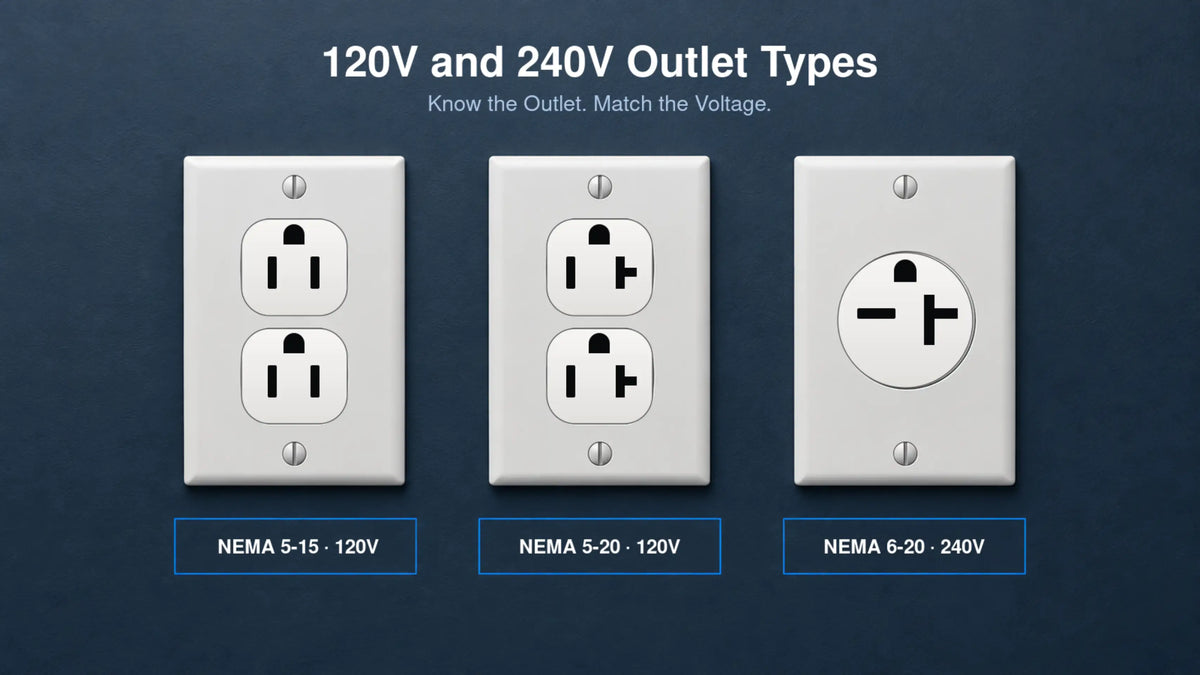
A dual-voltage portable EV charger gives drivers the flexibility to use 120V power where it is available and switch to faster 240V charging at a compatible outlet.
This flexibility only applies to chargers specifically designed for both voltages. Changing the input plug or adding an adapter does not make a single-voltage charger compatible with another power source.
What Dual-Voltage Charging Means
A dual-voltage charger contains components designed to operate within both supported input ranges. At 120V, it normally provides Level 1 charging. At 240V, the same unit can provide Level 2 charging.
The charger does not create additional electrical capacity. Its output still depends on the available voltage, the permitted current, and the maximum power the vehicle can accept.
Not every portable charger is dual-voltage. Both input voltages should be clearly listed in the product specifications or instructions.
How Charging Speed Changes at 240V
Charging power is determined by voltage and current:
Voltage × Current ÷ 1,000 = Approximate Charging Power
A dual-voltage charger with the following output levels would provide:
| Power source | Charging current | Approximate power |
|---|---|---|
| 120V | 12A | 1.44kW |
| 240V | 16A | 3.84kW |
In this example, the 240V configuration provides about 2.7 times as much power as the 120V configuration. It can replenish the same amount of energy in considerably less time.
Actual charging speed may still be limited by the vehicle’s onboard charger, battery conditions, or electrical supply. For more examples, see EV Charging Speed Explained with Real Examples.
How One Charger Connects to Both Power Sources
A dual-voltage charger may use different input plugs or a manufacturer-approved adapter for its supported outlets. The control box and vehicle connector remain the same.
For example, this dual-voltage portable EV charger supports a NEMA 5-15 connection for 120V charging and a NEMA 6-20 connection for 240V charging. It provides 12A on 120V and up to 16A on 240V.
The supported plug arrangement is part of the charger’s design. An unrelated adapter should not be used simply because it physically fits the plug or outlet.
What Dual-Voltage Does Not Change
Dual-voltage support does not turn a 16A charger into a higher-output 32A or 40A charger. At 240V and 16A, its approximate maximum output remains 3.84kW.
The vehicle connector must also match the vehicle. A charger with a NACS connector does not become a J1772 charger when the input voltage changes.
Dual-voltage support therefore provides more options for the power source, but it does not remove the charger’s current, connector, or vehicle compatibility limits.
When Is a Dual-Voltage Charger Useful?
A dual-voltage charger is useful when 240V power is available at home but a 120V option may be needed at another suitable location. The driver can use faster Level 2 charging at home without carrying a separate Level 1 charger for occasional use elsewhere.
It can also suit renters, plug-in hybrid owners, drivers with lower daily mileage, and people who want a portable backup charging option. For these situations, flexibility may be more useful than choosing the highest available charging output.
Drivers who always charge in one fixed location and need faster daily charging may prefer a higher-output 240V portable or wall-mounted charger instead. Dual-voltage capability is most valuable when the available power source can change.
Before moving between outlets, confirm that the charger supports the voltage and plug configuration, select a current the circuit can support, and briefly inspect the receptacle. Do not use an outlet that is loose, damaged, discolored, or unusually warm.
Recommended Reading: EV Charging Speed Explained with Real Examples


Share:
Can You Use a Portable EV Charger Every Day?