





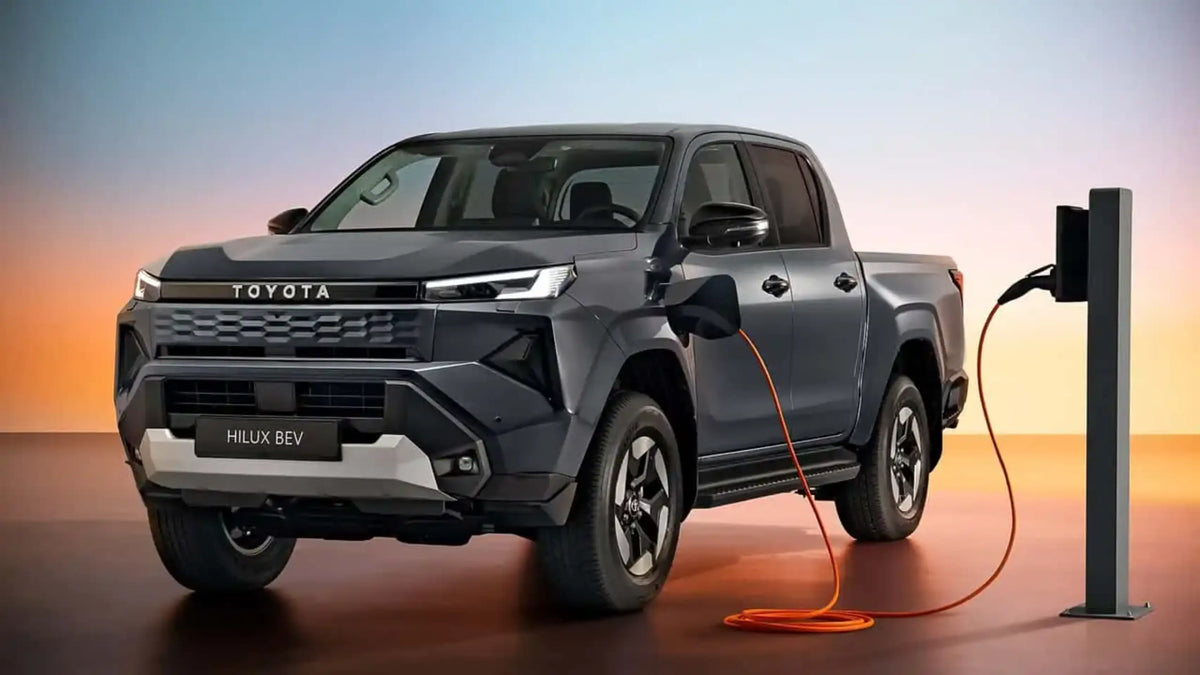
Toyota will launch a hydrogen fuel-cell version of the Hilux pickup in Europe in 2028, targeting more than 248 miles of range and up to 5,512 pounds of towing capacity. The Hilux FCEV will join battery-electric, mild-hybrid and combustion-powered versions as part of Toyota’s multi-powertrain strategy. Photo by: Toyota
Hilux FCEV Targets 248 Miles of Range
Toyota has confirmed that the production Hilux FCEV will arrive in Europe in 2028, extending the ninth-generation pickup lineup beyond diesel, hybrid and battery-electric powertrains.
The hydrogen model is targeting a WLTP driving range of more than 400 kilometers, or about 248 miles, together with a towing capacity of up to 2,500 kilograms (5,512 pounds). Toyota has not yet released final specifications such as hydrogen storage capacity, motor output, payload or pricing.
Those targets put the FCEV ahead of the battery-electric Hilux in two important areas. The Hilux BEV is rated at approximately 257 kilometers (159 miles) of WLTP range, while towing capacity reaches as much as 2,000 kg depending on configuration and market rules.
Toyota previously built hydrogen-powered Hilux prototypes in the United Kingdom, giving the company a development base before confirming a production model.
Hydrogen Offers Faster Energy Replenishment
The main operational difference between the two zero-tailpipe-emission Hilux versions is how they replenish energy.
A hydrogen fuel-cell vehicle stores compressed hydrogen and converts it into electricity onboard, which then powers an electric motor. The process produces water at the vehicle rather than carbon dioxide from combustion.
Toyota is targeting a refueling time of roughly five minutes for the Hilux FCEV, provided a compatible hydrogen station is available. That is considerably shorter than the charging stop required by most battery-electric vehicles.
The battery-electric Hilux, by comparison, needs around 30 minutes for a typical high-power DC charging session from 10% to 80%, according to the specifications cited for the model.
For commercial users covering long distances or towing regularly, the combination of quick refueling and longer targeted range could be useful. However, that advantage depends heavily on access to hydrogen infrastructure.
Hydrogen Stations Remain the Main Limitation
Europe’s hydrogen refueling network is still small compared with its EV charging infrastructure.
The European Hydrogen Observatory recorded 186 publicly accessible and operational hydrogen refueling stations in Europe as of May 2025. Updated 2026 datasets continue to track a network that remains limited geographically and unevenly distributed between countries.
Battery-electric drivers have access to a far larger network. The European Alternative Fuels Observatory reported approximately 1.16 million publicly accessible charging points across the EU in mid-2026.
That difference means the Hilux FCEV may be much easier to operate in regions with established hydrogen corridors than in areas without nearby stations.
European policy could gradually improve availability. Current EU infrastructure rules call for hydrogen refueling stations along major transport corridors and in urban nodes by 2030, although actual deployment will vary by country and market demand.
Toyota Continues Its Multi-Pathway Strategy
The hydrogen Hilux fits Toyota’s broader approach of offering several low-emission powertrains rather than relying on battery-electric vehicles alone.
Toyota has already confirmed battery-electric and electrified diesel versions of the latest Hilux, while the FCEV is scheduled for Europe and Oceania beginning in 2028.
For pickup buyers, each option comes with different trade-offs. The battery-electric model benefits from a much larger public charging network, while the hydrogen version is targeting longer range, faster refueling and greater towing ability.
The Hilux FCEV therefore represents less of a direct replacement for the electric Hilux and more of an additional option for specific commercial and fleet applications.
Its practical success will depend not only on the truck’s final specifications and price, but also on whether hydrogen refueling infrastructure expands enough to make routine operation convenient. Photo by: Toyota
FAQ
When will the Toyota Hilux FCEV go on sale?
Toyota plans to introduce the hydrogen-powered Hilux in 2028. Europe and Oceania are among the confirmed launch regions.
How far will the hydrogen Toyota Hilux travel?
Toyota is targeting more than 400 km, or about 248 miles, of WLTP range. The final certified figure may differ when production specifications are completed.
How much can the Hilux FCEV tow?
The planned towing capacity is up to 2,500 kg, or 5,512 pounds. That is higher than the maximum figure currently listed for the battery-electric Hilux.
How long will it take to refuel the Hilux FCEV?
Toyota is targeting hydrogen refueling in approximately five minutes when using a compatible station. Availability of suitable stations will remain an important factor for owners.
Why could hydrogen infrastructure be a problem?
Europe currently has far fewer hydrogen stations than public EV charging points. Hydrogen drivers may therefore have limited refueling choices depending on where they live or travel.
Recommend Reading: Toyota Hybrid Battery Upgrade Targets Lower Costs


Share:
Tesla Cybercab Debuts in China as Display Only