





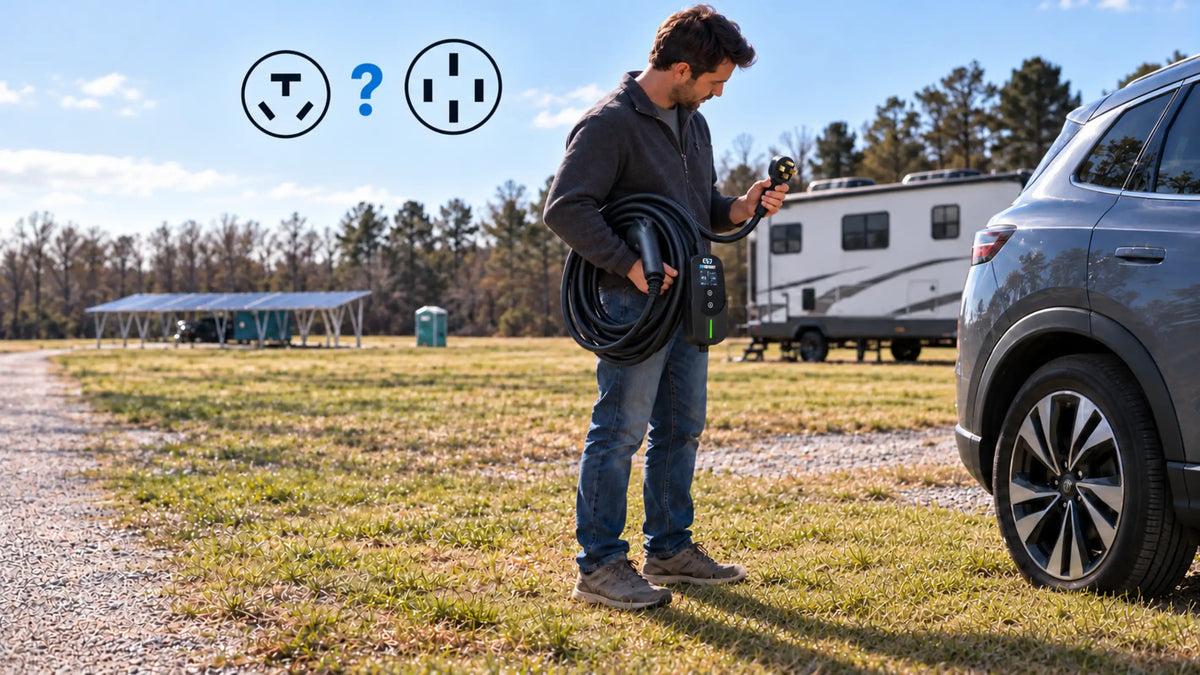
You may be able to charge an EV at an RV park, but only when the campground permits it and the available outlet matches the charger. A 50-amp NEMA 14-50 site can provide 240V, while a TT-30 outlet provides only 120V.
The outlet shape is only part of the decision. Campground rules, pedestal condition, available capacity and charger compatibility must also be checked before connecting.
Campground Permission Comes First
Ask the campground whether EV charging is permitted before reserving a site or plugging in. A site advertised as “30 amp” or “50 amp” describes its RV electrical service; it does not automatically mean that the pedestal is approved for charging a vehicle.
EV charging can place a sustained load on the electrical system for several hours. Some campgrounds prohibit it because their pedestals or shared electrical infrastructure were designed around typical RV use rather than continuous EV charging. KOA’s EV guidance, for example, states that its traditional campground pedestals should not be used for EV charging.
Other parks may provide designated EV sites, separate charging stations or specific current limits. Follow the rules provided by the individual campground rather than assuming that all RV parks have the same policy.
TT-30 Provides 120V, Not 240V
A NEMA TT-30 receptacle is commonly found at 30-amp RV sites. Despite the “30” in its name, it is a 30A, 125V outlet, not a 240V Level 2 connection. Its shape can also be confused with other high-current outlets. The Leviton TT-30R specifications confirm its 30A, 125V rating.
A charger designed only for 240V should not be connected to a TT-30 outlet. A physical adapter cannot add dual-voltage capability or turn the outlet into a 240V source.
Charging from TT-30 power requires a charger that explicitly supports 120V input and an approved connection arrangement for that model. The permitted charging current may also be lower than the outlet’s 30A rating.
NEMA 14-50 Can Provide 240V for Level 2 Charging
A 50-amp RV site commonly uses a NEMA 14-50 receptacle. A NEMA 14-50 receptacle is rated for 125/250V service, and a compatible portable EV charger can use its 240V supply for Level 2 charging. The Leviton NEMA 14-50 EV outlet, for example, is rated at 50A and 125/250V.
The U.S. Department of Energy identifies 240V as the typical residential supply for Level 2 charging. The available power can therefore be considerably higher than charging from a 120V source.
At an RV park, however, the campground must still allow EV charging and confirm that the pedestal is suitable for the continuous load. Finding a NEMA 14-50 outlet does not by itself establish permission or confirm the condition of the campground’s electrical system.
The Charger Must Match the Available Power
Check the charger’s supported input voltage, plug type and adjustable current settings. The charger’s vehicle connector—such as J1772 or NACS—does not determine whether its input side is compatible with the RV outlet.
A 40A portable Level 2 charger with a NEMA 14-50 plug, for example, offers adjustable charging settings up to 40A. The selected setting must still follow the charger instructions and the current approved by the campground.
Do not assume that the full capacity of the pedestal is available if the same site is also powering an RV. Do not use splitters, unrelated adapters or improvised connections to operate multiple high-power loads from the pedestal.
Check the Pedestal Before Connecting
Do not use an outlet that is loose, cracked, wet, corroded, discolored or visibly damaged. The charger plug should fit securely without being forced, and the control box should be supported rather than left hanging from the outlet.
Route the charging cable where it will not pass beneath a tire, through a closing door or across a busy walking area. Keep plugs and connection points within the environmental limits stated by the equipment manufacturer.
If charging repeatedly stops or the plug, outlet or cable becomes unusually hot, stop the session according to the charger or vehicle instructions. Leave the equipment disconnected and report the problem to campground staff rather than trying another adapter or repeatedly restarting the charger.
RV-Park Charging Is a Backup, Not a Guarantee
An RV park can provide a useful charging option during a trip, particularly when an approved NEMA 14-50 site is available. It should not be treated as a guaranteed replacement for a public charging station.
Confirm permission, outlet type and current limits before arrival. If the campground does not allow EV charging or cannot confirm that the pedestal is suitable, use a designated EV charging station instead.
Recommended Reading: Can You Use a Portable EV Charger Every Day?


Share:
Why Is My EV Charging Plug Stuck in the Car?