





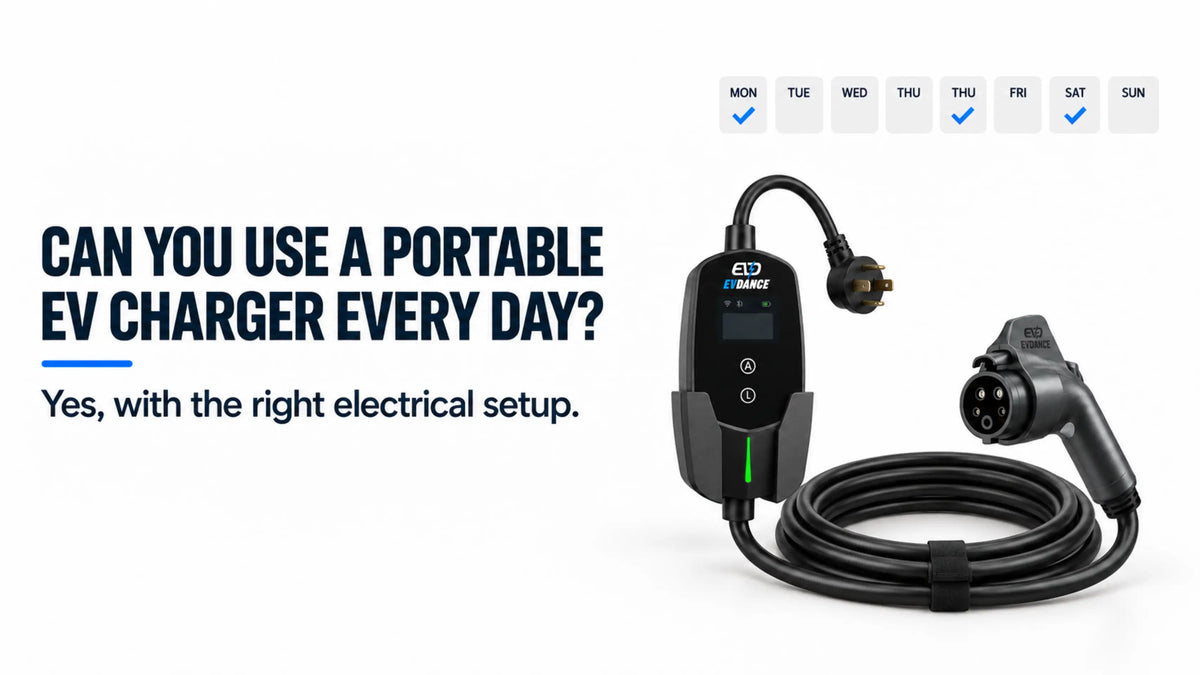
Yes. A portable EV charger can be used for regular home charging when the charger, outlet, circuit, current setting, and environment are properly matched.
“Portable” describes how the equipment can be moved and stored. It does not automatically mean the charger is intended only for emergencies or occasional travel.
Portable Does Not Mean Occasional Use
Portable and wall-mounted chargers both supply AC power to the vehicle. The difference is how they fit into the home: a portable charger connects to a compatible outlet and can move between suitable locations, while a wall-mounted charger stays in one position.
Whether a portable charger is suitable for everyday use depends on its specifications and instructions, along with the available electrical supply. The word “portable” alone does not determine how often it can be used.
Match the Charger to the Electrical Setup
Start with the available voltage, outlet type, circuit capacity, and vehicle connector. The charger must support the power source being used. A plug adapter alone does not add dual-voltage capability.
The selected charging current must stay within the limits of the breaker, wiring, receptacle, and charging equipment. An adjustable setting can help match a supported circuit, but it cannot make a damaged outlet safe to use.
For lower daily mileage or a plug-in hybrid, a 16A charger that supports Level 1 and Level 2 charging may be enough. With a suitable 240V supply, drivers can also consider 32A portable charging or 40A portable charging.
Choose based on daily driving and the time available to charge. Higher output will not help if the vehicle’s onboard charger accepts less power. If the circuit rating or outlet condition is uncertain, have an electrician check it before making it part of a daily routine.
Set Up the Charger for Regular Use
Place the control box on a secure support or suitable wall holder. Its weight should not hang from the outlet through the short input cable.
Route the vehicle cable where it will not be pulled tight, driven over, caught under a garage door, or left across a main walking path. For a longer cable, undo tight coils and twists before charging, then lay it out with relaxed curves. It does not need to be stretched straight.
Some cables have passed defined bending or pulling tests, but continuous strain and repeated sharp bends can still increase wear over time. After charging, a wall-mounted holster can keep the connector off the floor and the cable loosely stored.
When Does a Wall-Mounted Charger Make More Sense?
A portable charger is useful when charging equipment needs to travel with the car, move between properties, or come along when the owner moves. It can also remain part of a regular home setup when the outlet and equipment are suitable.
A wall-mounted charger is convenient when the vehicle parks in the same place each day and the household wants the cable ready in one fixed location. For example, the EVDANCE Flux Pro 40A home charger offers that type of setup.
A portable EV charger can be an everyday solution. The deciding factors are the electrical setup, the household’s charging needs, and whether flexibility or a fixed charging position is more useful.
Recommended Reading: EV Charging Speed Explained with Real Examples


Share:
Do EV Chargers Use Power When Not Charging?