





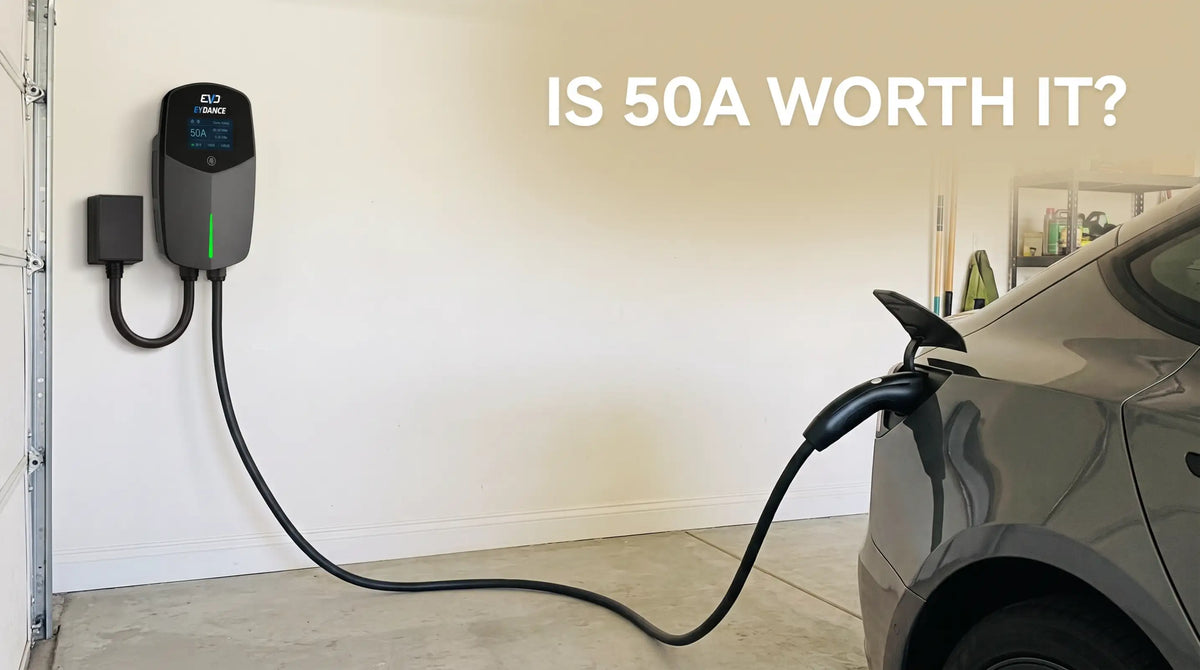
A 50A home EV charger can be worth it when the vehicle supports high-power AC charging and regularly needs to recover a large amount of energy in a limited time. If the vehicle accepts only 32A or 40A, or it remains plugged in throughout the night, a 40A charger may already meet the household’s needs.
The decision should be based on the time saved, the vehicle’s onboard charger and the home electrical setup—not the highest number on the product page.
How Much Faster Is a 50A Home Charger?
At 240V, a 50A charger can provide up to 12kW. This is more available power than common 32A and 40A home charging options.
The following comparison estimates the theoretical minimum time required to add 40kWh:
| Charging current | Approximate power | Time to add 40kWh |
|---|---|---|
| 32A | 7.68kW | About 5.2 hours |
| 40A | 9.6kW | About 4.2 hours |
| 50A | 12kW | About 3.3 hours |
Under these assumptions, moving from 40A to 50A saves approximately 50 minutes. Compared with 32A, the difference is nearly two hours.
These are not guaranteed session times. Actual charging may take longer because of voltage changes, charging losses, battery conditioning and limits set by the vehicle.
Can Your EV Use the Full 50A?
The charger can only make power available. The vehicle’s onboard charger determines how much AC power the battery can receive.
A vehicle limited to 32A will continue charging at no more than 32A when connected to a 50A charger. The same applies to a vehicle with a 40A or 48A AC limit.
Before buying, check the vehicle specifications for its maximum AC charging rate or onboard charger capacity. Higher output is most useful when the vehicle can accept it or when the owner expects a future vehicle to support a higher rate.
A 50A Charger Changes the Home Setup
The 50A hardwired NACS home charger is permanently connected to the home electrical system rather than plugged into a NEMA 14-50 receptacle.
Before installation, the home’s available electrical capacity, wiring route and intended mounting location need to be considered. The charging cable should also reach the vehicle’s charging port without remaining under tension or crossing a frequently used walkway.
The U.S. Department of Energy recommends having home charging equipment installed by a qualified electrical contractor in accordance with local requirements. The installation should be evaluated for the selected charger and home rather than assumed from the charger’s maximum rating alone.
When Does 50A Make a Real Difference?
A 50A charger becomes more useful when the household frequently needs to add a substantial amount of energy before the next trip.
Typical situations include:
-
Long daily driving distances
-
Late arrivals followed by early departures
-
Vehicles with larger daily energy use
-
More than one driver relying on the same charging position
-
A current or planned vehicle that supports higher-power AC charging
Battery size alone does not determine the answer. A vehicle with a large battery may still be easy to recharge at 40A when only a small portion of that battery is used each day.
Features Beyond Charging Speed
Charging power is only one part of the daily experience. The 50A hardwired model includes a 25-foot charging cable, a 3.5-inch TFT display, an LED status indicator and Wi-Fi and Bluetooth connectivity.
The display allows charging information to be checked directly at the unit, while connected controls provide another way to monitor and manage charging. The 25-foot cable can help reach vehicles parked in different directions without moving the car for every session.
The NACS handle also includes push-button charge-port opening for compatible Tesla vehicles. These features may have more everyday value than the difference between 48A and 50A for a vehicle that cannot use the full output.
When Is a 40A Charger Enough?
A 40A charger provides up to 9.6kW at 240V and can add 40kWh in a theoretical minimum of about 4.2 hours. That is already enough to restore a substantial amount of driving energy during an overnight session.
A 40A NEMA 14-50 portable charger may be the more suitable option when the vehicle accepts 40A or less, the existing electrical setup supports it and portability is useful.
For drivers who normally have eight or more hours at home, the extra output of a 50A charger may not change the morning result. In that situation, installation type, cable placement and control features may matter more than maximum current.
A 50A home EV charger is worth considering when its higher output solves a real timing problem and the vehicle can use the additional power. If overnight charging already restores the energy used each day, moving from 40A to 50A may provide limited practical benefit.
Recommend Reading: EV Charging Speed Explained with Real Examples


Share:
Best EV Charging Products for Black Friday 2026