





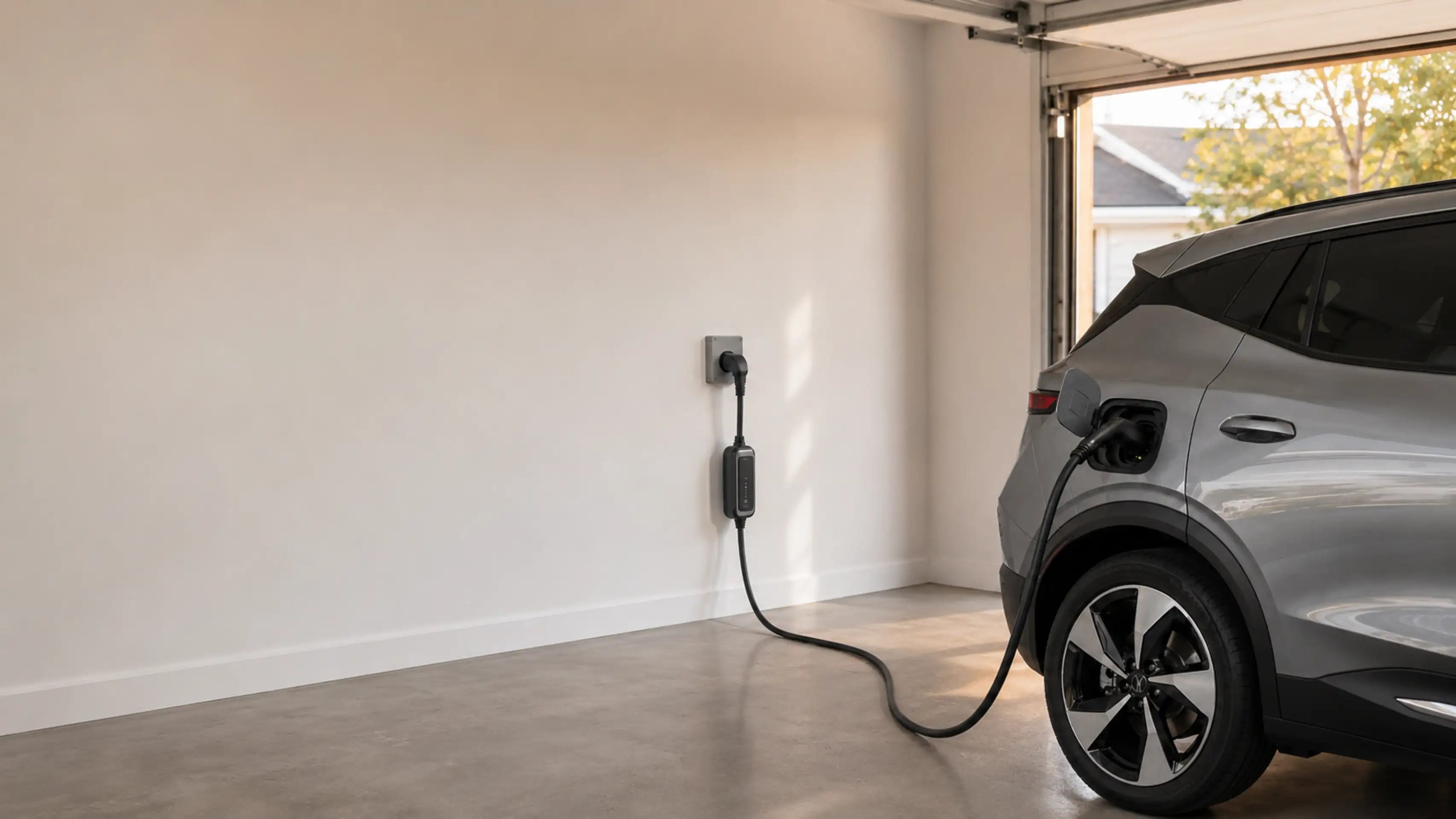
EV charging speed can be estimated with three numbers: voltage, current, and battery capacity.
First, use voltage and current to estimate charging power. Then use the battery capacity and the percentage you want to add to estimate charging time.
The result will not be exact, but it can help you understand what a charger’s amp rating means and roughly how long a charging session may take.
Charging Power Starts with Volts and Amps
Charging power is measured in kilowatts, or kW. For most home AC charging, you can use this simple formula:
Voltage × Current ÷ 1,000 = Approximate Charging Power
For example:
240V × 32A ÷ 1,000 = 7.68kW
This means a 32A charger can provide up to 7.68kW when connected to 240V. The vehicle must also be able to accept that amount of power.
Here are some common examples:
| Voltage | Current | Approximate power |
|---|---|---|
| 120V | 12A | 1.44kW |
| 240V | 16A | 3.84kW |
| 240V | 24A | 5.76kW |
| 240V | 32A | 7.68kW |
| 240V | 40A | 9.60kW |
These are estimated maximums. Actual voltage can vary.
Home Level 2 charging usually uses 240V, while some commercial buildings use 208V. At 208V, the same 32A charger would provide about 6.66kW instead of 7.68kW. The U.S. Department of Energy explains this difference between residential and commercial Level 2 power.
Circuit Size Sets the Safe Current Limit
A charger should not use the full rating of a standard circuit for a long charging session. EV charging is treated as a continuous electrical load, so the charging current is commonly limited to 80% of the circuit rating.
| Circuit rating | Common charging limit |
|---|---|
| 15A | 12A |
| 20A | 16A |
| 30A | 24A |
| 40A | 32A |
| 50A | 40A |
This is why 32A charging commonly requires a properly installed 40A circuit.
The outlet shape alone does not confirm how much current the circuit can safely provide. The breaker, wiring, outlet, charger instructions, and local electrical rules must all support the selected setting.
If the circuit rating or condition is unknown, have it checked by a licensed electrician before using a higher charging current.
The Lowest Power Limit Sets the Charging Speed
A charger’s amp rating shows its maximum available output. It does not guarantee that every vehicle will charge at that rate.
The actual speed depends on three main limits:
-
The home circuit
-
The EV charger
-
The vehicle’s onboard charger
For example, imagine that:
-
The circuit supports 32A charging.
-
The EV charger can provide up to 7.68kW.
-
The vehicle can accept only 5.8kW from an AC charger.
In this case, the vehicle will charge at no more than about 5.8kW.
The opposite is also true. A vehicle that can accept 11kW will still receive no more than 7.68kW from a 7.68kW charger.
The vehicle may lower the speed further because of battery temperature, battery level, charging settings, or power sharing. The connector style—such as J1772 or NACS—does not decide the speed by itself.
Battery Capacity Turns Power into Time
Charging power is measured in kW. Battery energy is measured in kWh.
To estimate how much energy the battery needs, use:
Usable battery capacity × Percentage added = Energy needed
“Usable battery capacity” means the part of the battery the vehicle allows the driver to use. It may be slightly lower than the total battery size listed in some specifications.
After finding the energy needed, estimate the charging time with:
Energy needed ÷ Charging power = Charging time
The result is an ideal estimate. Some incoming energy is used by the vehicle or lost during charging, so the real session will usually take longer.
A Complete Charging Time Example
Assume an EV has 75kWh of usable battery capacity. The owner wants to charge it from 20% to 80%.
First, find the percentage being added:
80% − 20% = 60%
Next, estimate the energy needed:
75kWh × 60% = approximately 45kWh
Now assume the vehicle is using a 32A charger at 240V:
240V × 32A ÷ 1,000 = 7.68kW
Finally, divide the energy needed by the charging power:
45kWh ÷ 7.68kW = approximately 5.9 hours
The 5.9-hour result is the ideal minimum, not a promise. Actual charging will normally take longer because the vehicle may not hold the maximum power for the full session.
An EVDANCE 32A portable Level 2 EV charger can provide up to 7.68kW at 240V when the circuit supports 32A charging and the vehicle can accept that power.
Vehicle Efficiency Changes the Miles Added
The same charger can add different amounts of range to different vehicles.
A smaller EV usually travels farther on one kilowatt-hour than a large electric SUV or pickup. Weather, speed, heating, air conditioning, and driving style also affect the result.
For a simple estimate, use the vehicle’s EPA electricity rating.
Assume an EV uses 30kWh per 100 miles:
30kWh ÷ 100 miles = 0.30kWh per mile
With a 7.68kW charger:
7.68kWh per hour ÷ 0.30kWh per mile = approximately 25.6 miles per hour
This is an estimate of EPA-rated range added, not guaranteed real-world range. The EPA includes Level 2 charging losses in its official EV efficiency figures.
Real Charging Conditions Change the Result
Several everyday conditions can make a charging session longer than the basic calculation suggests:
-
Lower supply voltage
-
A lower vehicle charging limit
-
A hot or cold battery
-
Heating or cooling used while plugged in
-
Power shared with another charger
-
The battery approaching its charge limit
There is no single percentage at which every vehicle slows down during Level 2 charging. Some vehicles reduce power near the top of the battery, while others stay close to their normal AC charging rate for longer.
For the most accurate estimate, check the vehicle’s current charging screen after plugging in. It reflects the power the vehicle is actually receiving under those conditions.
Recommend reading: Charging Records Make EV Costs Easier to Track


Share:
Charging Records Make EV Costs Easier to Track
Why Does My EV Stop Charging Before It’s Full?