





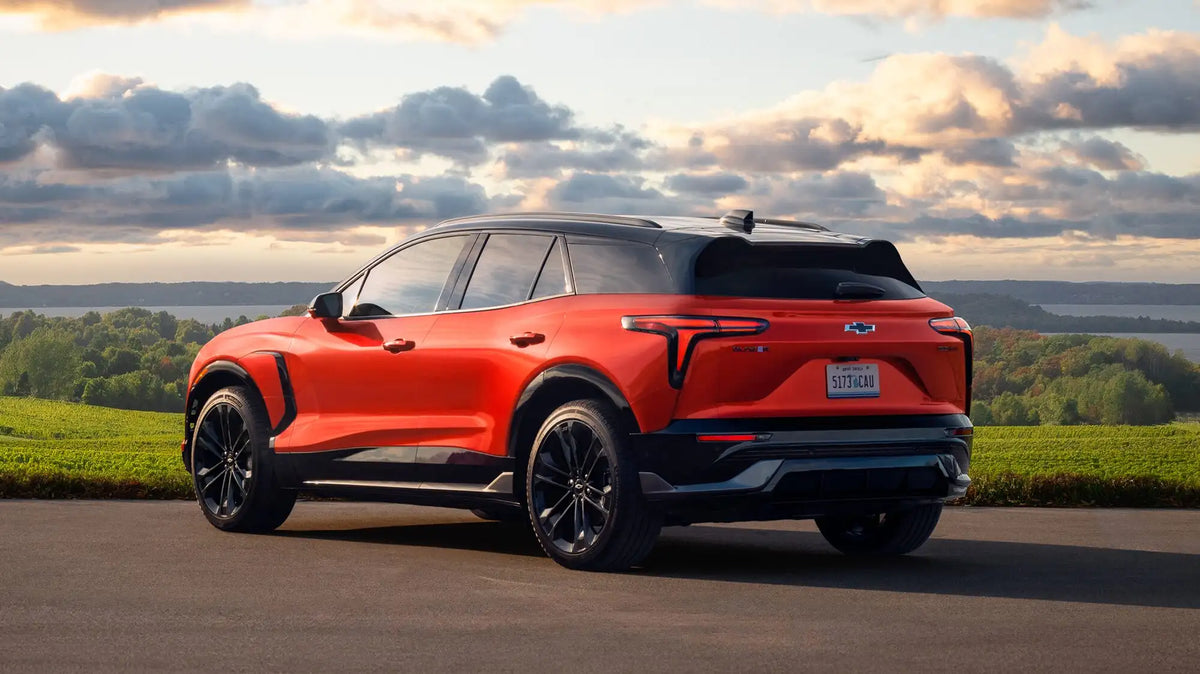
The 2027 Chevrolet Blazer EV starts at $46,795, including destination charges, following a $300 increase for its entry-level LT trim. The electric SUV also introduces a built-in NACS charging port and expanded premium audio availability, while offering up to 312 miles of EPA-estimated range.
2027 Blazer EV Pricing Starts Above $46,000
Chevrolet has revised pricing for the 2027 Blazer EV, with modest increases affecting two of its three available trim levels.
The entry-level LT FWD carries a base manufacturer's suggested retail price of $45,000. Adding the mandatory $1,795 destination charge brings the starting cost to $46,795, before taxes and optional equipment.
The more extensively equipped RS FWD starts at $52,595, including destination charges. Both the LT and RS are $300 more expensive than their corresponding 2026 versions.
Pricing for the performance-oriented SS AWD remains unchanged at $62,495.
Buyers choosing either the LT or RS can upgrade from front-wheel drive to all-wheel drive for an additional $3,000. The SS includes all-wheel drive as standard equipment.
The relatively small price adjustments preserve the Blazer EV's existing trim structure, although its starting price places it above several competing electric crossovers.
Battery Options Deliver Up to 312 Miles
Chevrolet continues to offer different battery configurations depending on the selected drivetrain and trim.
The LT and RS use an 85 kWh battery, with front-wheel-drive versions rated for up to 312 miles under EPA testing.
Choosing all-wheel drive reduces the estimated range to 283 miles, reflecting the additional energy requirements associated with the dual-motor configuration.
The performance-focused Blazer EV SS receives a larger 102 kWh battery and an EPA-estimated driving range of 302 miles.
Although the SS has greater battery capacity, its performance-oriented powertrain results in a slightly lower range estimate than the front-wheel-drive LT and RS.
For buyers prioritizing maximum distance between charging stops, the FWD configurations therefore provide the highest published range.
Those interested in additional traction or stronger performance can select AWD, accepting the corresponding differences in efficiency and driving range.
NACS Charging Port Becomes Standard
A notable change for the 2027 model year is the adoption of a native North American Charging Standard (NACS) connector.
The Blazer EV now includes the charging interface used by Tesla vehicles in North America, allowing compatible Tesla Superchargers to be accessed without a separate CCS-to-NACS adapter.
This brings the Blazer EV into line with General Motors' broader transition toward NACS charging hardware across its 2027 electric vehicle lineup.
For owners, the change simplifies charging at supported NACS-equipped stations by eliminating the need to carry an adapter for those connections.
However, access still depends on individual charging station compatibility and the vehicle's supported charging capabilities.
Drivers using other charging connector types should also consider whether an appropriate adapter is required.
The updated charging port represents a practical change rather than an increase in the vehicle's advertised driving range.
Premium Bose Audio Expands to More Trims
Chevrolet is also addressing an equipment limitation that previously affected customers considering lower-priced Blazer EV versions.
An eight-speaker Bose premium audio system is now available as an option on the LT and RS trims.
Previously, this upgraded audio equipment was limited to the more expensive SS version.
The change gives buyers greater flexibility when selecting interior features without requiring them to move to the highest-performance model.
Chevrolet has not positioned the audio upgrade as standard equipment across the lineup, so customers will still need to account for the cost of optional packages.
Beyond the audio system and charging connector, the 2027 Blazer EV largely retains the established characteristics of the previous model.
Higher Pricing Arrives During Slower Sales
The revised Blazer EV pricing comes as Chevrolet faces weaker demand for the electric SUV.
According to figures reported by Kelley Blue Book, Chevrolet sold 4,427 Blazer EVs through the third quarter of 2026, compared with 20,825 vehicles during the corresponding period in 2025.
That represents a decline of approximately 78%.
The decrease follows the expiration of the former $7,500 federal EV purchase tax credit, which had previously helped eligible customers reduce their effective purchase costs.
The Blazer EV also faces substantial price competition.
For comparison, the Tesla Model Y starts at approximately $41,380, while the Toyota bZ and Hyundai IONIQ 5 begin at around $36,575 and $36,900, respectively.
Chevrolet's electric SUV is larger than several of these alternatives, offering a different balance of exterior dimensions and cabin space.
Nevertheless, the price difference could influence customers shopping primarily on affordability.
With 2027 vehicles entering the market, remaining 2026 Blazer EV inventory may also attract buyers seeking discounts on outgoing models.
The updated Blazer EV therefore enters its next model year with improved charging convenience but faces the challenge of maintaining demand at a higher starting price.

FAQ
How much does the 2027 Chevy Blazer EV cost?
The 2027 Chevrolet Blazer EV LT starts at $46,795, including a $1,795 destination charge. The RS starts at $52,595, while the SS is priced at $62,495, with destination charges included.
What is the range of the 2027 Chevy Blazer EV?
The 2027 Blazer EV offers up to 312 miles of EPA-estimated range with front-wheel drive. AWD versions of the LT and RS are rated at 283 miles, while the SS AWD offers up to 302 miles.
Does the 2027 Blazer EV have a Tesla charging port?
Yes. The 2027 Blazer EV includes a built-in NACS charging port, allowing access to compatible Tesla Superchargers without a separate CCS-to-NACS adapter.
How much extra does AWD cost on the Blazer EV?
Adding all-wheel drive to the LT or RS costs $3,000. The performance-focused SS already includes AWD as standard equipment.
What is new on the 2027 Chevy Blazer EV?
The main updates include a native NACS charging connector and optional eight-speaker Bose audio for LT and RS models. Chevrolet has also increased pricing by $300 on the LT and RS trims.
Why have Chevy Blazer EV sales declined?
Blazer EV sales fell approximately 78% through the third quarter of 2026 compared with the same period in 2025. The decline occurred after the expiration of the federal EV purchase tax credit, although the available figures do not establish a single cause.
Recommend Reading: Why the 2027 Chevy Bolt Struggles to Sell


Share:
Honda Plans 15 New Hybrids With Electric AWD
Ford Fathom EV Pickup Pricing and Preorder Details