





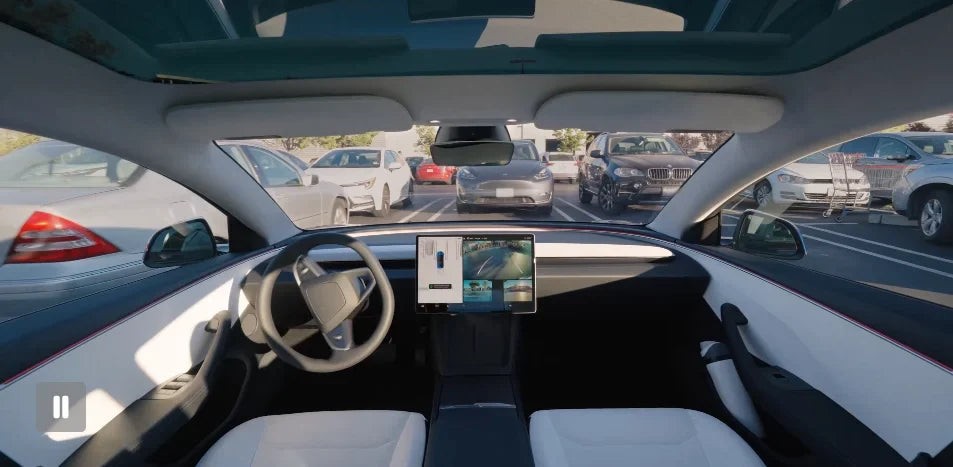
Tesla has renamed its Full Self-Driving (Supervised) system to Tesla Assisted Driving in Europe following objections from German transport authorities. The change addresses concerns that the original name overstated the system's capabilities, while Germany has agreed to support Tesla's efforts to obtain broader European regulatory approval. Photo by: Tesla
Germany Challenges Tesla's Driver Assistance Branding
Germany's Federal Ministry of Transport announced on October 6, 2026, that Tesla had agreed to change how its advanced driver-assistance technology is marketed in Europe.
The ministry considered the previous Full Self-Driving designation potentially misleading because the technology does not operate as a fully autonomous driving system.
Although the software can perform many driving functions, the person behind the wheel must continuously monitor its operation and remains legally responsible for driving.
German officials argued that the product name should reflect those limitations more accurately, particularly as Tesla seeks permission to expand its use across European roads.
During discussions in September, Tesla proposed the alternative name Tesla Assisted Driving to Transport Minister Steffen Bilger.
The revised terminology has since appeared on Tesla's German website. The previous product address now directs visitors to a page using the new name.
The decision changes the way Tesla presents the technology without establishing that the system has gained autonomous driving capabilities.
Speed Limits Become Part of the Approval Agreement
The discussions between Tesla and German authorities also addressed how the software handles posted speed limits.
Germany has indicated that it will support allowing the system to exceed a recognized speed limit by no more than 10% within the relevant European approval framework.
That position creates a potential technical requirement for Tesla, whose driver-assistance software has previously demonstrated more substantial differences between selected driving speeds and posted limits.
According to Reuters, the version authorized in the Netherlands permits speeds reaching 50% above the detected limit under its applicable conditions.
The German position is therefore considerably more restrictive and could require software adjustments before Tesla can satisfy the proposed standard.
Germany's support does not itself constitute approval for unrestricted use throughout the European Union.
Instead, the agreement establishes a position that German officials intend to advocate during the wider regulatory process.
Bilger has expressed support for making the technology available to European Tesla owners as soon as the necessary authorization is secured.
Tesla CEO Elon Musk publicly acknowledged Germany's cooperation following the announcement.
Tesla Keeps Its Main Performance Claims
Despite the new European branding, Tesla has retained much of the product information previously associated with Full Self-Driving.
The updated German website continues to describe a system capable of handling a wide range of journeys while requiring active human supervision.
Tesla also maintains its claim that the technology is seven times safer than human driving, based on a comparison with an estimated U.S. driving average.
That figure should be understood within the methodology described by Tesla rather than as a direct measurement of performance across European road conditions.
The website also continues to promote Tesla's longer-term autonomous vehicle ambitions, including its Robotaxi and Cybercab programs.
These references distinguish the company's future objectives from the capabilities currently offered through its supervised driver-assistance package.
Meanwhile, the American market retains the Full Self-Driving (Supervised) name.
Tesla continues to advertise the U.S. subscription at $99 per month, demonstrating that the European terminology change has not been adopted globally.
European Approval Remains Incomplete
Tesla's revised branding comes during an ongoing effort to expand regulatory acceptance of its driver-assistance software.
According to Tesla's European product information, approvals currently cover eight countries: the Netherlands, Lithuania, Estonia, Denmark, Belgium, Slovenia, Czechia and Croatia.
Germany is not yet included in that group, despite the transport ministry's support for further authorization.
The broader European decision has also faced scheduling delays. A vote concerning EU-wide approval is now expected no earlier than December 2026.
The relevant voting procedure requires support from at least 15 of the EU's 27 member states, representing a minimum of 65% of the bloc's population.
This means approval depends on more than the position of any individual national government.
France and Sweden have also expressed concerns about how the system manages vehicle speed, indicating that the issue remains important to the regulatory discussion.
What the Change Means for European Tesla Drivers
For European customers, the immediate change concerns product terminology and the regulatory conditions surrounding its use.
Tesla Assisted Driving remains a supervised driver-assistance system, not a replacement for an attentive driver.
The German agreement may help Tesla advance its approval application, particularly if the company can demonstrate compliance with the proposed speed restrictions.
However, the revised name does not automatically make the technology available in every European country.
The next major development will be the EU approval process, where national positions and technical requirements will determine whether Tesla can introduce the system more widely.
Until then, European availability will continue to depend on the permissions granted in individual markets. Photo by: Tesla
FAQ
Why did Tesla rename Full Self-Driving in Europe?
Tesla adopted the name Tesla Assisted Driving after German transport authorities raised concerns that Full Self-Driving could suggest a level of autonomy the system does not provide. Drivers must remain attentive and responsible whenever the technology is operating.
Is Tesla Assisted Driving the same as Full Self-Driving?
Tesla Assisted Driving is the new European branding for the supervised driving technology previously marketed as Full Self-Driving. The updated name does not indicate that the system can operate without human supervision.
Is Tesla Assisted Driving approved in Germany?
Germany is not currently among the eight European countries listed by Tesla as having approved the system. German authorities have expressed support for broader authorization, but regulatory approval is still required.
What speed limits will Tesla Assisted Driving follow in Europe?
Germany supports a framework allowing the system to travel up to 10% above the posted speed limit. That position is part of the European approval discussions and does not establish a final EU-wide operating rule.
When will Tesla Assisted Driving receive EU-wide approval?
A European vote is expected no earlier than December 2026, but approval is not guaranteed. The decision requires support from at least 15 EU member states representing 65% of the European Union's population.
Does Tesla still call the system Full Self-Driving in the US?
Yes. Tesla continues to market Full Self-Driving (Supervised) in the United States, where the subscription is advertised at $99 per month. The European naming change has not been applied to the American product.
Recommend Reading: Tesla Adds Home Backup to Model 3 and Model Y


Share:
Polestar Q3 Sales Rise as US Business Faces Ban