





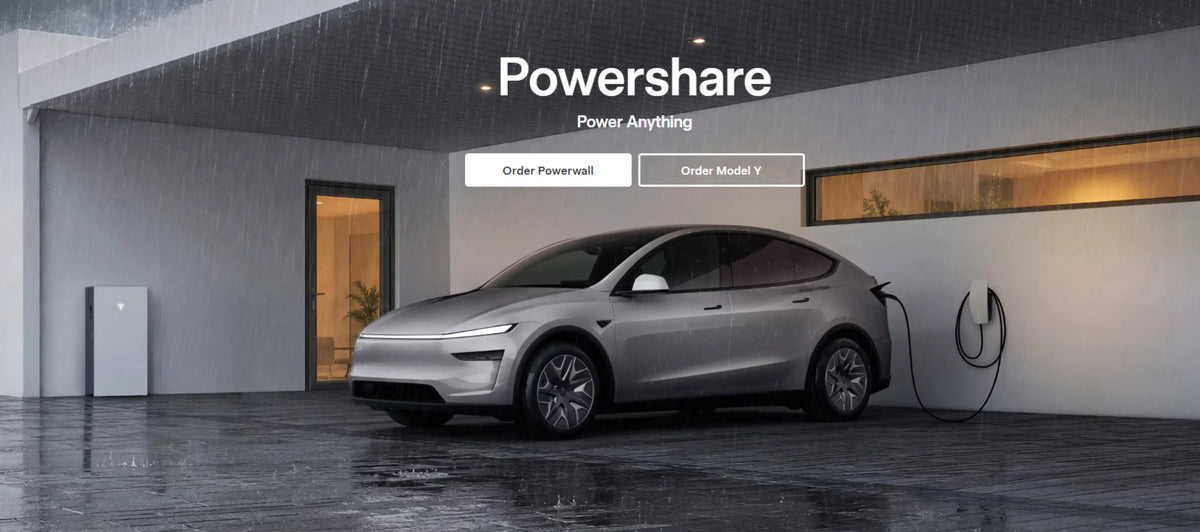
Tesla has enabled Powershare Home Backup for newly ordered Model 3 and Model Y vehicles when they are paired with a Powerwall 3. The feature allows the vehicle battery to supply electricity to a home during an outage, although compatibility depends on both the car’s hardware and the home energy setup.
Model 3 and Model Y Gain Bidirectional Backup
Tesla Energy announced on October 6 that new Model 3 and Model Y vehicles can now provide home backup power through the company’s Powershare system.
Until this update, the Cybertruck was the only Tesla vehicle officially supported for home backup. The expansion brings Tesla’s two highest-volume passenger models into its bidirectional energy ecosystem.
Tesla says guaranteed compatibility currently applies to Model 3 and Model Y vehicles ordered on or after October 1, 2026 in the United States and Puerto Rico.
The system requires a Powerwall 3 at the home. Owners also need a Tesla Wall Connector or Universal Wall Connector for the charging connection.
When utility power fails, electricity stored in the vehicle battery can supplement the Powerwall and continue supplying the house. Tesla estimates that a compatible Model 3 or Model Y starting at a 90% state of charge can provide more than two additional days of backup for a home consuming about 30 kWh per day.
Existing Powerwall 3 Owners May Need No New Hardware
Homes that already have both a Powerwall 3 and compatible Tesla Wall Connector may not need additional equipment.
Tesla says eligible customers can contact support to have Powershare Home Backup activated. The feature is then managed as part of the existing Tesla home-energy system.
The maximum continuous output listed for the Powerwall-based setup is 11.52 kW, although actual backup duration will vary with household electricity consumption, vehicle battery size and starting charge level.
Tesla provides slightly different estimates by vehicle configuration. Some standard Model 3 and Model Y versions are listed at up to two days of added backup, while other compatible versions can exceed two days. The Cybertruck, with its larger battery, can provide more than three days under the same 30 kWh-per-day example.
The feature is intended for backup power during outages rather than routine electricity trading.
Older Vehicles Need a Compatibility Check
Not every existing Model 3 or Model Y can use Powershare.
Tesla says some vehicles produced before the October 1 order cutoff contain the necessary hardware, while others do not. The difference centers on the vehicle’s bidirectional power electronics, including an inverter Tesla identifies as PCS2 Lite.
Owners can check their vehicle directly through the center touchscreen. Under Software and then Additional Vehicle Information, a listing showing Powershare support indicates that the necessary functionality is present.
Tesla has not published a complete production-date breakdown showing exactly when compatible hardware was introduced across every Model 3 and Model Y version.
That means earlier owners cannot assume support based only on model year or delivery date. The vehicle information screen remains the clearest way to determine whether an individual car has compatible hardware.
Several Limits Still Apply to the System
The initial rollout comes with several restrictions.
Powerwall 3 is currently required for Model 3 and Model Y home backup. Tesla says support for Powerwall 2 and Powerwall+ is planned, but it has not provided a launch date.
Unlike the Cybertruck, the two smaller Tesla models cannot currently use a standalone Powershare Gateway as an alternative to a Powerwall.
They also do not support Grid Support, meaning owners cannot use the vehicle battery to export electricity back to the utility grid through Tesla’s system.
Model S and Model X are not included in the current expansion, and availability is limited geographically. Tesla’s Canadian information still lists Powershare home backup around the Cybertruck rather than Model 3 and Model Y.
Tesla Joins a Growing Vehicle-to-Home Market
Tesla is entering a segment that already includes several competing automakers.
Ford introduced home backup capability for the F-150 Lightning in 2022, offering up to 9.6 kW through its compatible home integration system.
General Motors has also expanded vehicle-to-home capability across multiple EVs, including models from Chevrolet, GMC and Cadillac. Kia offers similar functionality with the EV9 when paired with compatible bidirectional charging equipment.
Tesla had discussed adding bidirectional charging to more vehicles for several years. The new Model 3 and Model Y support now moves that capability into much higher-volume products, but the requirement for Powerwall 3 means the feature remains closely tied to Tesla’s own home-energy ecosystem.
For existing Tesla Energy customers, however, the change is significant: a compatible Model 3 or Model Y can now function as an additional household energy reserve instead of serving only as an electricity consumer.
FAQ
Can a Tesla Model 3 power a house during an outage?
Yes. Compatible Model 3 vehicles can provide home backup power when connected to a home equipped with Powerwall 3 and a supported Tesla Wall Connector.
Can a Tesla Model Y use Powershare Home Backup?
Yes. Tesla now supports Powershare Home Backup on compatible Model Y vehicles, with guaranteed support for new vehicles ordered on or after October 1, 2026 in the U.S. and Puerto Rico.
How long can a Model 3 or Model Y power a home?
Tesla says a compatible vehicle starting at about 90% charge can add more than two days of backup for a household using approximately 30 kWh per day. Actual duration depends on energy use and vehicle configuration.
Do I need a Powerwall for Model 3 or Model Y home backup?
Yes. Powerwall 3 is currently required for official Model 3 and Model Y Powershare Home Backup. Tesla says support for earlier Powerwall versions is planned.
Can older Model 3 and Model Y vehicles use Powershare?
Some can, but compatibility is not guaranteed. Owners can check the vehicle’s Additional Vehicle Information screen for a Powershare Support listing.
Recommend Reading: What Is V2H? Understanding Vehicle-to-Home Energy Technology


Share:
Volkswagen Expands LFP Battery Production in Europe