





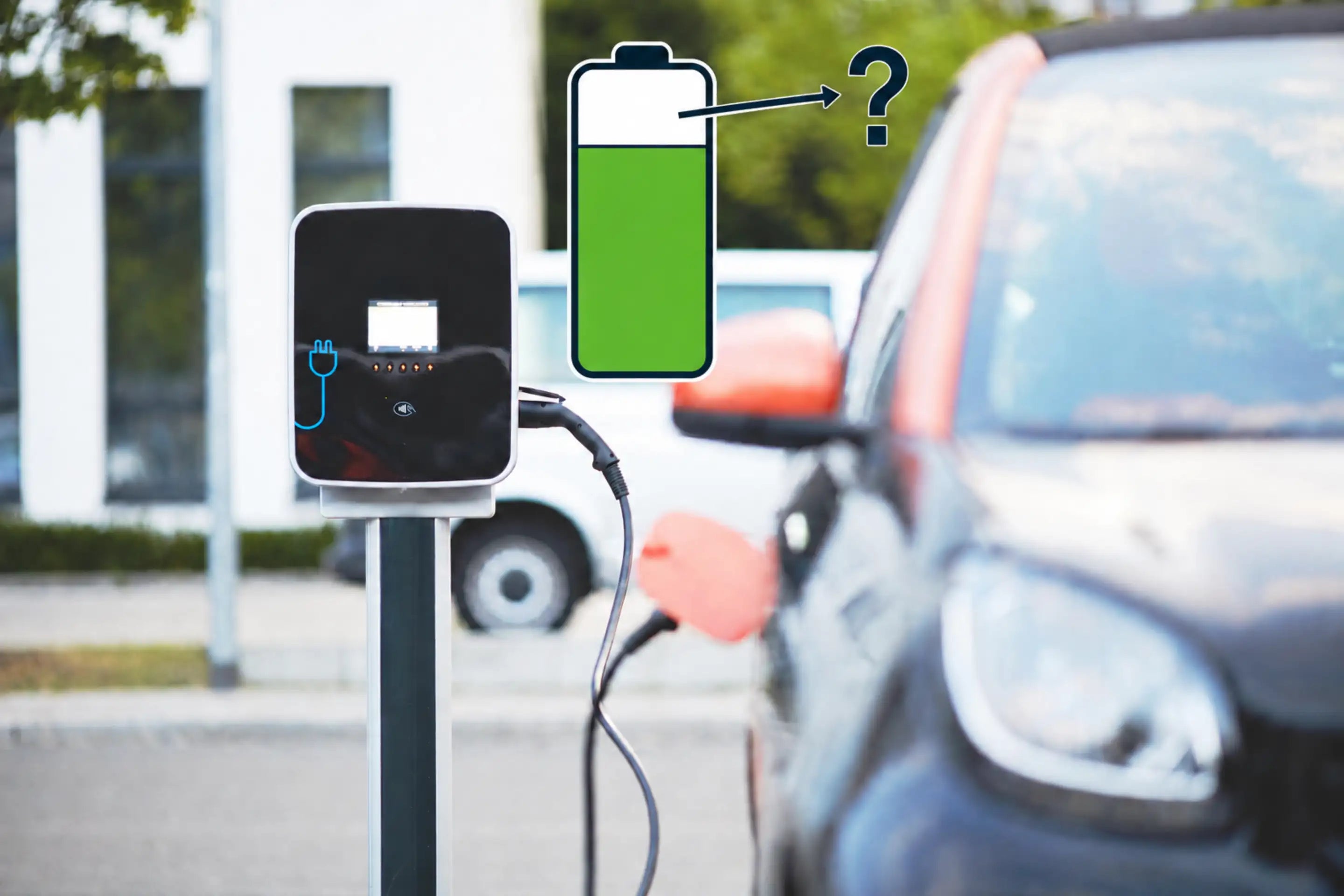
An EV usually stops charging early because of a charge limit or schedule. A warning on the car or charger points to a different problem.
A Charge Limit Can Stop the Session
Many EVs let you choose a maximum charge level. If the limit is set to 80%, charging should stop at 80%. This is normal.
The setting can be saved in the car, its app, or for a location such as home. Recommended limits differ by vehicle and battery type, so follow the instructions for your model.
A Schedule Can Leave the Car Waiting
A plugged-in EV does not always start charging right away. It can wait until the time set in the car, charger app, or utility program.
Charging will not start if the car and charger have schedules that do not overlap. Check both settings when the screen shows “scheduled” or “waiting.” Tesla and Ford explain this behavior in their official Tesla and Ford charging guides.
The Vehicle Can Reduce or Pause Charging
During AC charging, the vehicle controls how much power it accepts. The charger supplies available power, but the car decides whether to use all of it, lower the rate, or stop charging.
Battery temperature can change this rate. When the battery is too hot or cold, the car often reduces power while its heating or cooling system works. In extreme conditions, charging can pause until the battery reaches a safer temperature.
The car can also lower power as the battery approaches its selected limit. However, there is no universal 80% slowdown point for Level 2 charging. The exact behavior depends on the vehicle and battery.
A vehicle fault usually produces a warning on the dashboard or app. Tesla’s charging instructions, for example, clearly separate reduced-current charging from a fault that stops charging. Check the exact message before assuming the charger is the cause.
The Charger or Power Source Can Interrupt Charging
At home, a short power outage, tripped breaker, ground problem, unstable voltage, or charger fault can end the session. At a public station, payment, network, or station problems can also stop charging.
If a breaker trips again after charging restarts, do not keep resetting it. The circuit, outlet, and charger should be checked by a licensed electrician.
The Connector Can Lose Contact
A connector that is not fully inserted can start charging and then lose the connection. Dirt, ice, moisture, a damaged pin, or a worn latch can cause the same problem.
A charging cable can feel slightly warm during use. Strong heat, a burning smell, dark marks, soft plastic, or melting are not normal. Stop using the equipment if any of these signs appear.
The Charging Message Shows What Happened
“Charge complete” usually means the set limit was reached. “Scheduled” means the car is waiting. “Reduced power” points to temperature or available power, while “fault” requires further checking.
A charger with a clear display makes this easier to understand. The EVDANCE 32A J1772 Portable Level 2 EV Charger shows current, voltage, charging status, and delay settings. Drivers can quickly see whether the charger is waiting or supplying power, while the car’s display provides details about vehicle faults.
If the same car stops on different compatible chargers, the vehicle needs attention. If different cars have trouble with the same charger, the charger or power supply is the more likely source.
Recommended Reading: Why Does My EV Charger Keep Tripping the Breaker?


Share:
EV Charging Speed Explained with Real Examples
5 Smart 40A NEMA 14-50 EV Chargers Compared