





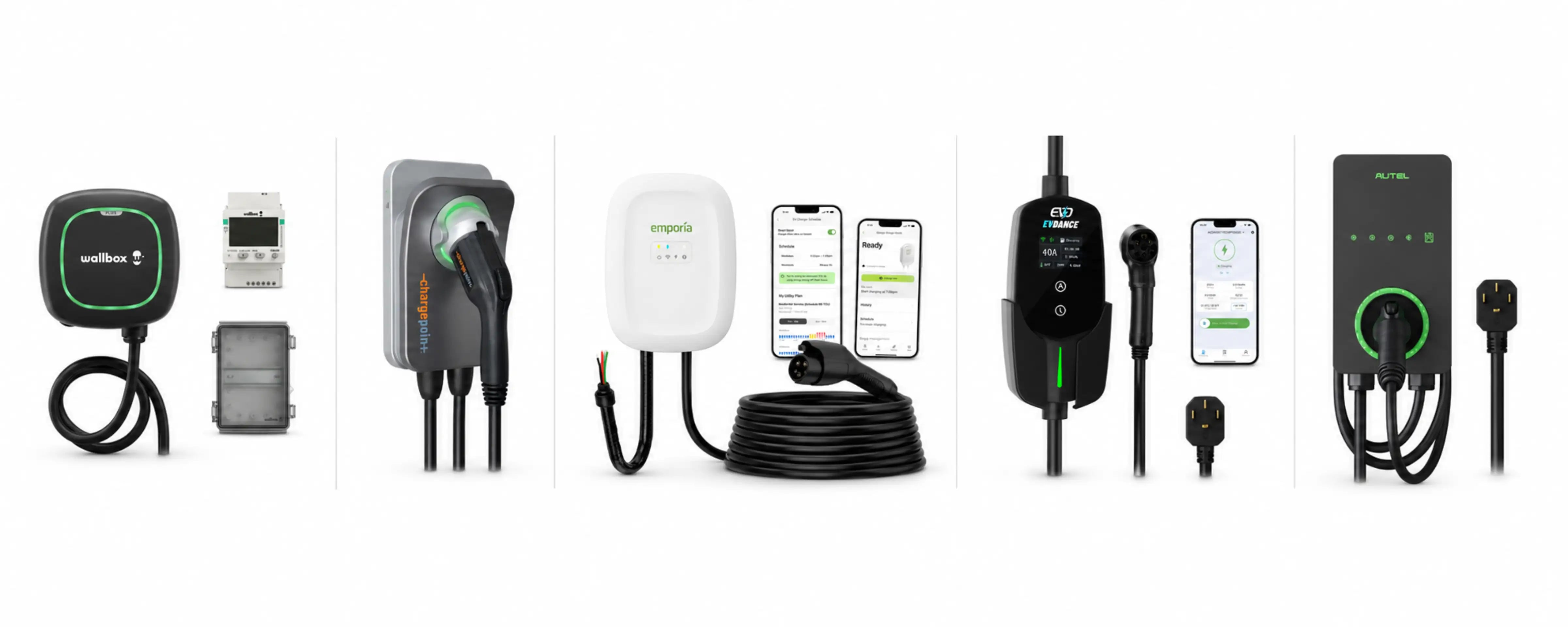
These five smart EV chargers can supply up to 40A through a suitable NEMA 14-50 outlet. Their main differences are App functions, cable length, mounting style, energy management and price.
This comparison uses published manufacturer specifications. The order is not a performance ranking, and the products were not tested under the same conditions.
Quick Comparison
| Charger | Output | Cable | Main difference | Listed price* |
|---|---|---|---|---|
| ChargePoint Home Flex | 40A / 9.6kW | 23 ft | Home and public charging in one App | $539 |
| Emporia Classic | 40A / 9.6kW | 25 ft | Detailed home energy data | $449 |
| EVDANCE Flux Portable | 40A / 9.6kW | 25 ft | Portable design with App control | $249.95 |
| Wallbox Pulsar Plus | 40A / 9.6kW | 25 ft | Optional load and solar management | $649.99 |
| Autel AC Lite Home | 40A / 9.6kW | 25 ft | App control with optional RFID access | $463.20 |
*Prices were listed on manufacturer websites on September 1, 2026. They can change without notice.
1. ChargePoint Home Flex
The ChargePoint Home Flex has a 23-foot cable and provides up to 40A through its NEMA 14-50 plug. Its App supports scheduling, charging history and energy-use tracking. The same App also provides access to ChargePoint’s public charging network.
Its main advantage is having home and public charging in one account. Its 23-foot cable is the shortest in this comparison, and the charger is designed mainly for fixed wall mounting.
Best for: Drivers who already use ChargePoint public stations.
2. Emporia Classic Level 2 EV Charger
The Emporia Classic includes a 25-foot cable and supports 40A charging with a NEMA 14-50 plug. The Emporia App shows charging status, energy use and estimated charging costs. It can also schedule charging around utility rates.
Emporia provides more detailed home-energy data when connected to other Emporia products. Drivers who only need basic scheduling might not use the full energy-monitoring system. The charger is intended for wall-mounted home use.
Best for: Homeowners who want detailed energy and cost data.
3. EVDANCE Flux 40A Portable EV Charger
The EVDANCE Flux 40A Portable EV Charger has a 25-foot cable and supplies up to 9.6kW at 240V. Its App supports scheduling, status monitoring and charging records. The unit is ETL listed and has an IP66 rating.
Unlike the wall-mounted models in this guide, the EVDANCE charger can be removed and stored in a vehicle. It still requires a suitable NEMA 14-50 outlet and does not offer the same optional home load or solar-management system as Wallbox.
Best for: Drivers who want App control and a charger they can store or carry.
4. Wallbox Pulsar Plus 40A
The Wallbox Pulsar Plus 40A uses a NEMA 14-50 plug and includes a 25-foot cable. Wi-Fi and Bluetooth connect it to the Wallbox App for scheduling, status checks and energy monitoring.
Its main difference is support for dynamic load management and solar charging. These features require a separate Wallbox power meter, which increases the total cost. The Pulsar Plus also has the highest listed starting price in this comparison.
Best for: Homes planning to add load management or solar charging.
5. Autel AC Lite Home 40A
The Autel AC Lite Home 40A includes a 25-foot J1772 cable and connects through Wi-Fi or Bluetooth. The Autel Charge App supports remote start and stop, scheduling and charging notifications.
Autel also supports optional RFID access, which can help control who uses the charger. The RFID cards are sold separately, and the 15.4-pound unit is designed mainly for wall-mounted use rather than regular transport.
Best for: Drivers who want a wall-mounted charger with App and access-control options.
Which Smart 40A Charger Fits Your Home?
ChargePoint offers the closest connection between home and public charging. Emporia focuses on household energy data, while EVDANCE provides a more portable design at a lower listed price.
Wallbox offers the most expandable home energy features, although additional hardware is required. Autel provides a traditional wall-mounted design with optional access control.
All five chargers need a suitable electrical setup. Continuous 40A charging normally requires a 50A circuit, but the breaker, wiring, receptacle and local code must all support the installation. The vehicle must also be able to accept the available AC power.
Recommend reading: Why Does My EV Stop Charging Before It’s Full?


Share:
Why Does My EV Stop Charging Before It’s Full?
Best Times to Drive an EV This Labor Day 2026
1 comment
The comparison is very useful for EV owners because charging requirements can vary depending on the vehicle and home electrical setup. I also like that the article explains the differences in cable length, smart features, portability, and energy management rather than simply ranking the chargers. Understanding the battery capacity and charging limits of an EV is equally important when choosing the right home charger.