



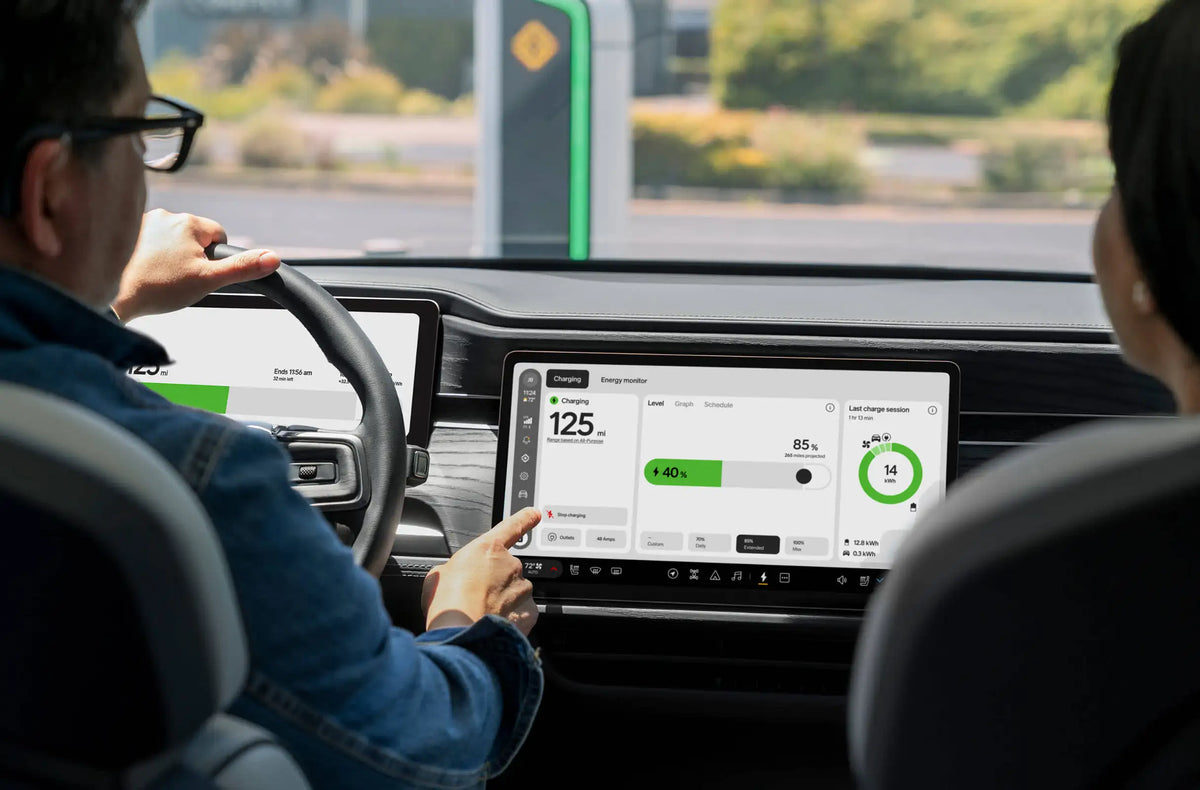
Rivian is beginning to select owners for an early testing program for its new point-to-point assisted driving system. Initial access is limited to eligible R2 and second-generation R1 vehicles in California and Florida, with additional requirements covering subscriptions, driving safety and participation.
The software is designed to support navigation between destinations while requiring drivers to remain attentive. Rivian has not announced when the feature will become widely available.

Who Can Join Rivian's Assisted Driving Beta?
Rivian's Autonomy Early Access Program is intended for a selected group of customers rather than everyone who owns a compatible vehicle.
The company began collecting expressions of interest in October and is now moving toward reviewing potential participants. Submitting a request does not guarantee acceptance.
For the initial phase, applicants must reside in California or Florida. Rivian has indicated that other states could be added as the testing program develops.
Owners elsewhere in the United States can still register their interest. Those responses may help Rivian determine where future testing should take place.
Vehicle compatibility is another important restriction. The program currently covers the Rivian R2 and second-generation R1 models, excluding vehicles built on the original R1 platform.
Participants must also maintain a paid Autonomy+ subscription. Rivian will consider how regularly applicants use the assisted driving functions already available in their vehicles.
How Rivian Evaluates Driver Safety
Rivian is placing driver behavior at the center of its selection process.
The company says it will examine each applicant's driving safety score, which incorporates information about potentially hazardous events recorded during vehicle operation.
Examples include forward-collision alerts, actual collisions and other indicators associated with driving risk.
According to reporting from RivianTrackr, the program's conditions may also allow Rivian to review an applicant's driving record.
Potentially disqualifying factors include impaired-driving offenses, reckless driving, suspended licenses, serious traffic violations and accidents for which the driver was responsible.
These screening measures indicate that Rivian wants participants who can evaluate developing software while maintaining appropriate attention to road conditions.
Meeting the published criteria does not automatically secure an invitation. The company retains discretion over which eligible owners enter the program.
What Early Access Participants Must Do
Selection comes with continuing responsibilities beyond installing the software.
Rivian expects enrolled drivers to use its point-to-point capabilities at least once per week, giving the company a regular stream of information about how the system performs.
Participants must also complete feedback surveys and report technical problems when they encounter them.
This process is intended to help Rivian identify unexpected behavior, evaluate usability and prioritize improvements before a broader release.
The program additionally involves a non-disclosure agreement, which restricts how participants can share certain information about the software.
RivianTrackr reports that the agreement covers data categories including vehicle location and camera information.
Prospective testers should review the applicable participation terms to understand the information collected and the responsibilities associated with enrollment.
Continued access depends on meeting the program's requirements rather than simply receiving an initial invitation.
How Rivian's Point-to-Point System Works
The new capability represents an expansion of Rivian's existing driver-assistance technology.
Instead of providing assistance only in selected driving situations, the proposed system is intended to support travel along a route between a starting location and a destination.
Its general approach resembles the point-to-point functionality associated with Tesla's Full Self-Driving (Supervised) system.
However, Rivian's implementation has not yet been described in enough detail to establish a complete feature-by-feature comparison.
Importantly, the technology remains an eyes-on driver-assistance system. Drivers must monitor the road and remain responsible for operating their vehicles.
The availability of route-based assistance does not mean a vehicle can operate as a fully autonomous robotaxi.
Rivian has not published a comprehensive list of supported road types, operating limitations or performance benchmarks for the beta software.
Those details will be important when evaluating how the system handles everyday traffic conditions.
When Will Rivian Expand the Program?
Rivian has not specified a final enrollment target or an official end date for the early testing phase.
A company representative confirmed to InsideEVs that the initiative is focused on developing and evaluating its Point-to-Point capability.
The automaker intends to increase participation over time and eventually make the technology available for demonstrations during new-vehicle test drives.
More information may emerge during Rivian's AI & Autonomy Day on December 9, an event the company has identified as a major opportunity to discuss Autonomy+.
For now, interested owners can submit a request through their Rivian account, provided they understand that selection is not guaranteed.
The next important milestones will be the first participant invitations, additional technical disclosures and any expansion beyond the initial two states.
FAQ
Which Rivian vehicles qualify for the point-to-point driving beta?
The initial program accepts eligible Rivian R2 vehicles and second-generation R1 models. First-generation R1 vehicles are excluded under the current requirements. Applicants must also have an active paid Autonomy+ subscription.
What states are eligible for Rivian's Autonomy Early Access Program?
The first testing phase is restricted to California and Florida. Rivian owners in other states may register their interest, but that does not provide immediate access to the beta.
Does Rivian check driving records before selecting testers?
Yes. Rivian evaluates driving safety information, including collision-related events and other risk indicators. Reported program terms also permit consideration of serious traffic offenses, license suspensions and certain accident records.
Is Rivian's point-to-point driving system fully autonomous?
No. The system is described as an eyes-on assisted driving feature, meaning the driver must remain attentive and responsible. It should not be confused with driverless vehicle operation.
What are the requirements after joining Rivian's beta?
Participants are expected to use the software weekly, complete surveys and report problems. Enrollment also involves data-sharing obligations and a non-disclosure agreement.
When will Rivian release point-to-point driving to all owners?
Rivian has not announced a general release date. The company plans to expand testing, with additional information potentially arriving at its December 9 AI & Autonomy Day.
Recommend Reading:


Share:
VW ID. Polo Delivery Wait Times Reach 21 Months
Ford Fathom EV Pickup Gets Its First LFP Batteries