



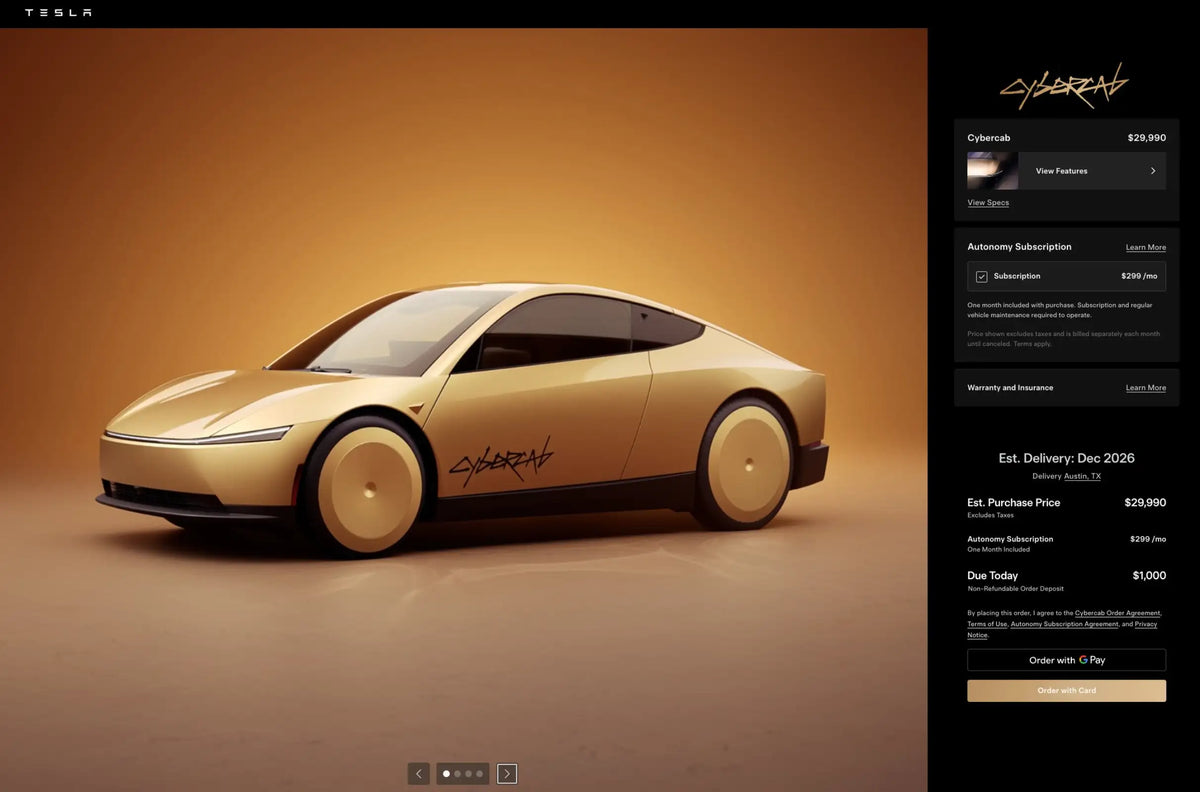
Tesla has announced a limited purchasing program for its Cybercab, offering selected customers a two-seat autonomous vehicle priced at $29,990. However, buyers must also subscribe to a $299 monthly self-driving service, and vehicle operation will be restricted to locations where Tesla supports autonomous service.
The announcement marks a potential expansion of Tesla's autonomous vehicle business from company-operated transportation services into private ownership, although several regulatory and operational questions remain unresolved.

Cybercab Pricing Includes a Required Subscription
The Cybercab's advertised purchase price makes it Tesla's lowest-priced vehicle, approximately $7,000 below the Model 3.
Unlike conventional passenger vehicles, the Cybercab is designed without a steering wheel or driver-operated pedals. Its operation therefore depends on an automated driving system rather than manual control.
Tesla's proposed ownership arrangement includes a recurring software expense.
Customers must pay $299 per month for autonomous driving access, with the initial month provided without charge.
That amounts to $3,588 annually at the advertised subscription rate, excluding the introductory period.
Insurance, maintenance and other ownership expenses would be additional.
The subscription requirement is particularly important because the Cybercab cannot be driven manually if autonomous functionality is unavailable.
As a result, its initial purchase price does not represent the complete cost of using the vehicle.
Who Can Buy the Tesla Cybercab?
Tesla is initially offering the Cybercab through an invitation-based purchasing process rather than opening reservations to every customer.
The company announced the program through its Robotaxi account on X, indicating that a limited group of buyers would receive access first.
A company-shared ordering screenshot suggested that deliveries could begin as early as December 2026.
However, Tesla has not published a comprehensive schedule for broader customer availability.
It remains uncertain how many vehicles will be offered during the first phase or what criteria Tesla uses to select eligible buyers.
The company has also indicated that Cybercab operation will be limited to designated service territories.
This means purchasing eligibility and practical vehicle usability may depend on geographic location.
Customers outside supported areas could face restrictions even if they are otherwise interested in buying the vehicle.
Where Will Privately Owned Cybercabs Operate?
Geographic availability is one of the most significant questions surrounding Tesla's ownership program.
Tesla has stated that the Cybercab will operate only within approved service areas, but the announcement did not provide a complete list of eligible locations.
Tesla already operates a Robotaxi transportation service in selected American cities, including Austin and Miami, according to the company's reported service expansion.
However, the presence of a Robotaxi service does not automatically establish that privately owned Cybercabs can operate throughout the same metropolitan area.
Operational boundaries may depend on software readiness, local requirements and regulatory permissions.
Tesla also says Cybercab owners will be able to use its mobile application to monitor vehicles and manage rides.
The company has not clarified whether private owners will be permitted to place their vehicles into Tesla's commercial Robotaxi network.
Consequently, potential revenue from providing rides to other passengers should not be treated as a confirmed ownership benefit.
Federal Safety Rules Remain a Major Consideration
The Cybercab's unconventional design introduces regulatory questions that do not apply in the same way to ordinary passenger vehicles.
Most vehicles sold for public-road use in the United States must comply with applicable Federal Motor Vehicle Safety Standards.
The Cybercab lacks conventional driver controls and exterior mirrors, making its compliance pathway particularly important.
The National Highway Traffic Safety Administration (NHTSA) has questioned aspects of Tesla's approach to determining whether the vehicle satisfies relevant requirements.
Federal regulations provide mechanisms for certain exemptions, but approval is not automatic.
The source reporting describes a general exemption limit of 2,500 vehicles annually under the relevant framework.
Other autonomous vehicle developers have pursued exemptions for specialized vehicles.
Tesla has not established in the announcement whether its proposed private Cybercab deliveries will rely on exemptions, a different compliance interpretation or subsequent regulatory changes.
Until those details are confirmed, the announced ordering program should not be interpreted as proof of unrestricted nationwide road approval.
How Cybercab Differs From Other Autonomous Vehicles
Most driverless passenger services currently operate through commercial fleets rather than individual vehicle ownership.
Companies such as Waymo and Zoox have focused on managed transportation networks with defined operating territories.
Tesla's proposal differs by introducing a vehicle specifically intended for autonomous operation into a private purchasing program.
Other automakers are developing advanced driving technology, although their approaches vary.
Rivian plans to combine lidar hardware with its proprietary computing platform to support future automated driving capabilities.
General Motors has discussed introducing an eyes-off version of Super Cruise in the Cadillac Escalade IQ in 2028, initially targeting highway use.
These systems should not automatically be considered equivalent to a vehicle operating without driver supervision.
Tesla's Cybercab announcement is therefore notable, but its significance depends on successful deliveries, regulatory authorization and reliable real-world operation.
The $29,990 price creates a new potential ownership option, while subscription costs, operating boundaries and regulatory approval will determine its practical value.
 Photo by: Tesla
FAQ
How much does the Tesla Cybercab cost?
Tesla has announced a $29,990 starting price for the Cybercab. Owners must also pay $299 per month for autonomous driving access after the complimentary introductory month.
When will Tesla Cybercab deliveries begin?
Tesla's shared ordering information indicates that initial deliveries could start in December 2026. The company has not confirmed when purchasing will become available to the general public.
Can anyone order a Tesla Cybercab?
No. Tesla's initial program is limited to selected customers who receive purchasing invitations. Broader availability has not yet been announced.
Can the Tesla Cybercab operate anywhere in the United States?
No. Tesla says Cybercab operation will be restricted to supported service areas. The company has not released a complete geographic list for privately owned vehicles.
Does the Tesla Cybercab have a steering wheel?
No. The Cybercab is designed without conventional steering and pedal controls. Its operation depends on autonomous driving technology, making regulatory approval and software availability essential.
Can Cybercab owners earn money through Tesla Robotaxi?
Tesla has not confirmed whether privately owned Cybercabs can join its commercial Robotaxi service. The company has discussed app-based vehicle monitoring and ride management, but owner earnings are not an established feature of the announced program.
Recommend Reading: What Tesla Still Needs to Prove With Cybercab


Share:
How Google Gemini Works With Apple CarPlay