





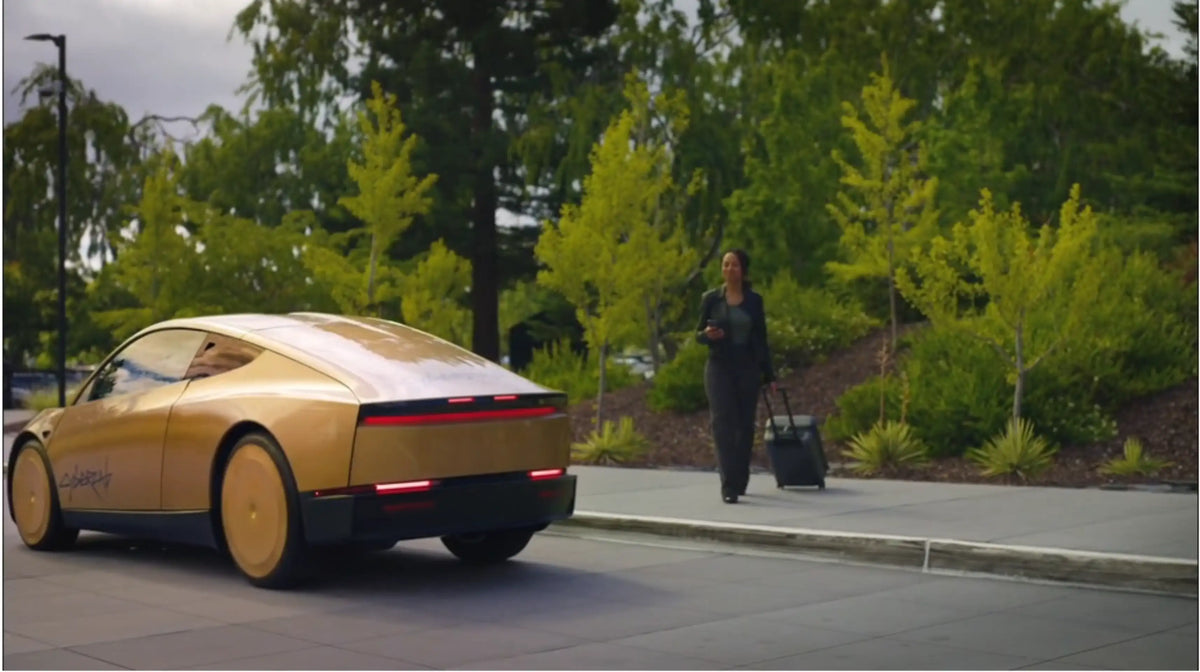
Tesla has started offering paid Cybercab rides in Austin, Texas, adding the purpose-built two-seat robotaxi to its existing driverless service. The vehicle can now carry public passengers, but its rollout remains limited by fleet size, geography, passenger rules and unanswered questions about future consumer sales. Photo by: Tesla
Cybercab Joins Tesla’s Austin Robotaxi Fleet
Public Cybercab service follows Tesla’s launch event in Austin, where selected attendees received early rides in the gold-colored autonomous vehicle.
Tesla said members of the public could begin requesting Cybercab trips from 5 p.m. Central Time on Friday. The new vehicle joins driverless Model Y vehicles already operating through Tesla’s Robotaxi platform.
For Tesla, the launch is an important step because Cybercab was designed specifically for autonomous transportation rather than converted from a conventional passenger car. It has no steering wheel or pedals, reflecting Tesla’s plan to operate the vehicle without a human driver.
The initial deployment remains small. Texas registration data shows 45 Cybercabs registered in the state, although Tesla has not confirmed how many are currently being used for commercial rides.
According to the crowdsourced Robotaxi Tracker, Tesla operates roughly 220 autonomous taxis across six cities. By comparison, Waymo reportedly has around 4,000 vehicles operating in 14 cities.
Passenger Rules Are More Restrictive Than Model Y
The Cybercab is designed for only two occupants, and Tesla has introduced stricter passenger rules than those applied to its Model Y robotaxi service.
Children under 13 years old cannot ride in a Cybercab. Passengers aged 13 to 17 may use one only when accompanied by an adult.
Tesla also requires riders to request a Robotaxi for themselves. That means another person cannot remotely order a Cybercab for an unaccompanied minor.
The vehicle does not include ISOFIX or LATCH mounting points for child seats. Tesla documentation indicates that one child seat can still be secured with a seat belt, although current Robotaxi age restrictions make that feature less relevant to normal commercial service.
By comparison, children as young as eight can use a Model Y robotaxi when traveling with an adult.
Two Seats Leave More Room for Cargo
Tesla says the two-seat configuration reflects typical robotaxi usage, with company representatives stating that most ride-hailing trips involve no more than two passengers.
The Cybercab provides 20.2 cubic feet of rear cargo capacity. Tesla says that space can hold two checked bags and two carry-on bags.
The trunk has a maximum load rating of 220 pounds, or 100 kilograms, and can also accommodate either a large folded stroller or a folded wheelchair.
Riders can open the trunk using the Tesla app. The doors can also unlock and open automatically as a passenger approaches, or they can be controlled through the app.
Inside the vehicle, passengers can open the doors using the central touchscreen or dedicated physical controls.
Cabin Settings Follow the Rider
Tesla has designed the interior around personalized ride profiles.
The two seatbacks can be adjusted separately, although the lower seat section moves together. Tesla says saved passenger preferences can automatically transfer to the Cybercab when it arrives.
Those settings can include cabin temperature and streaming-service accounts. Tesla says personal information is removed from the vehicle after the trip ends.
The cabin also includes Grok integration, allowing passengers to interact with the AI assistant during a ride.
A cabin-facing camera checks for cleanliness and objects that may have been left behind, while interior radar detects passenger positions to support airbag operation.
The restraint system includes front, knee, curtain and multiple seat-mounted airbags. USB-C ports are also included.
Cameras Handle All External Driving Perception
Cybercab continues Tesla’s camera-centered autonomous-driving strategy.
The vehicle uses eight exterior cameras rather than lidar. Their positions include the front, rear, windshield area, door pillars and front fenders.
Tesla is relying on these cameras and its driving software to perform all external perception required for autonomous operation.
The vehicle itself is also unusually light for a modern EV. EPA-related documentation lists a 48-kWh battery, a 219-horsepower front motor and a curb weight of 3,113 pounds.
Tesla vehicle engineer Eric Earley has also said the Cybercab has a drag coefficient below 0.20, making aerodynamic efficiency an important part of its design.
Those specifications help explain how Tesla is approaching robotaxi economics: a relatively small battery, low vehicle weight and two-seat layout are intended to reduce energy use and operating cost.
For now, however, Cybercab remains an Austin-focused service rather than a widely available consumer product. Tesla has still not provided a firm timeline for when individuals might be able to purchase the vehicle at the previously discussed $30,000 price point. Photo by: Tesla
FAQ
Can the public ride in a Tesla Cybercab now?
Yes. Tesla has opened paid Cybercab rides to the public in Austin, Texas. Availability remains limited by the small number of vehicles currently deployed.
How many people can ride in a Tesla Cybercab?
The Cybercab has two seats. Tesla says the layout reflects the fact that most robotaxi trips involve two passengers or fewer.
Can children ride in a Tesla Cybercab?
Children under 13 are not permitted in Cybercab rides. Passengers aged 13 to 17 must travel with an adult.
How much cargo can the Tesla Cybercab carry?
The rear cargo area provides 20.2 cubic feet of space and supports up to 220 pounds. Tesla says it can fit two checked bags and two carry-ons, or large folded mobility and stroller equipment.
What battery does the Tesla Cybercab use?
EPA-related documents list a 48-kWh battery pack and a 219-hp front-mounted motor. The vehicle weighs 3,113 pounds.
Can consumers buy a Tesla Cybercab for $30,000?
Not yet. Tesla has previously discussed a roughly $30,000 consumer price, but it has not announced a confirmed retail sales date.
Recommend Reading: Tesla Plans September Push for Three Long-Delayed Products


Share:
Ford Targets 100,000 Sales for $30,000 EV Truck
RivianOS 2 Brings R1 and R2 Software Together
1 comment
Battery efficiency will be especially important for vehicles designed to operate for extended periods throughout the day. Consistent charging performance and effective battery management can have a major impact on the practicality of autonomous vehicles.