





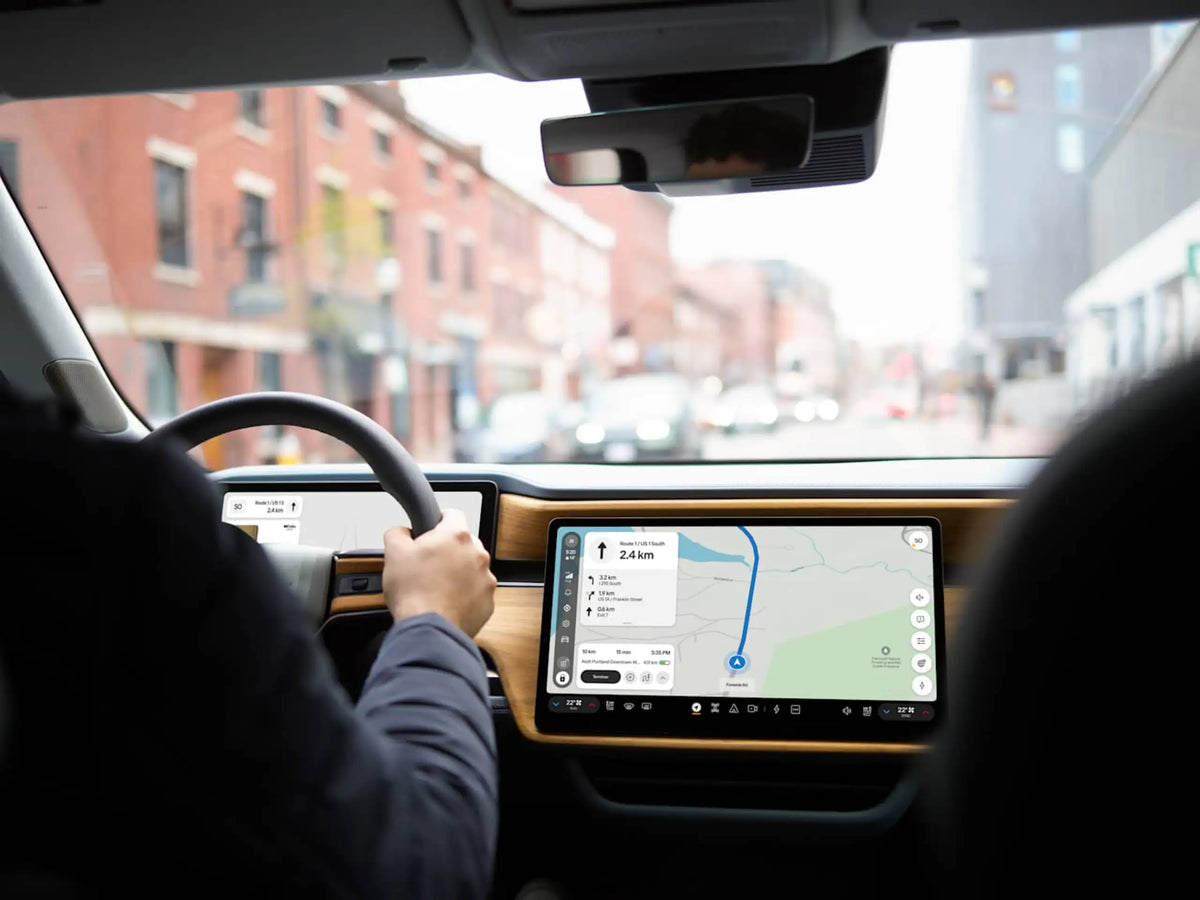
RivianOS 2 is bringing Rivian’s R1 and R2 vehicles onto a shared software foundation, reducing differences that had developed between vehicle generations. The 2026.31 update also introduces redesigned controls, upgraded graphics, new navigation alerts and a broader AI system called Rivian Unified Intelligence. Photo by:RIVIAN
Rivian Moves Its Vehicles to One Software Base
Rivian previously maintained separate software implementations across the first-generation R1, second-generation R1 and newer R2. RivianOS 2 is intended to consolidate those vehicles around one underlying platform, allowing future features and interface changes to be developed more consistently.
The experience will not be completely identical across every Rivian because computing hardware still differs.
The R2 and second-generation R1 support Unreal Engine 5, which Rivian uses to render real-time three-dimensional vehicle and environmental graphics. The first-generation R1 will continue using Unreal Engine 4 so that visual effects remain suitable for its older processors.
As a result, the unified platform is more about creating a common software architecture than delivering exactly the same graphics and performance on every model.
That approach becomes increasingly important as Rivian expands beyond the premium R1 lineup. The R2 is intended to reach a broader group of buyers, making a consistent software experience more important as the company’s installed vehicle base grows.
The Interface Gets a Major Redesign
The most immediate changes in RivianOS 2 appear on the center display.
Drivers can now position quick-access controls and the media interface on either side of the screen. Rivian has also added a vertical status bar designed to keep frequently used vehicle functions accessible without requiring users to move through multiple screens.
The settings system has been rebuilt as Settings 2. It introduces universal search and controls that can change according to the current vehicle context, reducing the need to manually locate individual menu options.
Navigation receives another significant update through Real-Time Route Alerts.
Using information integrated through Google Maps, the system can display reported police activity and speed-camera locations along a route. Rivian says the alert information combines data from local government sources, third-party providers and user contributions.
These additions move Rivian’s navigation software closer to the type of live road reporting already familiar to users of community-driven mapping services.
Connect+ Adds Weather and Remote Trip Tools
Some RivianOS 2 features require the company’s Connect+ subscription, currently priced at $14.99 per month or $149.99 per year.
Subscribers receive a dedicated weather application showing current conditions, air-quality information and forecasts covering the next 10 days.
Connect+ also adds Mobile Live Trips, extending active navigation sessions beyond the vehicle itself.
Drivers can use the Rivian smartphone app to view an ongoing route, begin a trip remotely or update trip information. The feature is intended to create a more continuous connection between route planning on a phone and navigation inside the vehicle.
The subscription structure means not every RivianOS 2 feature will be included with the vehicle by default, even though the broader interface and software architecture update reaches eligible vehicles directly.
Unified Intelligence Expands Rivian’s AI System
Artificial intelligence is another major component of the update.
RivianOS 2 uses Rivian Unified Intelligence, the technology foundation behind the company’s “Hey Rivian” voice assistant. The assistant is designed to go beyond answering general questions by interacting with supported vehicle functions.
How that intelligence operates depends partly on vehicle hardware.
The R2 and second-generation R1 can use a hybrid approach that combines processing inside the vehicle with external computing resources. Local processing can reduce response delays for tasks that benefit from faster execution.
Rivian is also expanding cloud-supported voice functions across both first- and second-generation R1 vehicles, allowing older models to receive part of the updated AI experience without requiring the newest onboard hardware.
The result is a software strategy that keeps older vehicles supported while allowing newer models to use more advanced computing capabilities.
For Rivian, the larger significance of RivianOS 2 is therefore not one individual feature. A common software platform gives the company a clearer foundation for developing future navigation, interface and AI functions across a growing lineup while still adjusting those features to the computing limits of each vehicle generation. Photo by:RIVIAN
FAQ
What is RivianOS 2?
RivianOS 2 is Rivian’s updated in-vehicle operating system introduced through software version 2026.31. It moves eligible R1 and R2 vehicles onto a more consistent software foundation while adding new interface, navigation and AI features.
Do all Rivian vehicles get the same RivianOS 2 graphics?
No. The R2 and Gen 2 R1 use Unreal Engine 5, while first-generation R1 vehicles remain on Unreal Engine 4 because of hardware differences. They share the broader software platform, but some visual features vary by generation.
What are Real-Time Route Alerts in RivianOS 2?
Real-Time Route Alerts provide information about reported police activity and speed cameras within Rivian navigation. The information is sourced through Google Maps using government, third-party and community data.
How much does Rivian Connect+ cost?
Connect+ costs $14.99 per month or $149.99 annually according to the supplied information. RivianOS 2 features tied to the service include the weather application and Mobile Live Trips.
What is Rivian Unified Intelligence?
Rivian Unified Intelligence is the AI foundation supporting Rivian’s voice and vehicle-control features. Newer Rivian vehicles can combine onboard and cloud processing, while older R1 models receive expanded cloud-assisted voice capabilities.
Recommend Reading: Rivian R2 Production Expansion Gains Speed


Share:
Tesla Cybercab Begins Paid Rides in Austin
Audi A2 e-tron Offers Up to 401 Miles of Range