





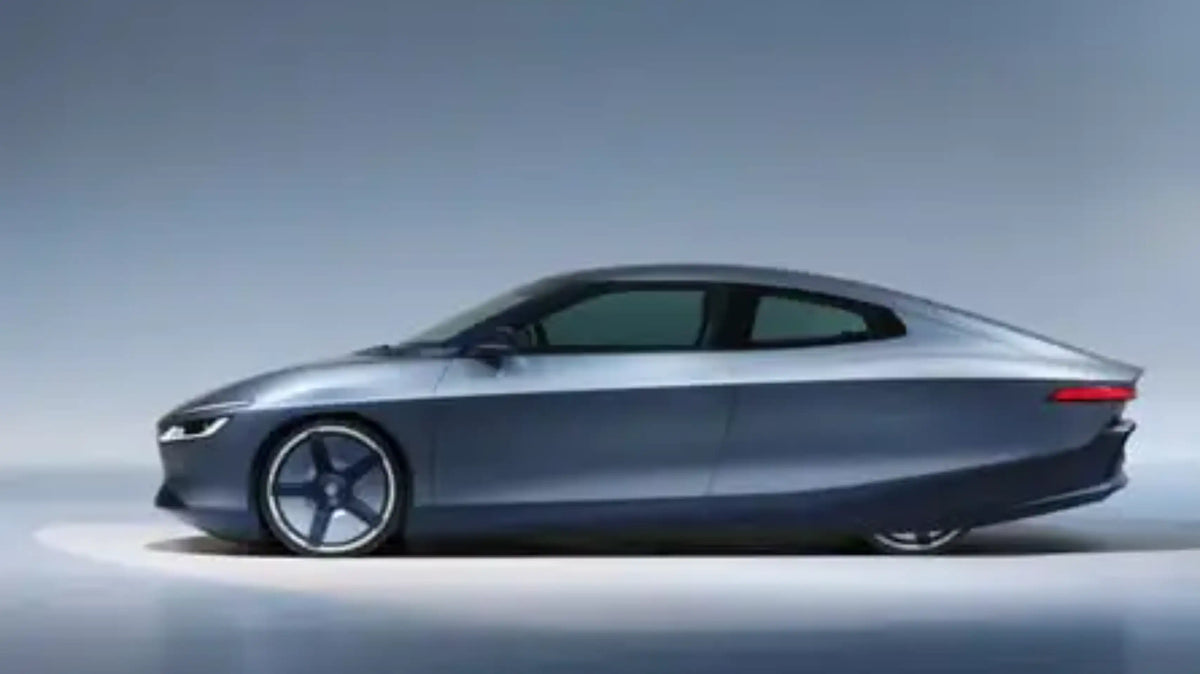
Volkswagen’s Mission Efficiency concept has demonstrated exceptionally low energy consumption, using as little as 6.48 kWh per 100 km under controlled driving conditions. The four-seat EV also completed a 794-mile (1,278-km) road trip with only one charging stop, showing how aerodynamics and low weight can substantially extend range without a larger battery. Photo by: Volkswagen
Aerodynamics Are Central to the Design
Mission Efficiency is a two-door electric concept built around technology related to Volkswagen’s ID. Polo. Instead of focusing on additional battery capacity, engineers concentrated on reducing the amount of energy needed to move the vehicle.
Volkswagen reports a drag coefficient of 0.158, achieved with a relatively small frontal area of 2.08 square meters and extensive airflow management.
Three active cooling openings at the front can operate in several combinations. When cooling demand is low, all three remain closed to reduce aerodynamic resistance.
The car also uses specialized wheel deflectors, heavily covered rear wheels and a fully enclosed underbody. Its rear track is 170 mm narrower than the ID. Polo’s, allowing designers to taper the body more aggressively toward the back.
Continental developed low-rolling-resistance tires for the project using technology derived from its EcoContact 7 range.
A 794-Mile Trip Required One Charging Stop
Volkswagen tested the concept on public roads between Wolfsburg and Vienna, taking a route through Poland and the Czech Republic.
The Mission Efficiency covered 794 miles (1,278.36 km) and stopped for charging only once. It arrived with another 102 miles (164 km) of indicated range remaining.
Based on the remaining energy, Volkswagen calculated potential total driving distance above 870 miles (1,400 km).
The vehicle was not driven exclusively at very low speeds during the test. It reached 86 mph (138 km/h) and recorded an average speed of approximately 42 mph (67.7 km/h).
Including energy lost during charging, average consumption was 7.51 kWh/100 km. Excluding charging losses, Volkswagen measured 6.89 kWh/100 km.
Engineers later conducted a separate efficiency-focused run on level ground at a constant 68 km/h with auxiliary equipment, including climate control, switched off. Consumption fell further to 6.48 kWh/100 km.
ID. Polo Hardware Powers the Concept
Despite its unusual body, Mission Efficiency relies on drivetrain components closely related to Volkswagen’s production EV technology.
A 54.9-kWh NMC battery supplies a front-mounted APP290 permanent-magnet motor producing 133 hp and 264 Nm (195 lb-ft).
The battery is closely related to the pack used by the ID. Polo, although Volkswagen unlocked an additional 2.9 kWh of usable capacity through software for the efficiency vehicle. The production ID. Polo limits usable capacity to 52 kWh with battery longevity in mind.
Charging specifications remain more conventional. Mission Efficiency supports up to 105 kW DC and 11 kW AC.
Volkswagen also integrated a 370-watt solar system into the glass roof and rear section. Rather than serving as the vehicle’s primary charging source, the solar panels help supply electricity for onboard systems.
Low Weight Complements the Efficient Shape
Reducing mass was another priority. Volkswagen used a self-supporting aluminum structure together with high-strength materials including carbon-fiber-reinforced polymer and aramid composites.
The interior follows the same approach. Lightweight seats replace heavier conventional designs, while a removable Bluetooth speaker eliminates the need for a more elaborate fixed audio installation.
There is also no traditional central infotainment display. A smartphone or tablet can connect wirelessly and serve as the main entertainment and interface device.
Despite these measures, Volkswagen designed Mission Efficiency to carry four occupants in a 2+2 layout. Cargo capacity is 481 liters (17 cubic feet), accessed through a large rear hatch.
The vehicle measures 4,775 mm long, 1,744 mm wide and 1,392 mm tall.
Mission Efficiency therefore demonstrates a different route toward longer EV range. Rather than relying on a very large battery, Volkswagen combined a highly aerodynamic body, reduced rolling resistance, lightweight construction and efficient production-based drivetrain components. The result shows how lowering energy demand could help future EVs travel farther while keeping battery capacity relatively modest. Photo by: Volkswagen
FAQ
How efficient is the Volkswagen Mission Efficiency EV?
Volkswagen recorded consumption as low as 6.48 kWh per 100 km during a controlled constant-speed test. On its longer public-road trip, consumption was 6.89 kWh/100 km when charging losses were excluded.
How far did Mission Efficiency travel?
The vehicle covered 794 miles (1,278.36 km) with one charging stop and finished with 102 miles of indicated range remaining. Volkswagen calculated potential total range above 1,400 km under those conditions.
What battery does the Volkswagen Mission Efficiency use?
The concept uses a 54.9-kWh NMC battery related to the battery technology in the ID. Polo. Volkswagen increased usable capacity by 2.9 kWh through software for this vehicle.
Why is Mission Efficiency so aerodynamic?
Its 0.158 drag coefficient comes from a small frontal area, active cooling openings, wheel deflectors, covered rear wheels, a smooth underbody and a narrower rear section.
Is Volkswagen Mission Efficiency a production car?
The supplied information describes Mission Efficiency as a near-production concept using several production-related components. It does not provide a sales date, production plan or customer pricing.
Recommend Reading: Volkswagen Budget EVs Reach 70,000 Orders


Share:
Tesla Roadster Reveal Set for October 1