





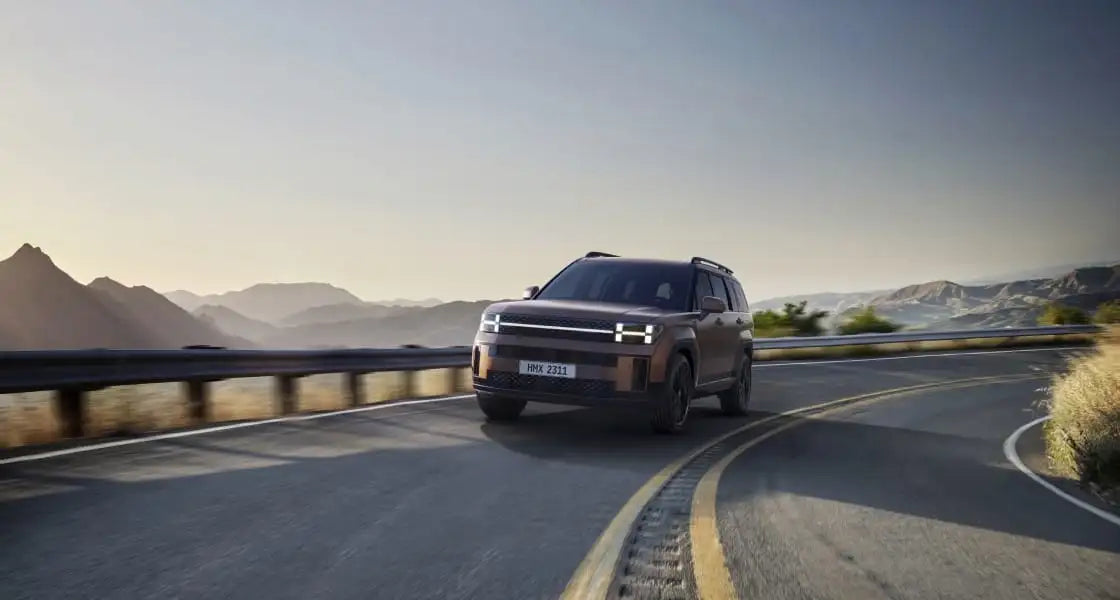
Hyundai plans to introduce an extended-range electric Santa Fe in 2027, combining battery-electric propulsion with a gasoline-powered generator. The company says the new SUV will deliver more than 600 miles of combined driving range and will be produced at its manufacturing plant in Alabama.
Photo by: Hyundai
Hyundai Is Adding a New Powertrain to the Santa Fe
The upcoming Santa Fe will use an extended-range electric vehicle, or EREV, system. Unlike a conventional hybrid, an EREV primarily relies on electric motors to move the vehicle, while its gasoline engine is used to generate electricity when additional energy is needed.
This setup allows drivers to complete many shorter trips using battery power while retaining gasoline as an additional energy source for longer journeys. It could be particularly useful for drivers who frequently travel long distances or tow, where energy consumption can increase significantly.
Hyundai announced the model as part of a much larger North American expansion. By 2030, the automaker plans to introduce or update 58 models across the region.
The Santa Fe EREV is expected to be one of the first products in that strategy and will be manufactured in the United States at Hyundai's Alabama facility.
More Hyundai Group EREVs Are Planned
The Santa Fe will not be the Hyundai Motor Group's only extended-range model.
Kia is planning an EREV version of the Telluride for 2029, followed by an extended-range pickup in 2030. Genesis is also expected to introduce an EREV SUV before the end of the decade, with Hyundai targeting more than 640 miles of combined range for that model.
The strategy comes as several automakers reconsider how to serve customers who want electric driving without relying entirely on charging infrastructure.
Extended-range vehicles are also being developed elsewhere in the U.S. market. Future products from Ford, Ram and Jeep are expected to use variations of the concept, suggesting EREVs could become a more important category between traditional hybrids and fully electric vehicles.
Whether consumers embrace another type of electrified powertrain remains uncertain. Much will depend on pricing, electric-only range, fuel economy and how clearly manufacturers explain the technology.
New Battery Technology Could Reduce Cost and Charging Time
Hyundai is also developing new batteries for both its EREVs and fully electric models.
The company says its extended-range vehicles will use high-nickel battery cells developed in-house. According to Hyundai, the technology could shorten charging times by 40% while allowing an EREV to use less than half the battery capacity required by a comparable battery-electric vehicle.
That smaller battery requirement could be significant because battery packs remain one of the most expensive components in electrified vehicles.
Hyundai is taking a different approach with its upcoming fully electric models. EVs arriving from 2027 are expected to adopt mid-nickel cells, which the automaker says could lower battery costs by approximately 30% without reducing performance.
Battery safety is another development area. Hyundai announced a new Thermal Runaway Protection system that will first appear in a future Genesis vehicle. The design places additional barriers between cells to help contain a thermal event and reduce the chance of it spreading through the battery pack.
Robotaxis and Software Are Part of the Same Expansion
Hyundai's plans extend beyond new passenger vehicles and battery chemistry.
The automaker expects to begin supplying Ioniq 5 robotaxis to Waymo in the fourth quarter of 2026. Motional, Hyundai's autonomous-driving joint venture, is also preparing a driverless ride-hailing service using the Ioniq 5.
Another major step is planned for 2028, when Hyundai expects to introduce its first software-defined vehicle. The platform will use a standardized sensor architecture connected to Nvidia technology.
Supporting these autonomous-driving programs will require substantial computing capacity. Hyundai is developing a 100-megawatt AI data center in South Korea that is expected to contain more than 50,000 GPUs.
The broader product expansion will also extend well beyond North America. Hyundai plans 49 new or updated models in South Korea, 41 in Europe, 26 in India and 22 in China by the end of the decade.
Together, the plans show that Hyundai is not committing to a single path toward electrification. Battery EVs will remain central to its strategy, but EREVs are being added as another option for customers who want electric propulsion with substantially more flexibility for long-distance driving.
Photo by: Hyundai
FAQ
What is the Hyundai Santa Fe EREV?
The upcoming Santa Fe EREV is an extended-range electric SUV that uses electric motors for propulsion and a gasoline engine to generate additional electricity. Hyundai plans to launch the vehicle in 2027.
How far will the Hyundai Santa Fe EREV travel?
Hyundai is targeting more than 600 miles of combined range using a fully charged battery together with gasoline. The company has not yet provided separate figures for battery-only driving range.
Where will the Santa Fe EREV be built?
Hyundai says the new Santa Fe EREV will be manufactured at its Alabama plant in the United States.
Is an EREV the same as a hybrid?
Not exactly. An EREV is designed around electric propulsion, with the gasoline engine primarily serving as an onboard source of electricity. A conventional hybrid can use its combustion engine more directly as part of the vehicle's propulsion system.
What other EREVs is Hyundai Motor Group planning?
Kia plans a Telluride EREV in 2029 and an extended-range pickup in 2030. Genesis is also developing an EREV SUV with a targeted combined range above 640 miles.
Recommend Reading: Hyundai Extends EV Charging Unit Warranty to 15 Years: Is It Enough?


Share:
How Mercedes Plans to Make AMG EVs Feel Familiar
BMW EV Sales Reach 2 Million Worldwide