





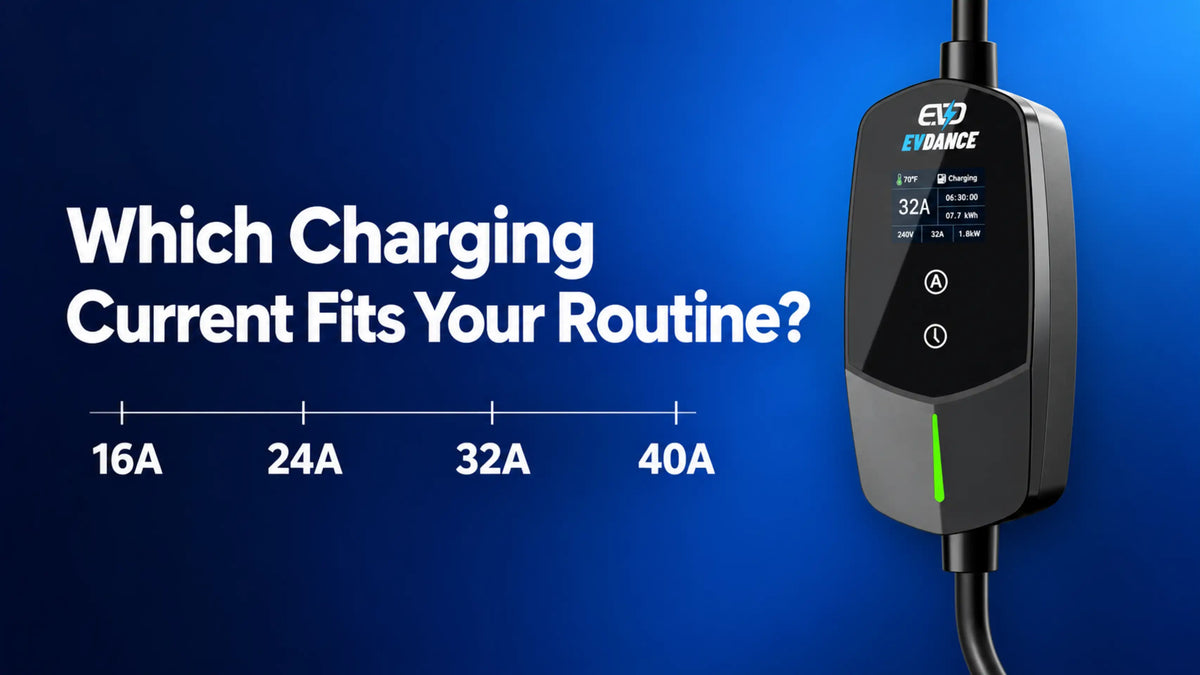
The right charging current depends on how much energy your vehicle needs each day, how long it remains parked and what the home electrical setup can support.
A higher amp rating provides more available charging power, but it is not automatically the best choice for every driver. A plug-in hybrid or an EV driven short distances may recover its daily use with 16A, while a longer commute or shorter charging window may make 32A or 40A more practical.
The comparison should begin with the charging routine—not the largest number on the product page.
Amperage Sets the Available Charging Power
When all four chargers receive 240V, their approximate maximum power is:
| Charging current | Approximate power at 240V |
|---|---|
| 16A | 3.84kW |
| 24A | 5.76kW |
| 32A | 7.68kW |
| 40A | 9.60kW |
These figures describe the power the charging equipment can make available. The actual rate is still limited by the home circuit, EV charger and vehicle’s onboard charger.
A 40A charger will not force a vehicle to accept 9.6kW if the vehicle supports a lower AC charging rate. For a more detailed explanation, see EV Charging Speed Explained with Real Examples.
 A 16A Charger Fits Lighter Charging Needs
At 240V, a 16A charger can provide approximately 3.84kW. This may be enough for a plug-in hybrid, a shorter daily commute or a vehicle that remains parked for most of the night.
A dual-voltage model adds another type of flexibility. The EVDANCE 12A/16A portable EV charger supports 120V and 240V charging through its approved NEMA 5-15 and NEMA 6-20 configurations.
The lower output does not make a 16A charger an emergency-only product. If it can replace the energy used during a normal day before the next departure, it can support a regular charging routine.
A 24A Charger Uses More of a 30A Circuit
A 24A charger can provide approximately 5.76kW at 240V. It sits between entry-level charging and the higher output commonly associated with 32A or 40A equipment.
This level can make sense when a compatible 30A circuit and outlet are already available. The EVDANCE 24A NEMA 14-30 portable EV charger, for example, provides up to 24A and 5.76kW at 240V.
A 24A model may suit drivers who need more overnight output than 16A provides but do not have a suitable circuit for 32A or 40A charging. The specific plug version must still match the installed receptacle.
A 32A Charger Balances Speed and Overnight Use
At 240V, 32A charging provides up to approximately 7.68kW. This is a practical middle point for drivers with longer daily mileage, larger batteries or fewer hours available at home.
The EVDANCE 32A J1772 portable EV charger offers 16A, 24A and 32A settings, allowing the selected current to match a supported electrical setup. At its maximum setting, it can provide up to 7.68kW. Fast 32A J1772 Charging
Adjustability does not mean every setting is suitable for every outlet. The breaker, wiring, receptacle and charger must all support the selected current.
A 40A Charger Helps With Shorter Charging Windows
A 40A charger can provide up to approximately 9.6kW at 240V. The additional power is useful when a vehicle regularly returns with a larger energy deficit or has fewer hours to charge before the next trip.
The EVDANCE 40A J1772 portable EV charger combines up to 40A output with a 25-foot cable and adjustable charging settings.
The vehicle must be able to accept the available power for the higher rating to reduce charging time. Otherwise, a 40A charger may operate at the same actual rate as a lower-rated model.
 Choose Around the Complete Charging Routine
Before selecting an amp rating, check four points:
- How many miles the vehicle normally travels each day
- How many hours it remains connected at home
- The vehicle’s maximum AC charging rate
- The current supported by the outlet and complete electrical circuit
For continuous EV charging, 16A, 24A, 32A and 40A commonly correspond to 20A, 30A, 40A and 50A circuits respectively. This relationship does not confirm that a particular installation is suitable. The outlet type alone cannot verify the breaker, conductors or receptacle condition.
The U.S. Department of Energy notes that many drivers can cover their daily needs with lower-power overnight charging, while Level 2 equipment is especially useful for longer commutes, irregular schedules and larger batteries. afdc.energy.gov
Choose the lowest output that can reliably restore the vehicle’s normal daily energy use within the available charging window. Moving to a higher current makes sense when the vehicle can use it, the electrical setup supports it and the existing charger no longer fits the driving routine.
Recommend Reading: EV Charging Speed Explained with Real Examples


Share: