





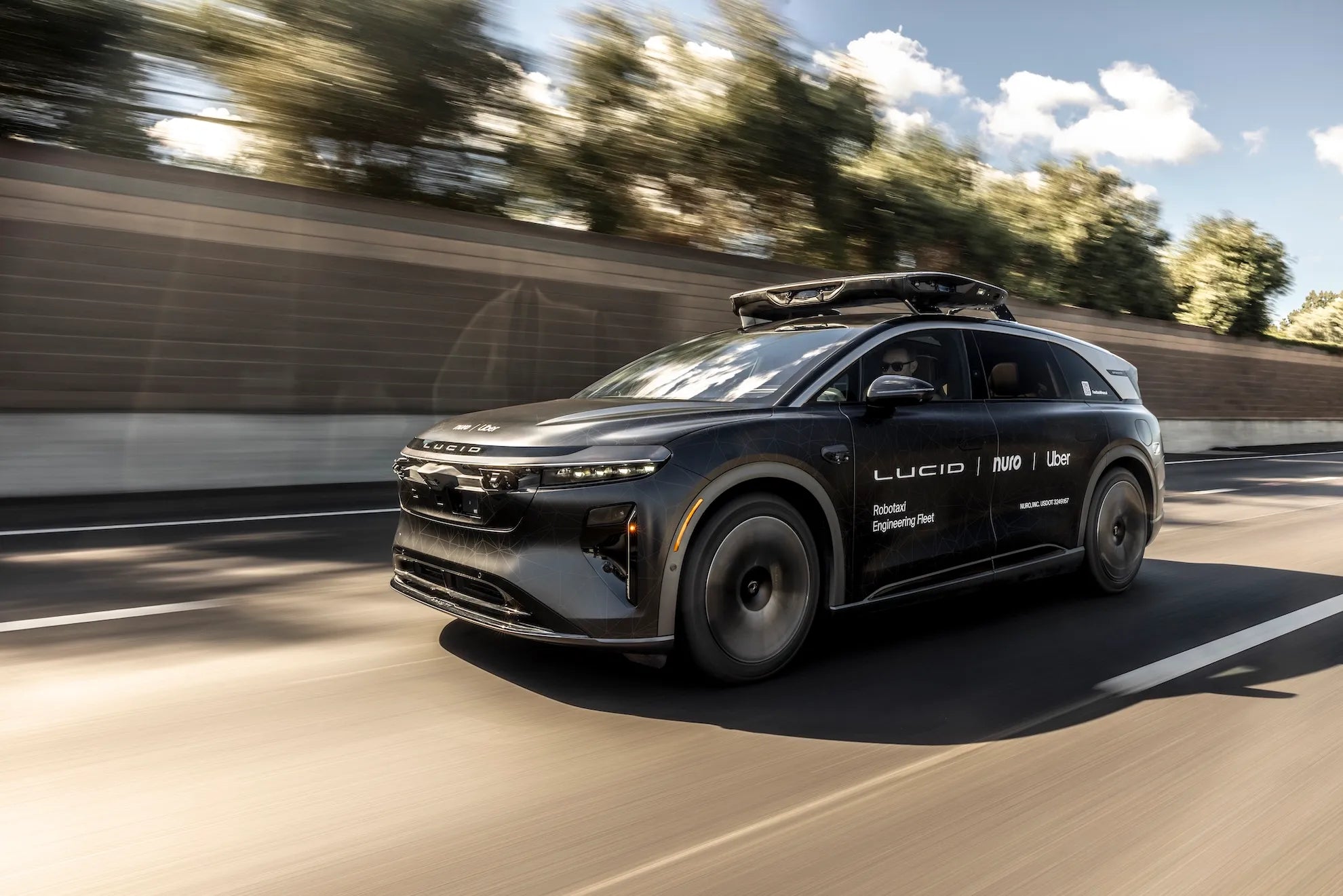
A robotaxi program based on the Lucid Gravity SUV has secured key California testing approvals ahead of a planned commercial rollout later this year. The permits allow autonomous driving company Nuro to expand real-world testing with and without onboard safety operators, putting the Lucid-Uber partnership further along in California’s regulatory process than several competing efforts.
The approvals are especially notable because some major autonomous vehicle developers, including Tesla, still do not hold California permits for fully driverless passenger testing.

California Grants Two Important Testing Permits
Nuro announced that it recently obtained authorization from the California Public Utilities Commission (CPUC) to transport passengers in autonomous test vehicles while a safety monitor remains inside the cabin.
That approval follows a separate permit issued earlier by the California Department of Motor Vehicles (DMV), allowing Nuro to operate driverless test vehicles on public roads without a human safety driver behind the wheel.
Although the company cannot yet charge customers for rides, these permits represent critical milestones in California’s autonomous vehicle approval system. Companies typically move through multiple stages of testing before regulators authorize commercial driverless operations.
Nuro’s testing activity involving the Lucid Gravity platform is currently approved in Santa Clara County and San Mateo County.
Lucid, Uber and Nuro Aim for Commercial Launch
The robotaxi initiative is built around a three-company alliance involving Lucid Motors, Nuro, and Uber.
Under the arrangement, Lucid provides the electric vehicles, Nuro contributes the autonomous driving system, and Uber integrates the service into its ride-hailing platform.
The companies plan to introduce autonomous ride services in San Francisco before the end of the year. Uber has already committed significant financial support to the project, including a reported $500 million investment in Lucid and plans to purchase at least 35,000 Lucid vehicles for future fleet deployment.
The fleet is expected to include both the Gravity SUV and additional EVs based on Lucid’s future midsize platform.
Once approved for commercial operation, riders would be able to request the autonomous vehicles directly through the Uber app.
California Remains a Difficult Market for Robotaxis
California continues to serve as one of the most tightly regulated testing environments for autonomous vehicles in the United States.
State agencies require companies to demonstrate vehicle safety under a wide variety of operating conditions before allowing fully driverless commercial deployments. Current testing permissions for the Lucid Gravity robotaxis include operation on dry and wet pavement, as well as limited use during light rain and moderate fog conditions.
Testing speeds are restricted to a maximum of 45 miles per hour.
Several autonomous vehicle developers are currently active in California, including Waymo, Zoox, and WeRide. Among them, Waymo remains the only company operating large-scale paid driverless ride services in parts of the Bay Area.
For newer entrants, obtaining regulatory approval in California is often viewed as a major credibility milestone because of the state’s extensive oversight requirements.
Tesla Still Lacks Driverless Testing Approval in California
The development also highlights the different regulatory positions of competing robotaxi programs.
Tesla currently operates supervised robotaxi services in California using Model Y vehicles with onboard safety personnel. However, the company does not yet hold a California DMV permit allowing fully driverless passenger testing without a human monitor.
Earlier reports from state officials indicated that Tesla had not submitted an application for driverless testing authorization as of February. More recent comments from California regulators reportedly confirmed that no new application had been received.
Tesla has instead focused part of its autonomous testing strategy on Austin, Texas, where state-level regulations for autonomous vehicles are generally less restrictive than California’s framework.
The contrast underscores how autonomous vehicle companies are increasingly choosing different regulatory paths depending on deployment speed, operational complexity, and market priorities.
Robotaxi Competition Is Accelerating Across the Industry
Autonomous ride-hailing services are becoming a major focus area for both automotive and technology companies.
Supporters argue that robotaxis could reduce traffic accidents by limiting human driving errors while also lowering long-term transportation costs. At the same time, companies see autonomous mobility services as a potential source of recurring revenue beyond traditional vehicle sales.
For Lucid, the partnership offers an opportunity to expand beyond premium consumer EVs and enter commercial mobility services. For Uber, autonomous fleets could eventually reduce dependence on human drivers in selected urban markets.
Whether these systems can scale profitably remains uncertain, but California’s latest permits move the Lucid Gravity robotaxi project significantly closer to public deployment.

FAQ
What permits did the Lucid Gravity robotaxi program receive?
Nuro obtained a California DMV permit for fully driverless road testing and a CPUC permit allowing passenger testing with a safety monitor onboard.
Can the Lucid robotaxis already offer paid rides?
No. The vehicles are currently authorized only for testing purposes. Commercial paid ride operations still require additional regulatory approval.
Which companies are involved in the Lucid robotaxi project?
The program is a partnership between Lucid Motors, Nuro, and Uber. Lucid supplies the EVs, Nuro develops the autonomous system, and Uber handles ride-hailing integration.
Where are the robotaxis being tested?
Testing is currently approved in parts of Santa Clara County and San Mateo County in California.
Does Tesla have the same California permits?
No. Tesla operates supervised robotaxi testing in California but does not currently hold a DMV permit for fully driverless passenger testing without a safety operator.
Why is California approval important for robotaxi companies?
California has some of the strictest autonomous vehicle regulations in the United States. Securing testing permits there is often viewed as a significant step toward commercial deployment.
Recommend Reading: Uber Turns to Lucid Gravity for Its Next Wave of Autonomous Ride Services


Share:
Tesla Semi Battery Size and Range Details Revealed
Chinese EV Brands Begin Expanding Into Canada After Tariff Cuts