





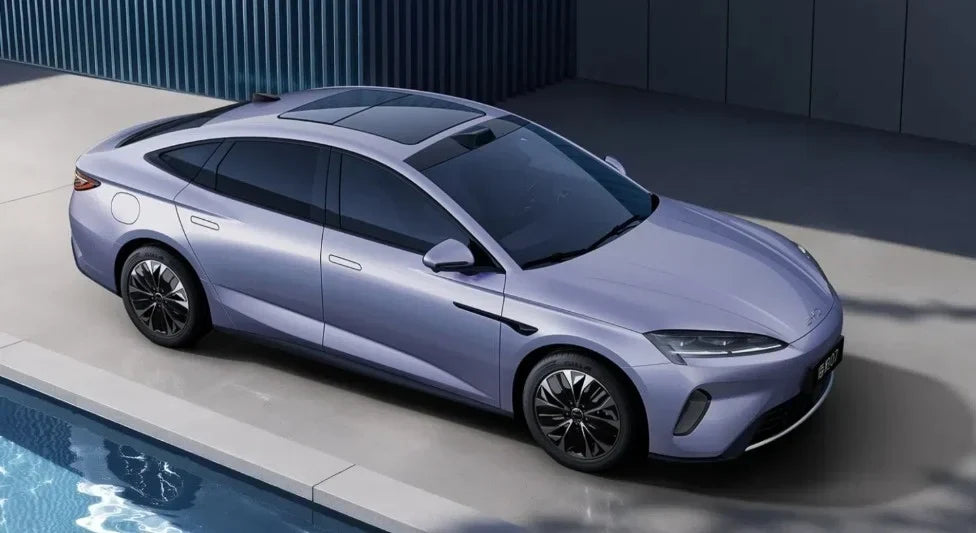
Hongqi has introduced an experimental EV battery that reportedly charges from 10% to 97% in just over eight minutes, highlighting how rapidly ultra-fast charging technology is advancing in China. Although the battery has not yet been announced for production vehicles, its test results place Hongqi among the industry's leading developers of high-power charging systems.
Hongqi Reports New Ultra-Fast Charging Breakthrough
China's Hongqi, a premium brand under FAW Group, has announced a new experimental battery capable of extremely short charging times during laboratory testing.
According to the company, the battery increased its state of charge from 10% to 70% in 3 minutes and 41 seconds under controlled conditions. The charging session continued to 97% in just 8 minutes and 3 seconds, demonstrating sustained charging performance well beyond the initial fast-charging window.
If these figures can eventually be replicated in production vehicles, the technology would represent another major step toward reducing charging times to levels approaching conventional refueling.
For now, however, Hongqi has not announced a production timeline or identified which future vehicle could receive the new battery system.
High Charging Rates Are Achieved Through Multiple Improvements
Hongqi says the battery was jointly developed with Lishen Battery, combining several engineering changes designed to support extremely high charging currents.
The company reports that the battery reaches a peak charging rate of 12C, meaning it can theoretically charge at up to twelve times its total capacity. For comparison, an 80 kWh battery operating at 12C would require charging power approaching 960 kW.
To support these charging speeds, engineers reportedly introduced a redesigned anode, a new electrolyte formulation, and an upgraded carbon coating process to lower internal electrical resistance.
Thermal management also plays an important role. During testing, Hongqi stated that its liquid cooling system limited the temperature variation across the battery pack to approximately 5.4°F (3°C), helping maintain charging performance while reducing thermal stress.
The Battery May Support FAW's Future 1,000V Platform
Although Hongqi has not confirmed how the battery will be commercialized, its announcement aligns with FAW's previously disclosed plans for next-generation EV technology.
The company has already announced that it is developing a 1,000-volt electric vehicle architecture capable of charging a battery to 80% in around five minutes. While Hongqi has not officially linked the newly tested battery to that platform, the charging performance reported in the latest demonstration suggests the two development programs could be closely related.
Several important technical details remain unknown. Hongqi has not disclosed the battery's capacity, cell chemistry, or maximum charging power, making it difficult to compare the technology directly with commercially available battery systems.
As a result, the latest announcement should currently be viewed as a demonstration of engineering capability rather than confirmation of an upcoming production vehicle.
China's Charging Competition Continues to Accelerate
Hongqi's announcement reflects a broader trend across China's electric vehicle industry, where automakers and battery suppliers are competing to reduce charging times through increasingly powerful charging systems.
Over the past two years, manufacturers have rapidly moved beyond the earlier benchmark of five-minute fast charging. Companies are now competing to shorten charging sessions even further while maintaining battery durability and thermal stability.
Rather than focusing only on larger battery capacity or longer driving range, Chinese manufacturers are increasingly treating charging speed as a key area of technological competition. The latest Hongqi battery demonstrates that ultra-fast charging continues to evolve quickly, even though many of these systems have not yet entered large-scale commercial production.
BYD, CATL and Geely Continue Raising the Standard
Hongqi is entering an increasingly competitive field where several Chinese automakers and battery suppliers have recently introduced their own ultra-fast charging technologies.
BYD has already demonstrated its Super e-Platform, capable of supporting charging power of up to 1,000 kW. In a production Han L sedan, the system reportedly replenished more than 50% of the battery in under five minutes, with the company claiming drivers could recover nearly 250 miles of CLTC driving range during a similarly short charging stop.
Battery manufacturer CATL has announced even faster laboratory figures for its third-generation Shenxing LFP battery. According to the company, the pack can increase from 10% to 80% in 3 minutes and 44 seconds, then reach 98% in 6 minutes and 27 seconds. CATL also says the battery retains more than 90% of its original capacity after 1,000 ultra-fast charging cycles, suggesting durability remains a priority alongside charging speed.
Meanwhile, Geely continues to expand its high-power charging portfolio. The Lynk & Co 10 reportedly completed a 10% to 70% charge in 4 minutes and 22 seconds, reaching 97% after 8 minutes and 42 seconds, while briefly drawing approximately 1,100 kW. Another Geely brand, Zeekr, has pushed peak charging power even higher, with an updated Zeekr 001 exceeding 1.3 MW during testing while charging from roughly 4% to 80% in less than seven minutes.
Ultra-Fast Charging Is Expanding Beyond Passenger EVs
The rapid pace of charging innovation is no longer limited to consumer vehicles.
CATL recently introduced a new battery designed for commercial transportation, claiming it can charge from 20% to 80% in less than seven minutes, with a full recharge requiring only about two additional minutes. These developments indicate that ultra-fast charging is becoming a broader industry objective across multiple vehicle segments.
Although Hongqi's latest battery has not yet appeared in a production model, its announcement reflects how aggressively Chinese manufacturers are pursuing shorter charging times. Each new demonstration raises expectations for future EVs, even if many of the technologies remain in the validation stage.
The current competition is no longer focused solely on increasing driving range. Instead, manufacturers are increasingly treating charging speed, thermal control, battery longevity, and high-voltage system integration as equally important factors in next-generation EV development. As additional production vehicles adopt these technologies, charging convenience may become one of the defining competitive advantages in the global electric vehicle market.
FAQ
How fast can Hongqi's new EV battery charge?
According to Hongqi, the experimental battery charged from 10% to 70% in 3 minutes and 41 seconds and reached 97% in 8 minutes and 3 seconds during controlled testing.
Is Hongqi's ultra-fast charging battery available in production vehicles?
No. Hongqi has not announced a production model, launch schedule, or commercialization timeline. The battery has only been demonstrated under test conditions.
What does a 12C charging rate mean?
A 12C charging rate means the battery can theoretically accept charging power equal to twelve times its capacity. For an 80 kWh battery, that would correspond to a peak charging power of approximately 960 kW.
Which Chinese companies are leading ultra-fast EV charging development?
Several companies are advancing high-power charging technology, including Hongqi, BYD, CATL, Geely, Lynk & Co, and Zeekr. Their latest systems demonstrate charging power ranging from roughly 960 kW to over 1.3 MW, although commercialization varies by manufacturer.
Why is faster charging becoming an industry priority?
Reducing charging time improves the practicality of electric vehicles by shortening stops during long-distance travel. Automakers are increasingly competing to deliver higher charging speeds while maintaining battery safety, cooling performance, and long-term durability.
Recommend Reading:Shell EV Concept Showcases New Battery Cooling Technology


Share:
Rivian R2 Charging Test Results
Future Mazda MX-5 Electric Plans