





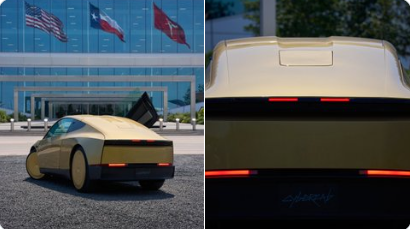
Tesla has shown the first physical Cybercab equipped with a roof-integrated Starlink antenna, turning a previously announced concept into visible hardware. The company has not yet explained exactly how satellite connectivity will be used in commercial robotaxi operations or when the feature will become operational.
Tesla Shows the First Starlink-Equipped Cybercab
Tesla's official robotaxi account published two new images of a gold Cybercab parked at Gigafactory Texas, offering the first clear look at a production-style vehicle fitted with integrated Starlink hardware.
One image shows the vehicle from the front with its door raised, while the second provides a rear view that makes the low-profile satellite antenna visible on the roof. The Cybercab badge can also be seen at the back.
Tesla provided only a brief caption confirming that the vehicle includes Starlink integration. No specifications were released, and the company did not disclose antenna performance, data speeds, power consumption, or how the connection will be used during daily robotaxi service.
The reveal follows an earlier announcement in July, when Tesla and Starlink showed a technical illustration indicating that satellite internet would be built directly into the Cybercab. The latest images are significant because they show that the concept has moved beyond a rendering and into a physical vehicle.
Starlink Is Not Required for Autonomous Driving
The most important unanswered question is why the Cybercab needs a satellite connection at all.
Tesla's autonomous driving system runs primarily on onboard computing hardware. The vehicle's driving decisions are processed locally rather than depending on a continuous internet connection, meaning Starlink is not required for basic autonomous operation.
That makes the feature less essential in the urban areas where Tesla's robotaxi program is currently focused. Markets such as Austin, Houston, Dallas, and Miami already have extensive cellular coverage, which can support functions such as fleet monitoring, remote communication, software updates, and operational support.
Tesla has indicated that satellite connectivity could become useful when vehicles operate in locations with weaker cellular coverage. In that context, Starlink could provide an additional communication layer for tracking or supporting vehicles outside dense urban environments.
However, Tesla has not confirmed whether that is the primary purpose of the system.
Cybercab Production Is Moving Ahead
Tesla originally introduced the Cybercab in October 2024 as a two-seat autonomous vehicle designed without a steering wheel or pedals. The company previously indicated a target price of around $30,000, positioning it as a lower-cost vehicle intended specifically for robotaxi service.
Production activities began at Gigafactory Texas earlier this year, and more than 100 units had reportedly appeared in factory storage areas by July.
Even so, the Cybercab is not yet operating as a fully unsupervised commercial robotaxi. Tesla still faces regulatory and operational limitations, and current autonomous services continue to involve human oversight in some form.
That means the company is building vehicles while several parts of the commercial deployment model remain unresolved.
Satellite Connectivity Could Add New Capabilities
Starlink could eventually provide advantages if Tesla expands robotaxi operations beyond major cities.
For vehicles traveling through rural regions, highways, or areas with inconsistent cellular coverage, satellite connectivity could improve communication reliability. A persistent connection could support fleet diagnostics, vehicle tracking, remote assistance, data transmission, or other operational functions.
The technology could also give Tesla more flexibility if future robotaxi routes extend between cities rather than remaining within tightly defined urban zones.
At the same time, adding satellite hardware introduces additional complexity. A roof-mounted antenna adds equipment cost, vehicle weight, and potentially ongoing connectivity expenses. Those factors matter for a vehicle Tesla intends to manufacture at relatively low cost and deploy at scale.
The Business Relationship Also Draws Attention
The integration is notable because Starlink is operated by SpaceX, another company led by Elon Musk.
That relationship has prompted questions about whether Starlink connectivity is being added primarily because it provides operational value to Tesla or because closer integration between Musk's companies creates strategic advantages for both businesses.
The images alone do not answer that question.
Tesla has not disclosed whether every Cybercab will receive Starlink hardware, whether connectivity will be optional, or how much the service would cost. It has also not explained whether satellite access will be necessary for future commercial operation.
For now, the new Cybercab demonstrates that Tesla is physically integrating Starlink into at least some vehicles. Whether the technology becomes essential to the robotaxi network—or remains a backup connectivity tool—will depend on how and where Tesla ultimately deploys autonomous transportation.
FAQ
Why does the Tesla Cybercab have Starlink?
Tesla has not provided a complete explanation. Satellite connectivity could support vehicle tracking, remote communication, diagnostics, or fleet operations in areas where cellular coverage is limited.
Does the Cybercab need Starlink to drive autonomously?
No. Tesla's autonomous driving system relies on onboard computing hardware to process driving decisions. An internet connection is not required for the vehicle's core driving functions.
Where was the Starlink-equipped Cybercab shown?
The vehicle was photographed at Gigafactory Texas. Tesla's robotaxi account published images showing the integrated antenna mounted on the roof.
Is the Cybercab already operating without human supervision?
Not yet at full commercial scale. Tesla continues developing its robotaxi service, but current operations still involve regulatory restrictions and human oversight in some markets.
Will every Cybercab include Starlink?
Tesla has not confirmed whether the satellite antenna will be standard across all Cybercabs. The company has also not announced pricing, subscription details, or technical specifications for the integration.
Recommend Reading: Tesla FSD Subscribers Reach 1.5 Million


Share:
Ford Fathom EV Truck: Price, Range and Launch
Tesla Plans $10.1B Texas Solar Cell Factory