





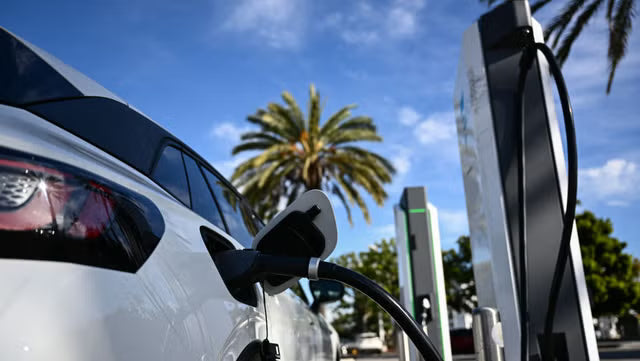
Electric vehicle sales in the United States declined in early 2026, yet charging infrastructure continued to expand with more than 3,300 new fast-charging ports added in Q1. This suggests long-term investment in EV adoption remains intact despite short-term market softness.

Charging Network Expansion Remains Steady
Data from charging analytics firm Paren shows that between January and March, operators activated 3,387 new DC fast-charging connectors across the country. During the same period, 617 new charging sites were brought online, bringing the national total to 13,708 stations and 73,394 fast-charging ports.
This pace of deployment closely matches the first quarter of the previous year, when just over 3,300 ports were added. Importantly, utilization rates have held steady, indicating that existing EV drivers are consistently using the growing network. In other words, demand is keeping up with supply rather than lagging behind.
Shift Toward Expanding Existing Sites
The way charging infrastructure is being built is evolving. Instead of focusing primarily on opening new locations, companies are increasingly adding more chargers to sites that are already operational.
This strategy reflects lessons learned from earlier rollouts. Expanding known locations can reduce permitting delays, improve maintenance efficiency, and deliver a more reliable user experience. As a result, network reliability has improved to roughly 90–95% uptime, compared with 85–92% in the previous year.
Another notable trend is the emphasis on higher-powered equipment. Most new installations now support charging speeds above 250 kW, enabling significantly faster charging sessions and better supporting long-distance travel.
Pricing Stability Amid High Fuel Costs
While infrastructure grows, pricing has remained relatively stable. Across most networks, drivers are paying between $0.45 and $0.55 per kilowatt-hour, a range that has changed little compared to last year.
This stability comes at a time when gasoline prices remain elevated nationwide. As a result, the cost of public charging is under closer scrutiny, especially for drivers comparing EV ownership with traditional vehicles.
Market Share and Industry Competition
Tesla continues to dominate the U.S. fast-charging landscape, but its share of new installations has declined. In the first quarter, the company added 880 new ports, accounting for 26% of total deployments. This marks a noticeable drop from previous periods, when its contribution exceeded 40%.
Other players are gaining ground. Ionna, a network backed by several major automakers, installed 278 ports, while Red E followed closely with 264 new connectors. This diversification suggests a more competitive and less centralized charging ecosystem is emerging.
Connector Standards and Technology Trends
Connector preferences remain heavily skewed toward CCS1, which continues to dominate non-Tesla networks. In Q1 alone, operators installed 2,102 CCS1 connectors, compared to 606 ports using Tesla’s NACS standard.
Interestingly, 154 CHAdeMO connectors were also added, despite the standard’s declining relevance. Although older models like early Nissan EVs still rely on it, most automakers have moved away from CHAdeMO in favor of newer systems.
Despite the growing presence of vehicles equipped with NACS ports, CCS1 still leads in infrastructure availability. However, recent quarters show a gradual increase in NACS adoption, while CHAdeMO installations continue to taper off.
EV Sales Slowdown vs. Long-Term Infrastructure Strategy
While charging networks expand, vehicle sales tell a different story. U.S. EV sales fell by 27% year-over-year in the first quarter, reflecting a cooling market influenced by shifting policies and reduced incentives.
Even so, infrastructure providers are not scaling back. One reason is timing: building charging stations often requires months or even years of planning, permitting, and construction. As a result, companies cannot easily pause or reverse projects in response to short-term market fluctuations.
More importantly, there is still a growing base of EVs already on the road that require reliable charging access. Operators are also preparing for future demand, anticipating that EV adoption will eventually accelerate again.
Outlook for the Charging Ecosystem
The divergence between slower EV sales and steady infrastructure growth highlights a key dynamic in the industry. Charging companies are investing with a long-term perspective, prioritizing network readiness over immediate returns.
If EV adoption rebounds, the expanded charging network will be critical in supporting that growth. Conversely, if demand remains uneven, operators may face pressure to optimize costs and improve utilization further.
For now, the data suggests that while the pace of EV purchases may fluctuate, the foundation supporting electrification continues to strengthen.

FAQ
Why are EV charging stations increasing while sales are down?
Charging projects are planned years in advance, so companies continue building infrastructure despite short-term sales declines. There is also ongoing demand from existing EV owners.
How many fast chargers were added in the U.S. in Q1 2026?
A total of 3,387 new DC fast-charging ports were installed, along with 617 new stations, according to Paren.
What is the average cost of fast charging in the U.S.?
Most public fast chargers currently cost between $0.45 and $0.55 per kWh, with prices remaining stable compared to the previous year.
Which charging connector is most common?
CCS1 remains the dominant standard in non-Tesla networks, although NACS adoption is increasing as more automakers transition to it.
Is Tesla still leading in charging infrastructure?
Yes, Tesla added the most new ports in Q1, but its share dropped to 26%, indicating growing competition from other providers.
Recommend Reading: EV Charging Expansion: Ionna and Circle K Announce Nationwide Rollout







Share:
When Will Rivian R2 Deliveries Start and What to Expect
Do EV Batteries Lose Range Over Time? New Data Explained