





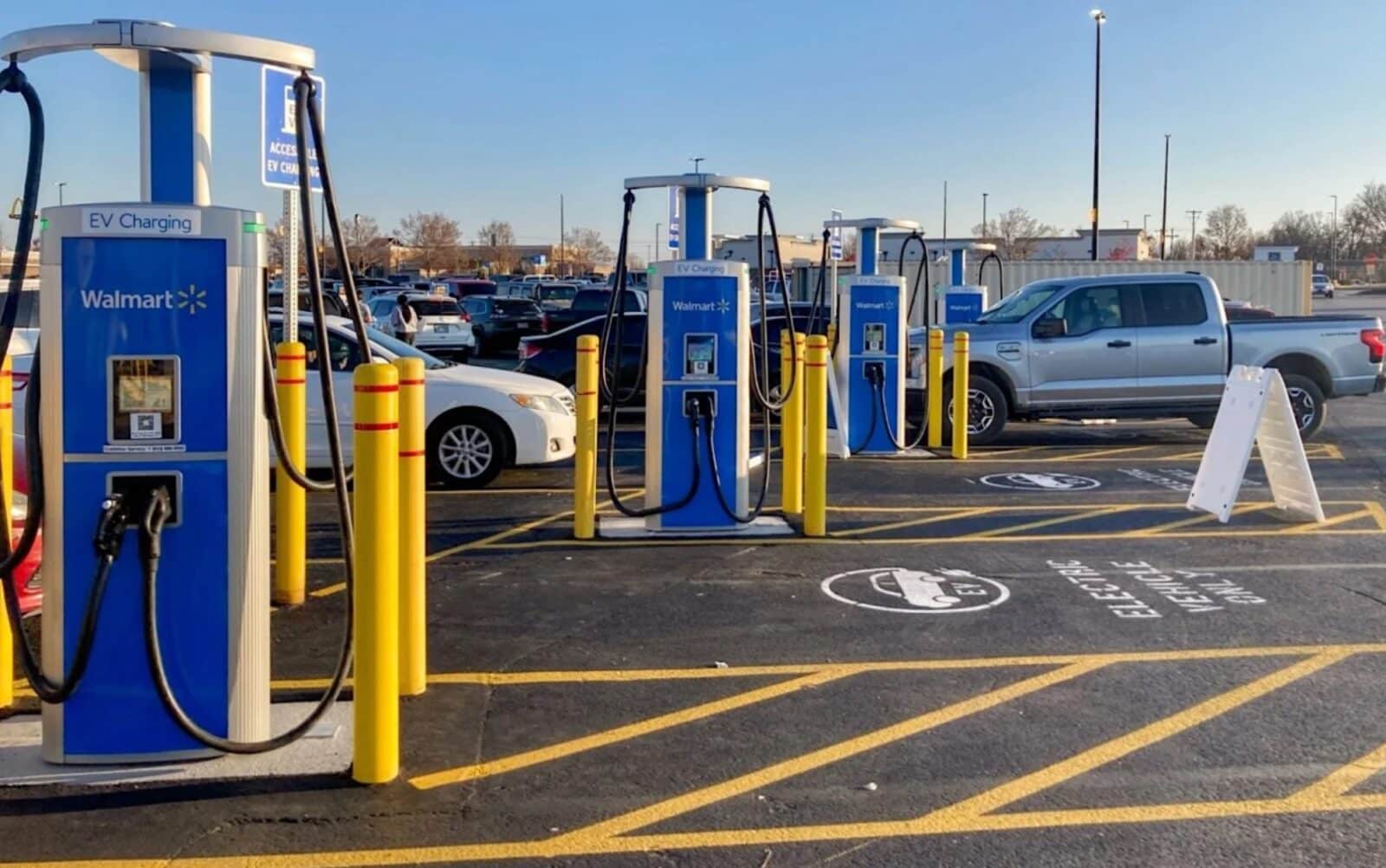
Walmart is rapidly expanding its electric vehicle charging network, adding new fast-charging locations across the United States at a pace that highlights its long-term commitment to EV infrastructure. In just over a year, the retailer has grown from a newcomer in public charging to one of the country's fastest-expanding charging providers, with additional sites expected in the coming months.

Walmart Accelerates Its Charging Rollout
Walmart continues to increase the number of EV charging stations available at its stores, strengthening its presence in the public charging market. Community-tracked data indicates that the retailer now operates 73 charging locations across 17 U.S. states, providing approximately 612 individual charging connectors. Meanwhile, the U.S. Department of Energy's Alternative Fuels Data Center currently lists 66 sites with 528 charging ports, although government databases often trail newly opened locations.
Regardless of the reporting source, the trend is clear: Walmart is steadily expanding its charging footprint and investing in nationwide accessibility for electric vehicle drivers.
Rapid Growth Since the Network Launch
The company's charging initiative officially launched in April 2025, marking Walmart's direct entry into the DC fast-charging market. Since then, expansion has progressed at a notable pace.
Only a few months ago, Walmart's network consisted of just over 300 charging connectors across roughly 50 stores. Within approximately two months, that number nearly doubled, demonstrating how quickly new locations are being deployed.
This rapid buildout reflects Walmart's broader strategy of integrating charging services into its existing retail ecosystem. Because thousands of Walmart stores already serve as convenient shopping destinations with extensive parking, they offer natural locations for drivers to recharge while completing everyday errands.
High-Power Charging Designed for Multiple EV Standards
Rather than installing lower-powered equipment, Walmart has standardized its network around 400-kilowatt DC fast chargers, enabling compatibility with both current and future high-performance electric vehicles.
The charging hardware comes from established manufacturers including ABB and Alpitronic. Each charging stall includes two connector options:
- CCS for many existing battery-electric vehicles
- NACS, the charging standard that is rapidly being adopted across North America
Supporting both connector types allows Walmart to serve a broader range of drivers without requiring adapters in many situations. As more automakers transition toward NACS compatibility, this dual-connector approach may help the network remain useful throughout the industry's ongoing charging standard transition.
Digital Payments Remain the Primary Experience
Charging sessions are currently managed mainly through Walmart's mobile application. Drivers can locate chargers, begin charging sessions, and complete payments directly from the app.
The retailer is also testing chargers equipped with integrated credit card readers, making the service more accessible for customers who prefer not to use a smartphone application. However, there is an incentive to continue using the digital platform.
Customers enrolled in Walmart+ receive a 10% charging discount when paying through the mobile app. Drivers choosing to pay directly by credit card at compatible stations will generally not receive that membership benefit.
Competitive Pricing Supports Broader Adoption
Charging costs vary by location, but Walmart's network currently averages around $0.46 per kilowatt-hour. Some stations also offer lower pricing during off-peak hours, providing additional savings for drivers who can charge outside peak demand periods.
When off-peak rates are combined with the Walmart+ membership discount, customers may reduce charging costs by as much as $0.20 per kilowatt-hour. While pricing differs across regions, this approach allows Walmart to compete not only on convenience but also on affordability.
A Long-Term Investment in EV Infrastructure
Walmart's continued expansion comes at a time when some industry forecasts predict slower EV adoption in the United States over the next several years. Despite that uncertainty, the retailer has shown no indication of slowing its charging investments.
Instead, Walmart appears to be positioning its stores as convenient charging destinations capable of serving both existing EV owners and future buyers. The company has previously outlined ambitions to install thousands of fast chargers across its nationwide retail network, leveraging its extensive store footprint to improve charging accessibility.
If that rollout continues at its current pace, Walmart could become one of the country's largest public charging providers. Its combination of widespread retail locations, high-power charging equipment, and integrated shopping experience may strengthen its role as demand for convenient public charging continues to grow.
Although overall EV market growth may fluctuate from year to year, investments in charging infrastructure remain a critical part of supporting long-term vehicle adoption. Walmart's latest expansion suggests the retailer sees charging not as a short-term initiative, but as a strategic service that complements its broader business.

FAQ
How many EV charging locations does Walmart currently operate?
Community-tracked data indicates Walmart has approximately 73 charging locations across 17 U.S. states, while the U.S. Department of Energy currently lists 66 locations. The difference is largely due to reporting timelines and database updates.
What type of chargers does Walmart use?
Walmart installs 400-kW DC fast chargers manufactured by ABB and Alpitronic. Each charging stall provides both CCS and NACS connectors to support a wide range of electric vehicles.
How much does charging at Walmart cost?
The average charging price is about $0.46 per kWh, although rates vary by location. Some stations also offer off-peak pricing, and Walmart+ members can receive additional discounts when paying through the mobile app.
Can drivers pay without using the Walmart app?
Yes. Walmart is testing chargers equipped with built-in credit card readers. However, customers paying by card generally do not receive the 10% Walmart+ charging discount available through the app.
Does Walmart plan to expand its charging network further?
Yes. Walmart has stated that it intends to install thousands of fast chargers across more stores in the future, making EV charging available at a much larger portion of its retail locations.
Recommend Reading: Walmart to Launch Thousands of EV Charging Stations by 2030










Share:
Why U.S. EV Adoption Is Slowing in 2026