





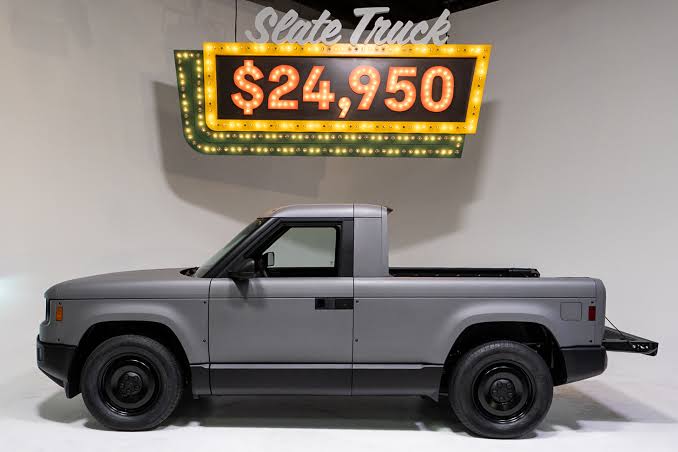
Slate Auto's upcoming electric pickup is built around one core idea: reducing the cost of vehicle ownership by removing many features consumers have come to expect. With a starting price of $24,950, the startup is testing whether affordability can outweigh demand for longer range, advanced technology, and premium equipment.

A New EV Focused on Cost Above Everything Else
Vehicle prices in the United States have climbed steadily over the past several years, pushing monthly payments and loan balances to record levels. Against that backdrop, Slate Auto believes there is room for a radically simplified vehicle designed primarily around affordability.
The company's first model, scheduled to begin deliveries later this year, enters the market as one of the least expensive new electric vehicles available. Rather than competing directly with feature-rich electric crossovers and trucks, Slate is positioning its product as a practical transportation tool for buyers who prioritize price.
The strategy is unusual in a market where manufacturers have increasingly added technology, luxury features, and larger batteries to justify higher sticker prices.
What Buyers Get for Under $25,000
The entry-level version is intentionally minimalist. It comes with two doors, two seats, steel wheels, and a compact pickup body. Many features that have become common across the industry are absent.
There is no large infotainment screen, built-in audio system, or extensive list of premium materials. Exterior customization through factory paint is also unavailable. Instead, every truck leaves production wearing the same molded gray finish integrated into its body panels.
Dimensionally, the vehicle is significantly smaller than many modern pickups. Measuring 174.6 inches in length, it occupies less space than compact trucks currently on sale while still offering a five-foot cargo bed and additional front storage space.
The compact footprint could appeal to urban drivers, small businesses, and customers who find today's full-size trucks unnecessarily large.
Performance Targets Everyday Driving Needs
Despite its budget-oriented positioning, the truck is not designed to feel underpowered.
A rear-mounted electric motor produces 181 horsepower, providing the instant torque typically associated with electric vehicles. While it is not intended to compete with performance-focused EVs, the power output appears sufficient for daily commuting, local deliveries, and light-duty hauling.
The vehicle's smaller size may also contribute to a more agile driving experience compared with larger electric trucks that often exceed 6,000 pounds.
Ride comfort and handling are expected to prioritize practicality rather than sportiness, aligning with the truck's broader mission as an affordable utility vehicle.
Range Could Become the Biggest Test
One of the most important questions surrounding the Slate truck involves driving range.
The vehicle uses a 65-kWh lithium iron phosphate (LFP) battery pack, delivering an estimated 205 miles on a full charge. According to the company, that figure aligns with the daily travel habits of most American drivers.
For many commuters, 205 miles may provide several days of driving before needing to recharge. Fleet operators and local businesses may also find the range sufficient for predictable routes.
However, the broader EV market has moved toward larger battery packs and longer driving distances. Several competing electric vehicles offer significantly more range while also including additional passenger space and standard convenience features.
As a result, consumers will ultimately decide whether lower pricing compensates for the shorter driving distance.
Customization Is Central to the Business Model
Unlike traditional automakers, Slate is avoiding trim levels and option packages.
Instead, the company plans to build a growing ecosystem of accessories that owners can add whenever they choose. Buyers can start with a basic truck and gradually modify it over time.
Available upgrades include interior accessories, decorative exterior components, lighting enhancements, storage solutions, and vinyl wraps. More notably, Slate offers conversion kits that can transform the pickup into a multi-row SUV configuration.
The company says owners can either install many accessories themselves or seek professional installation assistance.
This modular approach allows customers to spread expenses over time rather than purchasing every feature upfront.
A High-Risk Experiment in the EV Industry
Slate's approach challenges several assumptions that currently shape the automotive market.
Most manufacturers have pursued larger vehicles, longer range figures, and increasingly sophisticated technology. Slate is moving in the opposite direction by emphasizing simplicity, lower acquisition costs, and user-driven customization.
The concept has generated substantial attention, with the company reporting more than 180,000 reservations since revealing the vehicle. Yet reservations alone do not guarantee long-term success.
The coming months will reveal whether consumers are willing to trade convenience features and extended range for a significantly lower purchase price. If enough buyers embrace that tradeoff, Slate could establish a new category within the EV market. If not, it may reinforce the industry's belief that consumers prefer more equipment, even at a higher cost.

FAQ
Why is the Slate electric truck attracting attention?
The vehicle starts at $24,950, making it one of the lowest-priced new EVs in the United States. Its focus on affordability differentiates it from most modern electric vehicles.
How much driving range does the Slate truck offer?
The truck is equipped with a 65-kWh battery and has an estimated range of 205 miles. The company believes this covers the needs of most daily drivers.
What features are missing from the base model?
The standard version excludes many common features, including a built-in infotainment system, factory audio equipment, and extensive luxury amenities. The design prioritizes cost reduction.
Can owners customize the vehicle later?
Yes. Slate's business model centers on post-purchase customization through a wide range of accessories and upgrade kits that can be added over time.
Who is the target customer for the Slate truck?
The vehicle may appeal to budget-conscious consumers, small businesses, fleet operators, and buyers seeking a compact electric utility vehicle rather than a premium EV.
Are reservations a guarantee of sales success?
No. Vehicle reservations indicate interest, but actual market performance depends on how many customers complete their purchases after production begins.
Recommend Reading: Jeff Bezos-Backed Slate Auto Raises New Capital for Low-Cost Electric Truck Program










Share:
BMW iX5 Battery Capacity Sets New Benchmark