





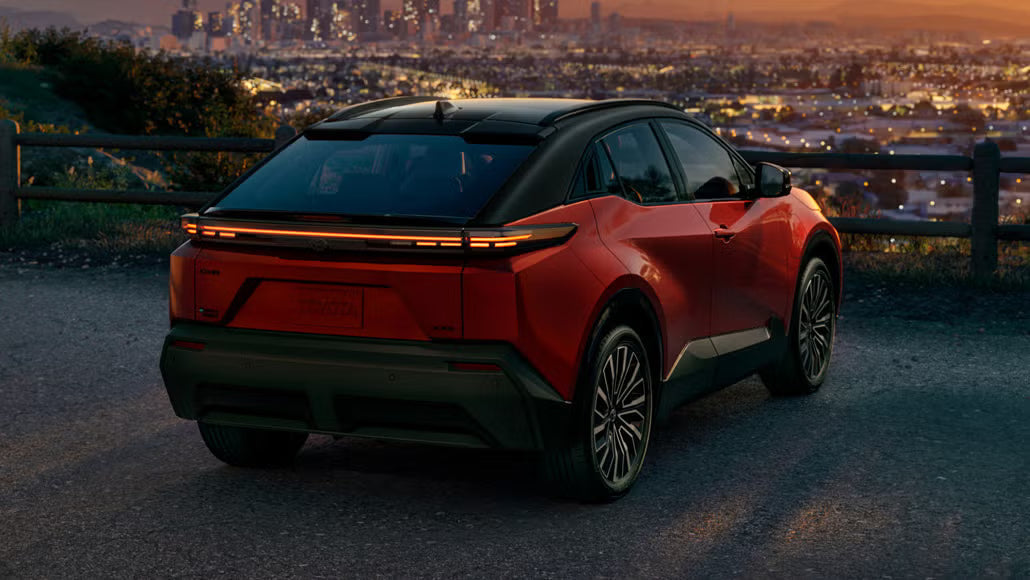
Toyota has become one of the fastest-growing electric vehicle brands in the United States, with EV sales jumping 136% in the first half of 2026. The increase was driven by a broader product lineup and improvements to the company’s existing battery-electric models.
The strong performance marks a significant shift for an automaker that was long criticized for moving cautiously on fully electric vehicles. With more than 21,800 EVs sold between January and June, Toyota has climbed into the top tier of U.S. electric vehicle sellers and overtaken several established competitors.

A Dramatic Turnaround for Toyota’s EV Business
Toyota’s electric sales momentum comes from a much stronger lineup than it had a year ago.
During the first half of 2025, the company offered only the Toyota bZ crossover in the U.S. market and sold just 9,249 EVs. By contrast, the first half of 2026 brought three battery-electric models: the updated bZ, the new bZ Woodland, and the compact C-HR EV.
According to data compiled by Cox Automotive, Toyota sold 21,855 electric vehicles during the first six months of 2026, more than doubling its year-earlier total.
The company’s rapid growth has pushed it ahead of brands such as Volkswagen, Rivian, Nissan, Kia, Honda, GMC, Ford, Cadillac, BMW, and Audi in U.S. EV sales rankings.
The Updated bZ Is Driving Most of the Growth
The bulk of Toyota’s electric sales still comes from the bZ crossover.
The model recorded 17,553 sales in the first half of 2026, nearly twice its volume from the same period in 2025. Toyota also sold more than 3,700 units of the new C-HR EV, while the remaining sales came from the recently launched bZ Woodland.
Toyota has not relied solely on adding new models. The company also upgraded the bZ with better driving range and faster charging performance, addressing two of the biggest weaknesses identified by early buyers and reviewers.
Those improvements appear to be helping the vehicle compete more effectively against newer electric crossovers from Hyundai, Chevrolet, and Tesla.
Toyota Is Growing While Some Rivals Scale Back
Toyota’s gains are particularly notable because they come during a period of softer overall EV demand in the United States.
Since the expiration of the federal EV tax credit and other supportive policies, several automakers have reduced production plans or trimmed their electric lineups. Industry demand has remained uneven as manufacturers adjust to a market with fewer nationwide incentives.
At the same time, some competitors have canceled or delayed key models. Ford has scaled back plans related to the F-150 Lightning, Volkswagen has reduced emphasis on the ID.4, and Nissan has cut back on the Ariya.
Toyota, by contrast, has expanded its EV offerings and continued investing in new products.
Cox Automotive Sees Toyota Becoming a Major EV Player
Market researchers say Toyota is no longer a fringe participant in the U.S. electric market.
In its latest analysis, Cox Automotive described Toyota as an increasingly significant EV seller and noted that the company now ranks among the top five electric vehicle brands in the United States.
The result is especially striking given Toyota’s previous reputation. For years, the automaker emphasized hybrids and plug-in hybrids while taking a more cautious approach to battery-electric vehicles. Many analysts viewed that strategy as evidence that Toyota was falling behind competitors that were launching multiple EV models.
The latest sales data suggests the company may be gaining traction much faster than expected.
New Models Could Sustain the Momentum
Toyota’s next wave of electric products may determine whether the company can maintain its current growth rate.
The bZ Woodland is positioned as a higher-utility crossover with wagon-like proportions, a body style that remains relatively rare in the U.S. EV market. Early interest in the model has been strong, and Toyota appears to see it as a key opportunity to attract buyers who want more cargo space and outdoor-oriented capability.
The company is also preparing a fully electric next-generation Highlander, which is expected to become a three-row EV aimed at larger families. Sales are currently targeted for early 2027 after a recent delay.
If those models launch successfully, Toyota could expand beyond the compact crossover segment and compete more directly with larger electric SUVs from Kia, Hyundai, and Tesla.
Incentives Still Matter
Despite the encouraging results, Toyota’s momentum is not guaranteed.
Manufacturer incentives have played an important role in boosting sales of the bZ, and future demand will depend partly on how aggressively Toyota continues supporting the model with discounts and financing offers.
Still, the company’s broader strategy appears clear: increase EV volume through a larger range of products rather than relying on a single flagship model.
For an automaker once viewed as a reluctant participant in the electric transition, the first half of 2026 represents a major shift in perception—and potentially the beginning of a much larger push into the U.S. EV market.

FAQ
How many EVs has Toyota sold in the U.S. in 2026?
Toyota sold 21,855 electric vehicles in the United States during the first half of 2026, according to Cox Automotive data.
Why did Toyota’s EV sales increase so much?
The growth was driven by the addition of the C-HR EV and bZ Woodland, along with improved range and charging performance for the existing bZ crossover.
Is Toyota now a major EV brand in the U.S.?
Yes. Cox Automotive says Toyota has become one of the top five EV sellers in the U.S. market, surpassing several competitors that were previously ahead of it.
Which Toyota EV is selling the best?
The Toyota bZ is the company’s best-selling electric vehicle, with 17,553 units sold during the first six months of 2026.
What new Toyota EVs are coming next?
Toyota plans to launch a fully electric next-generation Highlander in early 2027, expanding its EV lineup into the three-row SUV segment.
Recommend Reading: US EV Sales Recover as Market Adjusts After Tax Credit End


Share:
US EV Sales Recover as Market Adjusts After Tax Credit End
Tesla Sales Recovery Faces Its Next Big Test