





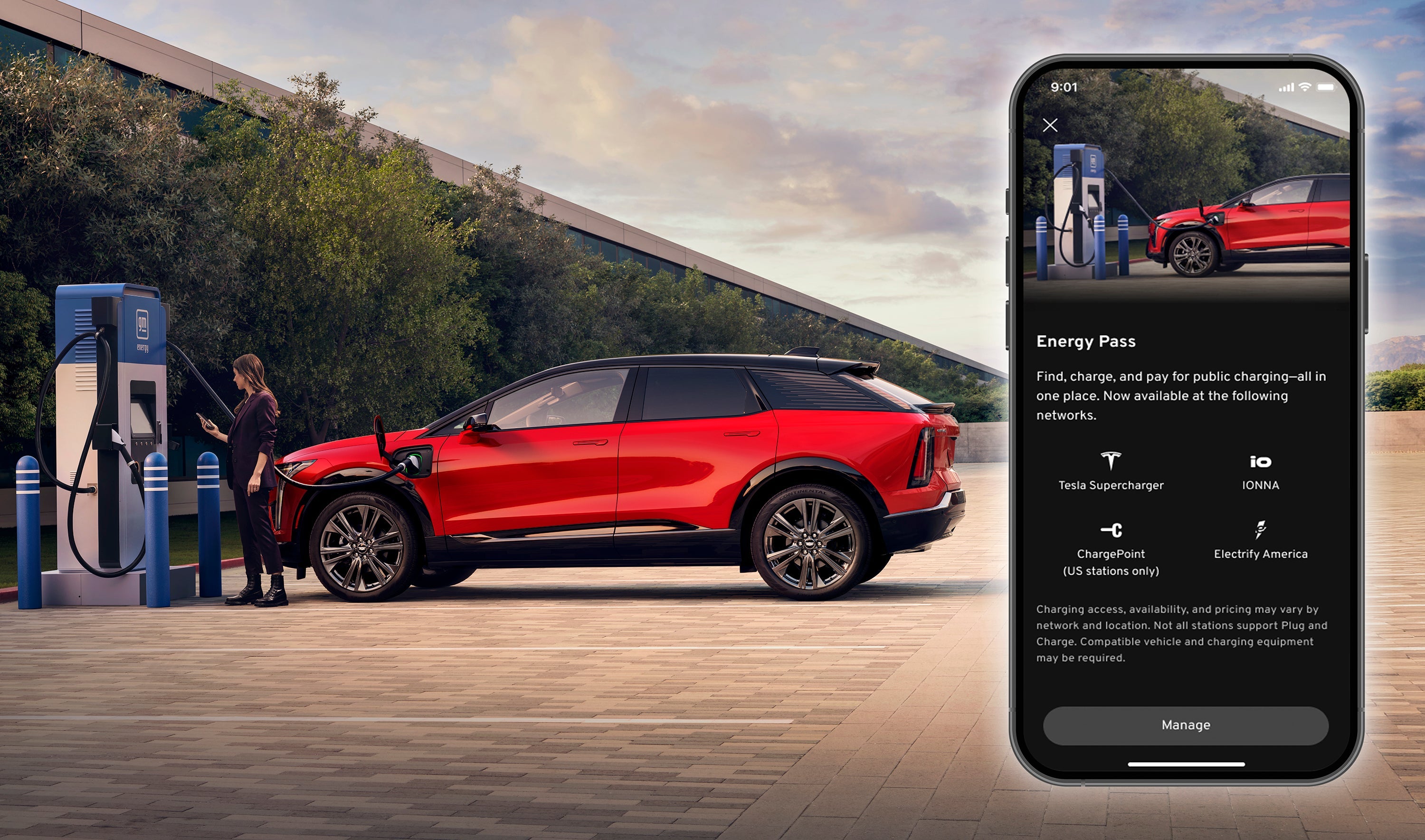
General Motors is simplifying public charging for EV owners by introducing Energy Pass, a unified charging platform that connects multiple major charging networks through a single account. At the same time, GM has confirmed that all of its 2027 electric vehicles will adopt the NACS charging port, further reducing charging complexity for customers.
Together, these changes represent one of the company's most significant efforts to streamline the EV ownership experience.

A Single Platform for Multiple Charging Networks
One of the biggest frustrations for electric vehicle drivers has been managing multiple charging accounts, payment methods, and smartphone applications. Depending on where they travel, drivers often need several different apps to access public charging stations.
GM's new Energy Pass system is designed to address that problem.
Integrated directly into the MyChevrolet, MyGMC, and MyCadillac mobile applications, Energy Pass allows drivers to access several major charging providers without creating separate accounts for each network.
At launch, the platform supports charging through Tesla Supercharger, Electrify America, and Ionna locations. Additional support for ChargePoint and EVgo is expected to follow.
According to GM, these participating networks collectively account for nearly 70% of the DC fast-charging infrastructure available across the United States, giving drivers access to a substantial portion of the country's public charging ecosystem through a single interface.
Charging Management Becomes More Centralized
Beyond network access, Energy Pass consolidates several charging-related functions into one platform.
Drivers can use the application to initiate charging sessions, monitor charging progress in real time, review past charging activity, and access payment records without switching between multiple services.
The system also provides access to network-specific benefits when available. For example, certain charging operators have begun offering discounted charging rates to GM EV owners who connect through the automaker's official applications.
By centralizing these tools, GM hopes to reduce the administrative friction that often accompanies public charging.
Plug & Charge Reduces Driver Interaction
Another key component of the rollout is expanded support for Plug & Charge technology.
Once a payment method is linked to a customer's account, compatible vehicles can automatically authenticate and begin charging when connected to a supported charger. This removes the need to manually start sessions through a mobile app, RFID card, or touchscreen interface.
Currently, Plug & Charge functionality is available at select Ionna and EVgo locations for eligible GM vehicles.
The company plans to broaden compatibility in the coming months. ChargePoint stations are expected to gain support, while Tesla Superchargers will eventually offer the same seamless charging process for GM vehicles equipped with factory-installed NACS connectors.
GM says an upcoming over-the-air software update will enable Plug & Charge capability at compatible Tesla charging locations later this year.
NACS Will Become Standard Across the Lineup
Alongside software improvements, GM is also making a major hardware transition.
The automaker confirmed that all future 2027 model-year electric vehicles from Chevrolet, GMC, and Cadillac will be equipped with the North American Charging Standard (NACS) connector instead of the older CCS1 charging port.
The move follows a broader industry trend as more automakers align with Tesla's charging standard to improve compatibility with the rapidly expanding Supercharger network.
Some GM vehicles have already begun the transition. The 2026 Cadillac Optiq and the next-generation Chevrolet Bolt are among the first models to receive factory-installed NACS ports.
Over the next several months, additional GM EVs will follow the same approach until the entire 2027 lineup adopts the standard connector.
Why the Changes Matter for EV Owners
While battery technology and charging speeds often receive the most attention, convenience remains one of the most important factors influencing EV ownership satisfaction.
Public charging can become complicated when drivers must navigate different apps, pricing structures, authentication methods, and charging standards. GM's latest strategy attempts to simplify those variables through both software integration and charging-port standardization.
A single account, broader Plug & Charge availability, and universal NACS adoption could make public charging more predictable and less time-consuming.
As EV adoption continues to grow, reducing complexity may prove just as important as increasing charging speed or expanding network coverage.
A Broader Shift Across the Industry
GM's announcement reflects a larger movement within the electric vehicle sector toward interoperability and ease of use.
Charging providers, automakers, and software developers are increasingly working toward systems that require fewer steps from drivers. The objective is straightforward: make charging an EV feel as effortless as possible.
With Energy Pass and the transition to NACS, GM is positioning itself within that trend, aiming to offer customers a more connected and streamlined charging experience across much of the U.S. charging landscape.

FAQ
What is GM Energy Pass?
Energy Pass is a charging management platform integrated into GM's mobile apps. It allows EV owners to access multiple charging networks using a single account and payment setup.
Which charging networks are supported by Energy Pass?
At launch, the platform works with Tesla Supercharger, Electrify America, and Ionna. Support for ChargePoint and EVgo is expected to be added as the rollout expands.
What is Plug & Charge?
Plug & Charge automatically identifies the vehicle and starts charging once it is connected to a compatible charger. Drivers do not need to manually initiate the session through an app or charging station screen.
Will all GM EVs switch to NACS?
GM has confirmed that all Chevrolet, GMC, and Cadillac electric vehicles for the 2027 model year will use the North American Charging Standard connector.
Why is NACS important?
NACS provides direct compatibility with Tesla's charging ecosystem and is becoming a widely adopted industry standard. This can improve charging access and reduce the need for adapters.
Recommend Reading: Android Auto Update Expands Across More Car Screens


Share:
Lucid Gravity Update Adds Hands-Free Driving
GM Sodium-Ion Battery Plans Target U.S. Energy Storage