





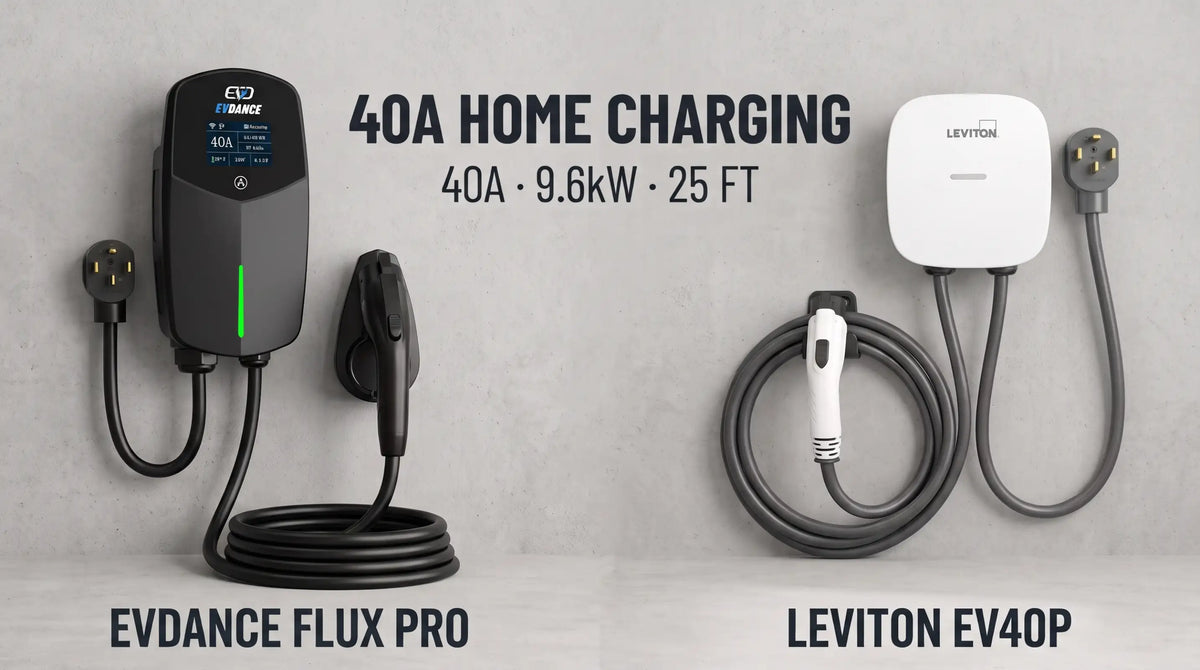
The EVDANCE Flux Pro and Leviton EV40P offer the same maximum charging power, but their displays, controls, connected features, warranties and prices create different ownership experiences.
Both are plug-in Level 2 home chargers with a maximum output of 40A and 9.6kW. They also use NEMA 14-50 plugs, J1772 vehicle connectors and 25-foot charging cables.
That makes this a relatively direct comparison. Charging power is unlikely to separate the two, so the more useful questions involve how each charger is controlled, what information it displays and which connected features fit the home.
This comparison focuses on the J1772 models. EVDANCE also offers a native NACS version of its 40A plug-in home charger, while the Leviton EV40P can charge NACS vehicles using Leviton’s separately sold NACSA adapter.
EVDANCE Flux Pro and Leviton EV40P at a Glance
| Feature | EVDANCE Flux Pro | Leviton EV40P |
|---|---|---|
| Maximum output | 40A / 9.6kW | 40A / 9.6kW |
| Input plug | NEMA 14-50 | NEMA 14-50 |
| Vehicle connector | J1772 | J1772 |
| Charging cable | 25 ft | 25 ft |
| Display | 3.5-inch TFT screen | Status indicators |
| Current control | Adjustable from 6A to 40A | Adjustable through My Leviton |
| Connectivity | Wi-Fi and Bluetooth | Wi-Fi |
| Access control | — | Optional RFID |
| Listed warranty | 3 years | 2-year limited warranty |
| Official listed price | $339.95 | $743.81 |
Prices and promotions can change. The figures above reflect the prices displayed by the brands when this comparison was prepared.
Charging Performance Is Closely Matched
Both chargers can supply up to 40A at 240V, producing approximately 9.6kW of available charging power. When connected to the same suitable electrical supply and vehicle, their maximum charging speeds should therefore be similar.
The vehicle may still set a lower limit. If its onboard charger accepts only 7.2kW, for example, both units will charge it at no more than that rate.
Both models deliver the full 40A output expected from this class of plug-in home charger. Their differences are found mainly in how charging information is displayed and how the settings are managed.
The Displays and Controls Feel Different
The EVDANCE Flux Pro 40A home charger uses a 3.5-inch TFT display. It gives the driver a place to view charging information directly at the unit instead of relying entirely on a phone.
The charger provides on-device controls for adjusting the current and setting a delayed start. Its output can be set between 6A and 40A, although the selected current must remain within the limits of the installed circuit and outlet.
The Leviton EV40P takes a simpler approach at the charger itself. Its indicators show whether power is available, charging is underway or a fault is present. More detailed management is handled through the My Leviton App.
This difference is mainly about preference. A built-in screen is useful when charging information needs to be visible in the garage. Status lights may be sufficient when settings and records are usually checked through an app.
Their Smart Features Serve Different Priorities
Both models support connected charging, but they organize those features differently.
EVDANCE includes Wi-Fi and Bluetooth connectivity. Its smart functions focus on the charging session, including status monitoring, scheduling and current management.
The EV40P connects to the My Leviton App over Wi-Fi. Charging schedules and amperage can be managed through the app, while the same platform can support compatible Leviton lighting, load centers and other connected electrical products.
Leviton offers optional RFID access control as well. This can help manage access when the charger is installed in a shared or easily accessible parking area. It may be less relevant inside a private garage used by one household.
A home already using My Leviton products may benefit from managing several electrical devices in one app. Drivers who prefer to see charging information directly on the unit may place more importance on the Flux Pro display and physical controls.
Installation and Daily Use Are Closely Matched
Both chargers are wall-mounted and use a NEMA 14-50 plug. Each model includes a 25-foot vehicle cable, giving them similar reach around a garage or driveway.
EVDANCE includes a wall dock and connector holder to keep the cable and J1772 handle organized. Leviton supplies a mounting bracket, and the company offers separate cable-management accessories.
Both products require a suitable NEMA 14-50 outlet and 50A circuit for 40A charging. If the home does not already have this setup, the cost of adding the outlet and circuit should be included in the overall budget.
Because the plug type, output and cable length are closely matched, everyday placement will depend mainly on the shape of the garage, outlet location and position of the vehicle’s charging port.
Price and Warranty
The official EVDANCE product page lists the Flux Pro at $339.95. Leviton’s official store lists the EV40P at $743.81. Retailer pricing, promotions and bundled accessories may change the final amount.
The Flux Pro comes with a three-year warranty. The EV40P carries a two-year limited warranty.
The products include different features within those prices. Leviton provides access to the My Leviton platform, optional RFID control and integration with compatible Leviton home electrical products.
EVDANCE includes a TFT display, Wi-Fi and Bluetooth connectivity, direct current controls and a longer listed warranty. Buyers can therefore compare the price difference against the particular controls and connected features they expect to use.
Which 40A Charger Fits Your Home?
The EVDANCE Flux Pro may fit drivers who want charging information visible on the charger, direct access to current and delay controls, Wi-Fi and Bluetooth connectivity, and a three-year warranty.
The Leviton EV40P may fit households already using the My Leviton App or planning to connect charging with compatible Leviton lighting, load-center or energy-management products. Optional RFID access gives it another feature for shared or accessible parking locations.
Both chargers provide up to 40A and 9.6kW, making charging performance a shared strength. Both also offer the same 25-foot cable length and plug into a NEMA 14-50 outlet.
The final choice comes down to how the charger will be controlled and used. EVDANCE places more charging information and control on the unit itself, while Leviton connects the charger to a broader home electrical platform.
Recommend Reading: 5 Smart 40A NEMA 14-50 EV Chargers Compared


Share:
EVDANCE 40A vs Tesla Mobile Connector