





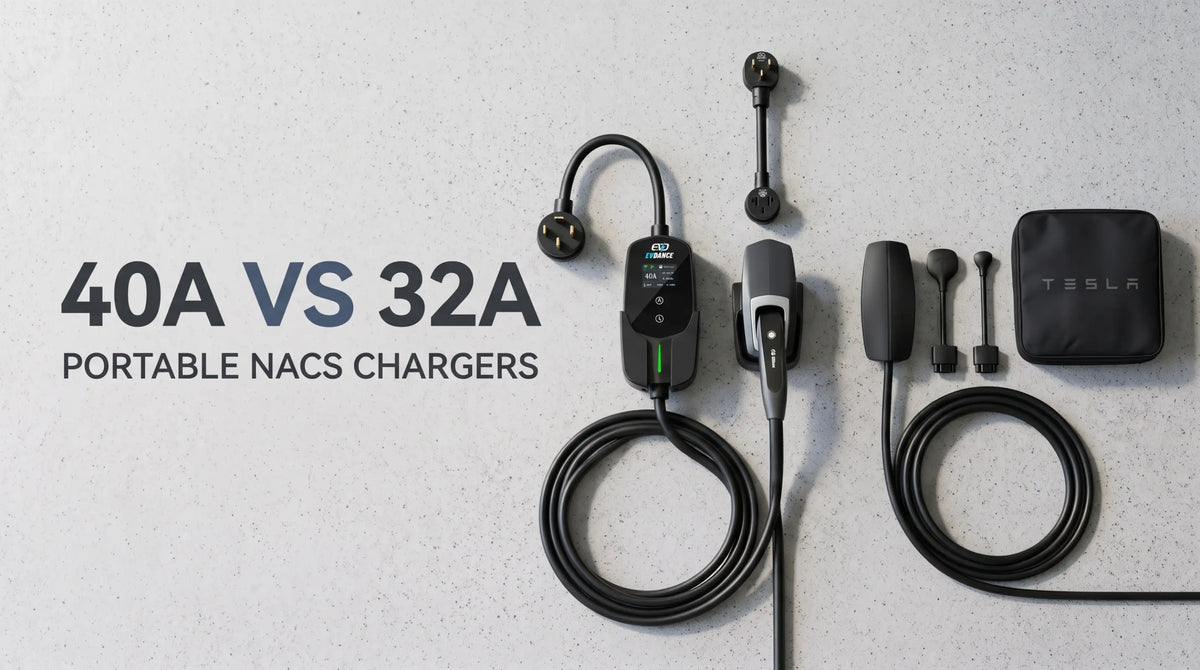
The EVDANCE 40A Portable Charger and the Tesla Mobile Connector are both designed for drivers who want a NACS charger that can be stored, carried and connected to an available outlet.
Both products cover common 120V and 240V charging situations. The main differences are maximum output, cable length, outlet connection design and how charging information is displayed.
EVDANCE 40A vs Tesla Mobile Connector at a Glance
The EVDANCE charger connects directly to a NEMA 14-50 outlet and includes an adapter cable for NEMA 5-15 charging. Tesla uses detachable power adapters, with NEMA 5-15 and NEMA 14-50 versions included in the current Mobile Connector bundle.
| Feature | EVDANCE 40A | Tesla Mobile Connector |
|---|---|---|
| Vehicle connector | NACS | NACS |
| 120V connection | Included NEMA 5-15 adapter cable | Included NEMA 5-15 adapter |
| 240V connection | NEMA 14-50 plug | Included NEMA 14-50 adapter |
| Maximum 240V output | 40A / 9.6kW | 32A / 7.6kW |
| Cable length | 25 ft | 20 ft |
| Charging information | Display and app | Vehicle screen and Tesla app |
| Current listed price | $249.95 | $300 |
Prices and package contents may change with promotions or product updates.
40A Can Shorten Charging Time When the Vehicle Supports It
At 240V, the EVDANCE charger can provide up to 40A and approximately 9.6kW. The Tesla Mobile Connector reaches a maximum of 32A and approximately 7.6kW through its NEMA 14-50 adapter.
If a vehicle needs 60kWh of energy, the theoretical charging time would be about 6.25 hours at 9.6kW and 7.8 hours at 7.6kW. These calculations do not include conversion losses, battery conditioning or changes ordered by the vehicle.
The difference only matters when the vehicle can accept more than 32A of AC power. If its onboard charger is limited to 32A, both products will deliver a similar maximum charging rate.
The electrical setup must support the selected current as well. A higher charger rating does not increase the capacity of the outlet, wiring or circuit.
Both Support 120V and 240V in Different Ways
The 40A NACS portable EV charger uses a fixed NEMA 14-50 input plug for its full 240V output. Its included adapter cable allows it to connect to a standard NEMA 5-15 outlet for 120V charging, with the adapter configuration limited to 12A.
The Tesla Mobile Connector takes a modular approach. Its current bundle includes separate NEMA 5-15 and NEMA 14-50 power adapters that attach to the Mobile Connector. Tesla also sells official adapters for outlets such as NEMA 6-20, 10-30, 14-30 and 6-50.
This gives the two products different kinds of flexibility. EVDANCE directly covers the common NEMA 14-50 home-charging setup and provides NEMA 5-15 as a slower backup option. Tesla offers a broader adapter range for drivers who expect to charge from several outlet types.
If the charger will remain connected to the same NEMA 14-50 outlet, access to additional adapters may be less important than maximum output, controls and cable length.
At 120V, neither product provides its higher Level 2 output. The NEMA 5-15 connection is better treated as a slower option for overnight charging, travel or occasions when compatible 240V power is unavailable.
Charging Information and Controls Are Presented Differently
The EVDANCE charger provides charging information through its control box and app. Drivers can view operating status and charging data, adjust the available current and set a delayed start without relying entirely on the vehicle interface.
These controls may be useful when the charger is used with different supported power sources or when a driver wants to review charging information separately from the vehicle. The 40A model provides adjustable settings from 10A to 40A, but the selected current must remain within the capacity of the complete electrical setup.
The Tesla Mobile Connector does not include a comparable information screen. Charging status, current settings and schedules are handled primarily through the Tesla touchscreen and Tesla app. The connected Tesla power adapter also identifies the maximum current associated with that outlet type.
For a Tesla owner already comfortable managing charging through the vehicle, this approach may feel more integrated. Drivers who prefer information and controls directly on the charging equipment may find the EVDANCE interface more useful.
Cable Length Affects Everyday Placement
The EVDANCE charger includes a 25-foot cable, while the Tesla Mobile Connector has a 20-foot cable. Both lengths can work in a typical garage, but the additional five feet may help when the outlet and vehicle charging port are on opposite sides of the parking space.
Cable length can also matter when a household alternates between parking nose-in and backing into the same space. A longer cable may reduce the need to reposition the vehicle solely to reach the charging port.
Both products include a storage bag. The better cable length depends on the location of the outlet, the vehicle’s charging port and the normal parking position rather than portability alone.
Which Portable Charger Better Matches the Setup?
The EVDANCE 40A charger is the stronger match when the vehicle can accept more than 32A, the electrical setup supports 40A charging and a 25-foot cable provides useful additional reach. Its display, adjustable current settings and app controls also make charging information available outside the vehicle.
The Tesla Mobile Connector makes sense for drivers who prefer a Tesla factory accessory, normally manage charging through the Tesla app and may use several official Tesla outlet adapters. Its 32A maximum output can still cover a normal overnight charging period for many drivers.
For drivers who mainly use NEMA 14-50 and have a vehicle capable of accepting 40A, EVDANCE offers additional available power and a longer cable. When 32A already restores the energy used during a normal day, the decision is more likely to come down to controls, cable placement and adapter preferences than charging speed alone.
Recommend Reading: Can One Portable EV Charger Work on 120V and 240V?


Share:
Best NACS-to-J1772 Adapters in 2026
EVDANCE Flux Pro vs Leviton EV40P: 40A Home Charging