





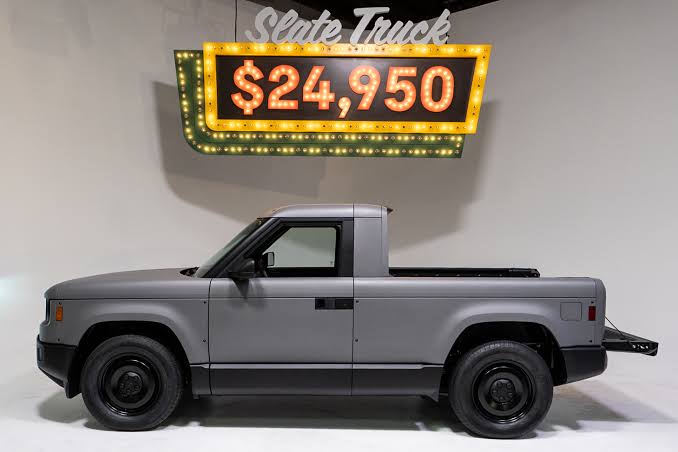
The Slate electric pickup will start at a total price of $26,400, including a newly confirmed $1,450 destination charge. While that keeps it among the least expensive new EVs in the U.S., buyers should expect an intentionally minimalist vehicle that relies heavily on optional upgrades and customization.
Rather than competing through luxury or technology, Slate is betting that simplicity, affordability, and aftermarket flexibility will attract drivers looking for a different kind of electric vehicle.

Final Pricing Is Now Complete
Since Slate first introduced its compact electric pickup, one question remained unanswered: what would buyers actually pay after mandatory delivery charges?
The company has now confirmed that the truck's destination fee is $1,450, bringing the base purchase price to $26,400 before taxes, registration fees, or optional accessories.
Earlier pricing estimates evolved several times. Initially, the truck was promoted as costing less than $20,000 when the federal EV tax credit was still available. After the incentive disappeared, Slate adjusted its guidance to the "mid-$20,000" range before officially announcing a $24,950 starting MSRP. With the destination charge now disclosed, customers finally have a complete picture of the vehicle's entry price.
According to company representatives, the delivery fee is lower than that charged for any other pickup currently sold in the United States, supporting Slate's goal of keeping ownership costs as low as possible.
Affordability Comes Through Radical Simplicity
Slate's pricing strategy depends on removing nearly every feature modern drivers typically expect from a new vehicle.
The standard truck is intentionally basic. Buyers won't find power windows, powered exterior mirrors, an infotainment touchscreen, built-in audio system, or factory paint. Aside from federally required safety equipment—including a backup camera displayed through the driver's information screen—the truck offers very little beyond the essentials.
Instead of bundling features into the base vehicle, Slate plans to let owners customize their trucks over time. Many upgrades will be available directly from the manufacturer, while others are expected to come from third-party aftermarket suppliers.
This modular philosophy allows customers to pay only for the equipment they actually want rather than financing expensive factory-installed options.
Customization Is Central to the Business Model
Unlike most automakers that lock buyers into fixed trim levels, Slate is building its truck around personalization.
The standard configuration leaves the factory as a two-door, single-cab pickup with a five-foot cargo bed. Customers who want additional passenger space can purchase conversion packages that transform the vehicle into an SUV.
One available package converts the truck into a Squareback-style SUV for approximately $5,000, while another fastback-inspired version costs roughly $7,000. Both include structural upgrades, rear-seat airbags, and rollover protection while retaining the vehicle's two-door layout.
With the confirmed destination charge included, the least expensive SUV version starts at approximately $31,400, making customization a significant part of the overall ownership cost.
Performance Focuses on Everyday Driving Rather Than Speed
The Slate truck isn't designed to compete with today's high-performance electric pickups.
Its standard powertrain produces 181 horsepower, sends power exclusively to the rear wheels, and delivers an estimated 205 miles of EPA-rated driving range.
On paper, those figures fall well below larger electric trucks currently available from established manufacturers. However, Slate has never positioned its vehicle as a performance leader. Instead, the company emphasizes practical daily transportation at the lowest possible purchase price.
By limiting battery size and simplifying the drivetrain, Slate aims to reduce manufacturing costs while keeping ownership accessible to buyers who may otherwise be priced out of the EV market.
Can Slate Stand Out Against Established Rivals?
Although Slate currently occupies a unique price segment, it will not remain alone for long.
Today, the closest electric pickup alternatives cost dramatically more. Retail versions of the Chevrolet Silverado EV begin at roughly $58,000, while the Tesla Cybertruck starts near $70,000. That leaves Slate with a substantial pricing advantage in the electric truck market.
However, competition is already on the horizon. Ford is reportedly preparing a more affordable electric pickup expected to launch in 2027. Industry expectations suggest it will include four doors, a fully equipped cabin, and the convenience features many buyers now consider standard.
In the broader crossover and SUV market, Slate also faces competition from models such as the Chevrolet Bolt EV and Nissan Leaf. While these vehicles occupy a different category, they provide greater driving range, more passenger space, additional standard technology, and comparable charging capabilities at similar price points.
As a result, Slate's value proposition depends less on specifications than on offering something that mainstream vehicles currently do not.
A Vehicle Built for Customization Enthusiasts
Rather than appealing to every EV shopper, Slate appears to be targeting a specific audience.
Many drivers have grown frustrated with increasingly complex vehicles filled with subscription services, oversized touchscreens, and software-dependent controls. Slate takes the opposite approach by delivering a straightforward platform that owners can personalize over time.
The company's aftermarket-friendly design encourages buyers to upgrade the truck gradually instead of paying for expensive factory options upfront. Whether customers want exterior styling changes, interior accessories, or SUV conversion kits, the vehicle is intended to evolve according to individual preferences.
This strategy also creates opportunities for third-party accessory manufacturers, potentially building an ecosystem similar to those surrounding popular off-road vehicles.
Still, simplicity alone does not guarantee commercial success. The biggest question is whether enough buyers are willing to sacrifice convenience features in exchange for a significantly lower purchase price.
What Comes Next for Slate?
Slate's pricing announcement removes one of the final unknowns surrounding its first production vehicle, but many important questions remain unanswered.
The company must still demonstrate that it can manufacture vehicles efficiently, maintain quality standards, and deliver orders at scale. It also faces the challenge of convincing mainstream consumers that a deliberately stripped-down EV offers better long-term value than similarly priced competitors equipped with far more standard features.
If demand for affordable, customizable electric vehicles proves stronger than expected, Slate could establish an entirely new niche within the EV market. If buyers ultimately prioritize convenience and equipment over simplicity, however, the company's unconventional approach may face a difficult test once deliveries begin.
Production is expected to start later this year, giving the industry its first real opportunity to evaluate whether Slate's minimalist strategy can succeed in an increasingly competitive electric vehicle landscape.

FAQ
Why does the Slate truck cost more than its advertised MSRP?
The advertised $24,950 MSRP does not include the mandatory $1,450 destination charge. Once this fee is added, the base purchase price becomes $26,400 before taxes and registration.
What features are missing from the base Slate truck?
The standard model omits several common features, including power windows, power mirrors, a central infotainment screen, a built-in audio system, and factory paint. Buyers can add many of these features later through optional accessories.
Can the Slate pickup be converted into an SUV?
Yes. Slate offers optional SUV conversion kits that transform the pickup into either a Squareback-style or fastback-style SUV. These packages include additional safety equipment and rear seating while maintaining the two-door design.
How does the Slate compare with other electric trucks?
The Slate is significantly less expensive than current electric pickups such as the Chevrolet Silverado EV and Tesla Cybertruck. However, it also delivers lower performance, shorter driving range, and fewer standard features.
Who is the Slate truck designed for?
The vehicle targets buyers seeking an affordable, customizable EV rather than a technology-packed premium model. Its minimalist design may appeal to owners who value simplicity, lower costs, and aftermarket personalization.
Recommend Reading: Slate EV Pickup Accessories Can Quickly Raise the Price







Share:
US EV Fast Charging Growth Shifts Toward Quality