





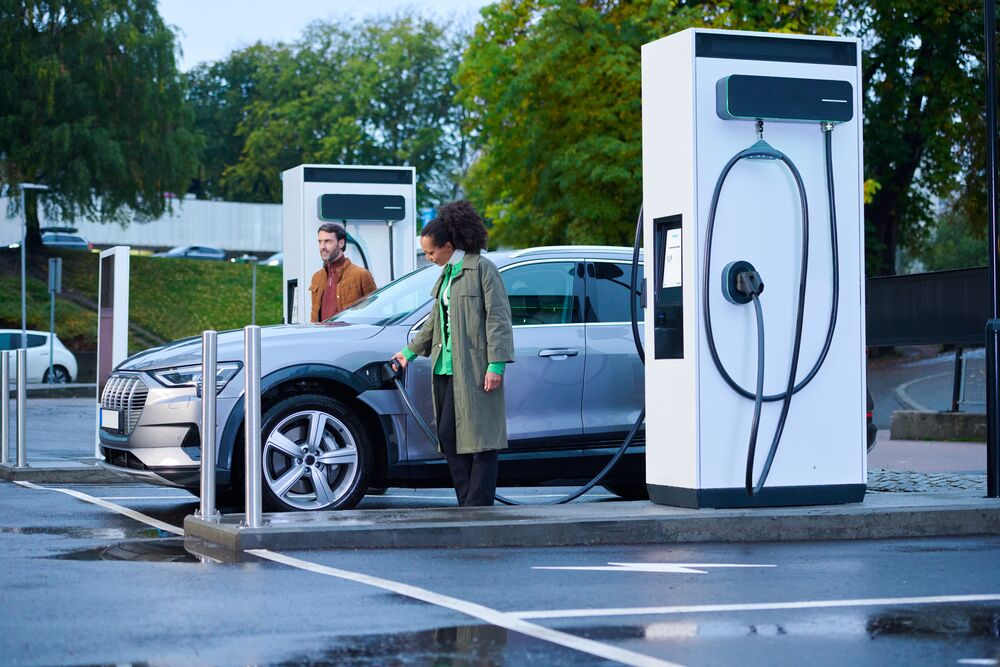
The United States now has more than 250,000 publicly accessible EV charging ports, marking a significant expansion of the country's charging infrastructure. The milestone suggests that charger availability is growing faster than many consumers realize, even as concerns about charging access continue to influence EV adoption.

Public Charging Network Reaches New High
According to the latest figures from the U.S. Department of Energy's Alternative Fuels Data Center, the country currently hosts 250,406 public charging ports spread across 80,543 charging locations.
The network includes a mix of charging technologies designed for different use cases. More than 180,000 Level 2 charging ports make up the largest share of the infrastructure, while over 73,000 DC fast-charging connectors provide rapid charging options for long-distance travel and commercial use. A smaller number of Level 1 chargers also remain in operation.
The achievement reflects years of steady investment from charging providers, automakers, utilities, and government-supported programs aimed at improving nationwide EV accessibility.
Charging Growth Continues Despite EV Market Challenges
The charging sector's expansion comes during a period of mixed momentum for electric vehicle sales.
While EV adoption continues to grow overall, some automakers have reported slower demand growth compared with earlier expectations. In addition, policy changes and shifting regulatory priorities have created uncertainty in parts of the EV industry.
Despite those challenges, charging infrastructure deployment has maintained a strong upward trajectory.
The pace of expansion illustrates an important distinction between vehicle sales and infrastructure development. Charging companies often plan projects years in advance, and many operators continue investing aggressively to prepare for future EV demand.
As a result, the charging network has continued growing even as the broader EV market experiences periods of fluctuation.
Charger Deployment Is Accelerating
Recent data highlights how quickly charging availability has increased over the past few years.
The combined number of public Level 2 and DC fast-charging ports exceeded 100,000 units in April 2021. The network then surpassed 200,000 ports in March 2026, demonstrating how deployment rates have accelerated.
During the current year alone, operators have added more than 5,000 new DC fast-charging ports and nearly 13,000 additional Level 2 charging connections.
Each charger type serves a different role within the ecosystem.
Fast chargers are primarily intended for drivers who need to recharge during longer journeys. Their higher power output can significantly reduce charging times compared with slower alternatives.
Level 2 chargers, meanwhile, are generally installed in locations where vehicles remain parked for extended periods. Common examples include shopping centers, hotels, workplaces, entertainment venues, and residential streets.
Together, these charging options create a broader and more flexible charging network capable of supporting a growing number of electric vehicles.
Major Networks Continue Expanding
Several charging providers are contributing to the infrastructure buildout, although deployment strategies vary significantly between networks.
Tesla remains the dominant force in DC fast charging. Its Supercharger network now includes approximately 38,000 fast-charging ports across the United States, making it the largest high-speed charging system in the country.
Other operators are expanding rapidly as well.
Ionna, a newer charging network backed by major automakers, has grown to 120 locations with approximately 1,130 DC fast-charging ports. The company continues building out its footprint along major travel corridors and urban markets.
Meanwhile, Rivian's Adventure Network has reached 149 charging sites and now operates slightly more than 1,000 DC fast chargers. The network primarily targets outdoor recreation destinations and long-distance travel routes.
For Level 2 charging, ChargePoint remains the clear leader. The company operates more than 76,000 Level 2 charging ports, giving it one of the broadest charging footprints in the country.
Reliability and Performance Are Also Improving
The growth story is not limited to charger quantity alone.
Many newer charging installations deliver higher power levels than earlier generations, allowing compatible vehicles to charge more quickly. Network operators have also focused on improving uptime, maintenance procedures, and software reliability to address long-standing concerns among EV drivers.
Industry analysts generally agree that additional infrastructure will still be necessary as EV ownership expands. However, the latest figures suggest that public charging availability has already reached a much larger scale than many consumers may assume.
As networks continue adding locations and upgrading equipment, the gap between public perception and actual charging availability could continue to narrow.
The latest milestone demonstrates that the U.S. charging landscape is no longer emerging infrastructure—it is rapidly becoming a nationwide transportation network capable of supporting millions of electric vehicles.

FAQ
How many public EV charging ports are available in the United States?
The United States currently has 250,406 public charging ports across 80,543 charging locations, according to Department of Energy data.
What types of EV chargers make up the network?
The network includes more than 180,000 Level 2 chargers, over 73,000 DC fast chargers, and a smaller number of Level 1 charging ports.
Why are Level 2 chargers important?
Level 2 chargers are less expensive to install and work well in places where vehicles remain parked for extended periods, such as workplaces, hotels, and shopping centers.
Which company operates the largest fast-charging network?
Tesla currently operates the largest U.S. fast-charging network, with approximately 38,000 Supercharger ports nationwide.
How fast is the U.S. charging network growing?
In 2026 alone, operators have added more than 5,000 DC fast chargers and nearly 13,000 Level 2 charging ports, continuing a multi-year expansion trend.
Is charging infrastructure still expanding despite slower EV sales growth?
Yes. Charging companies continue investing heavily in new locations and equipment, and public charging availability has continued increasing even as EV market growth has become less predictable.
Recommend Reading: New ultra fast EV chargers coming to the US










Share:
Megawatt EV Chargers Arrive in the U.S.—Are Cars Ready?
BMW iX5 Battery Capacity Sets New Benchmark