





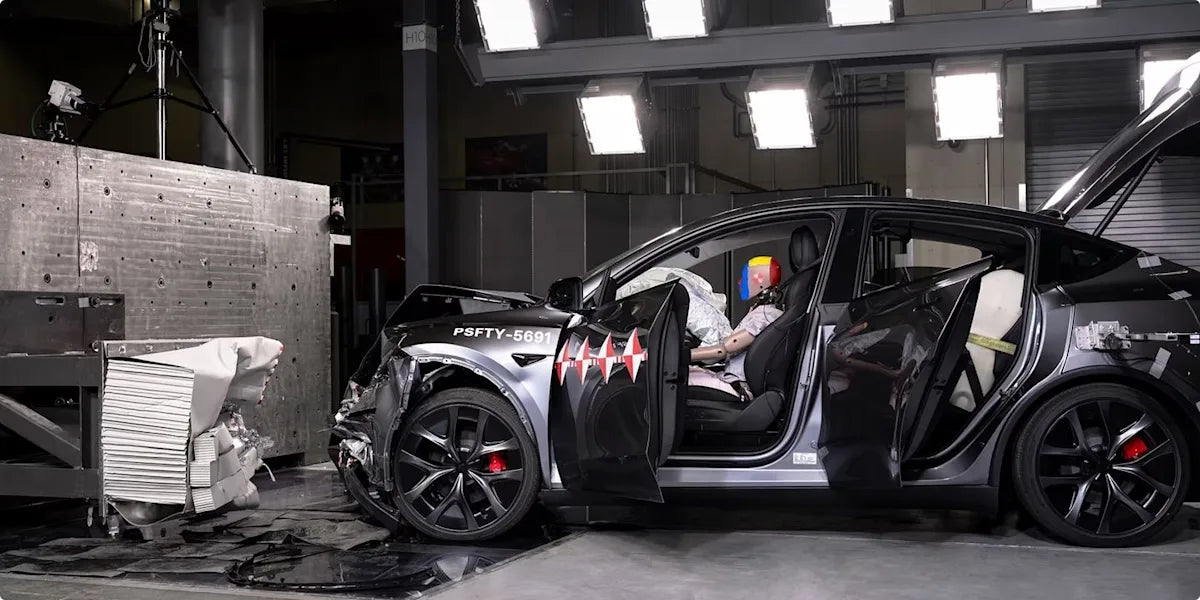
Tesla has introduced a new crash-preparation feature that allows its vehicles to begin readying occupant protection systems before a collision occurs. By using onboard cameras to predict an unavoidable impact, the system can activate airbags up to 70 milliseconds earlier, potentially improving passenger protection during serious accidents.

Cameras Now Play a Bigger Safety Role
Tesla has steadily expanded the responsibilities of its camera-based vision system beyond automated driving and parking assistance. Its latest software enhancement applies the same hardware to crash prediction, giving the vehicle additional time to prepare its safety systems before physical contact takes place.
Traditional restraint systems rely primarily on accelerometers and impact sensors. Those components only begin collecting meaningful crash data once the vehicle has already been struck. Tesla's new approach attempts to shorten that delay by analyzing what the cameras see before the impact occurs.
If the system determines that a collision cannot be avoided, it estimates the expected direction, timing, and severity of the impact. That information is then used to prepare several occupant protection systems even before conventional crash sensors complete their measurements.
Earlier Airbag Deployment Can Matter
Although airbags appear to inflate instantly during crash-test footage, deployment actually requires a measurable amount of time. Even fractions of a second can influence how effectively an airbag cushions occupants during a high-speed collision.
According to Tesla, the updated system can reduce deployment timing by as much as 70 milliseconds compared with relying solely on traditional impact detection. While the time difference sounds small, vehicle safety engineers often measure improvements in milliseconds because crashes unfold extremely quickly.
By recognizing an impending collision before physical contact occurs, the vehicle can begin preparing the restraint system sooner, allowing airbags to reach their intended position closer to the moment occupants move forward.
How the New Safety Process Works
The upgraded feature combines predictive vision with existing crash hardware rather than replacing it.
Tesla explains that its cameras continuously monitor the surrounding environment. When software determines that an impact is unavoidable, the vehicle evaluates several factors, including the likely collision angle, estimated impact timing, and expected crash severity.
Based on those predictions, systems such as seatbelt pretensioners can begin preparing occupants before contact occurs. The airbags themselves are also primed for faster deployment.
Importantly, Tesla has not eliminated traditional crash sensors. Accelerometers and impact detectors still provide the final confirmation required before airbags are actually deployed. Instead of replacing proven hardware, the camera system serves as an additional layer of predictive intelligence.
This hybrid approach combines forward-looking environmental awareness with established crash-detection technology.
Building on Existing Vehicle Safety
Tesla vehicles have consistently earned strong ratings from multiple automotive safety organizations, and the latest update reflects the company's continued emphasis on software-driven safety improvements.
Unlike many safety enhancements that require redesigned hardware, this feature is expected to reach existing vehicles through an over-the-air software update. That allows eligible owners to receive new functionality without replacing physical components.
Tesla has not yet identified exactly which vehicle models or software versions will support the predictive airbag feature. The company also has not published a detailed rollout schedule.
Interestingly, recent software release notes have contained very little public information about this capability. Aside from a "Frontal Airbag System Enhancement" listed in a software update released during September 2025, Tesla has not specifically documented this new predictive deployment feature in publicly available update logs.
A Broader Shift Toward Predictive Vehicle Safety
The new capability illustrates how modern vehicles increasingly use software and artificial intelligence to improve passive safety as well as active safety.
Historically, crash protection systems reacted only after impact forces were detected. Tesla's latest implementation moves part of that decision-making process earlier by using camera-based perception to anticipate what is about to happen rather than responding only after a collision begins.
Whether other automakers adopt similar approaches remains to be seen. However, the concept reflects a growing industry trend toward combining sensor fusion, machine learning, and predictive analysis to enhance occupant protection.
If widely deployed across Tesla's lineup, the update could demonstrate how existing camera hardware can deliver meaningful safety improvements through software alone, without requiring major changes to the vehicle's physical design.

FAQ
Why is Tesla using cameras to improve airbag deployment?
Tesla uses its camera system to detect when a collision appears unavoidable before physical impact occurs. This allows the vehicle to begin preparing its restraint systems earlier than traditional crash sensors alone.
How much earlier can Tesla deploy the airbags?
According to Tesla, the updated system can activate the airbag deployment process up to 70 milliseconds sooner. Although this is a very short period, milliseconds can significantly influence occupant protection during high-speed crashes.
Does the camera system replace traditional crash sensors?
No. Tesla still relies on conventional impact sensors and accelerometers to authorize airbag deployment. The camera-based prediction serves as an additional safety layer that prepares the vehicle before those sensors complete their measurements.
Which Tesla vehicles will receive this feature?
Tesla has confirmed that the capability will be delivered through an over-the-air software update for existing vehicles. However, the company has not yet published a complete list of supported models or the required software versions.
Why does earlier airbag deployment improve safety?
Airbags require a brief amount of time to fully inflate after deployment begins. Starting that process earlier increases the likelihood that the airbags will reach full inflation at the optimal moment, helping reduce occupant injuries during severe collisions.
Recommend Reading: Tesla FSD Expansion in Europe Faces New Hurdles









Share:
Why Slate Switched to an LFP Battery for Its EV Truck
Slate EV Pickup Accessories Can Quickly Raise the Price