





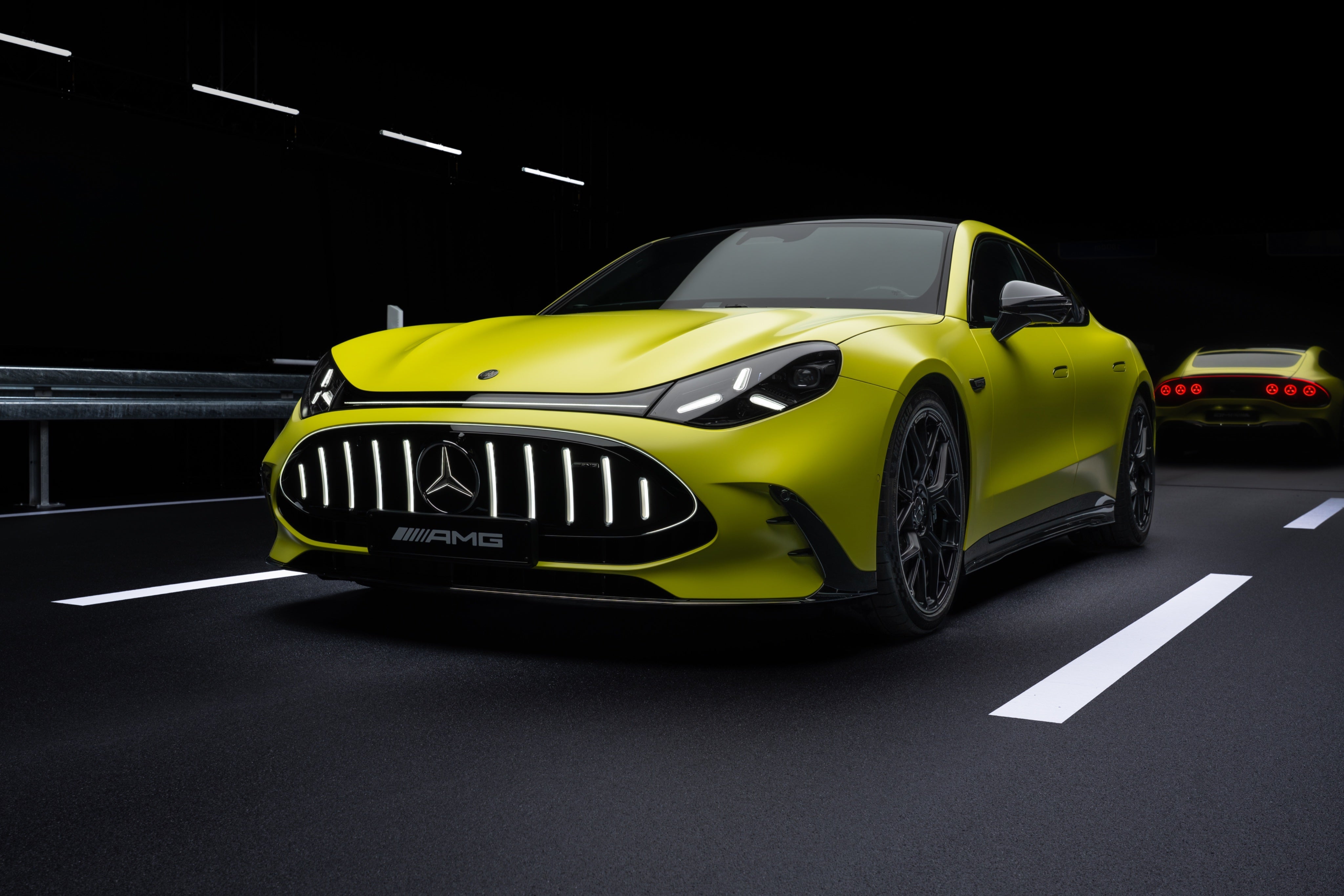
Mercedes-Benz’s newest AMG electric sedan introduces several technologies rarely seen together in a production EV, including axial-flux motors, a silicon-enhanced battery, and ultra-fast 600-kilowatt charging. The company says the car can recharge from 10% to 80% in 11 minutes, making it one of the fastest-charging electric vehicles currently announced by a Western automaker.
The new four-door AMG model also marks a major shift in Mercedes-Benz’s EV strategy after the company’s earlier EQ lineup struggled to gain broad traction in global markets.

Mercedes Rebuilds Its EV Performance Strategy
Mercedes-Benz spent the last few years rethinking its electric vehicle direction. Earlier EQ-branded models prioritized aerodynamic styling and efficiency, but many buyers criticized their unconventional appearance and lack of emotional appeal. With the latest AMG electric sedan, the German automaker is taking a very different approach.
Built on the new AMG.EA dedicated EV platform, the car is positioned as a flagship performance model aimed at competitors such as the Porsche Taycan and Lucid Air Sapphire. Unlike previous Mercedes EVs focused mainly on efficiency, this vehicle emphasizes extreme acceleration, advanced battery engineering, and track-inspired technology.
The exterior design is intentionally aggressive. Illuminated grille elements, oversized lighting graphics, and a sloping fastback roofline give the sedan a much more dramatic appearance than earlier Mercedes electric cars. Active aerodynamic systems also play a major role in the design. Panels underneath the vehicle automatically adjust at higher speeds to improve airflow and increase downforce.
Mercedes says these systems activate progressively as speed rises, helping stabilize the vehicle during high-performance driving.
New Axial-Flux Motors Deliver More Power
One of the biggest technical highlights is the use of axial-flux electric motors, a design rarely found in fully electric production cars. Mercedes gained access to this technology after acquiring British motor specialist YASA in 2021.
Most EVs today use radial-flux motors, which have a cylindrical structure. Axial-flux motors use a flatter disc-shaped architecture that improves torque density and packaging efficiency. Mercedes claims the new motor units are roughly 67% lighter and shorter than traditional designs with similar output.
The top GT 63 configuration uses three motors and produces up to 1,153 horsepower along with 1,475 lb-ft of torque. According to Mercedes, the sedan can accelerate from zero to 60 mph in 2.3 seconds and reach a maximum speed of 186 mph.
A second version, the GT 55, delivers 805 horsepower while still targeting high-performance driving dynamics.
Mercedes is also attempting to preserve some of the emotional characteristics associated with combustion-engine performance cars. The vehicle includes simulated gear changes and digitally generated engine audio designed to imitate V8 behavior during acceleration and deceleration.
Battery Design Focuses On Cooling Efficiency
The sedan’s battery system incorporates technology influenced by Mercedes-AMG’s Formula 1 engineering program and the AMG One hypercar project.
The pack has a usable capacity of 106 kWh and contains 2,660 cylindrical battery cells arranged across 18 modules. Mercedes estimates driving range at approximately 700 kilometers on the WLTP cycle, which would translate to roughly 315 miles under EPA testing standards.
Cooling is a central focus of the battery design. Mercedes selected narrow cylindrical cells because smaller diameters reduce the distance heat must travel from the center of the cell to the outer casing. Each cell is surrounded by cooling elements, while the battery management system can selectively cool specific modules when temperatures rise.
The chemistry also differs from many existing EV batteries. Mercedes uses a nickel-cobalt-manganese-aluminum cathode combined with a silicon-containing anode. Silicon-based anodes have attracted industry attention because they can increase energy density beyond conventional graphite designs.
Mercedes says the battery achieves an energy density of 298 Wh/kg, placing it near the upper end of current high-performance nickel-based battery systems.
600 kW Charging Pushes Beyond Current U.S. Standards
The charging capability may be the vehicle’s most attention-grabbing specification. Mercedes claims the sedan supports charging speeds of up to 600 kW, exceeding most EVs currently sold in North America and Europe.
Under ideal conditions, the car can reportedly recover 10% to 80% battery capacity in 11 minutes. Mercedes also says a 10-minute charging session could add approximately 285 miles of WLTP-rated range.
However, infrastructure remains a major limitation. Chargers capable of consistently delivering more than 500 kW remain extremely rare in the United States. Most public high-power stations currently operate below that threshold.
Chinese automakers such as BYD have already demonstrated even higher charging capabilities in some domestic-market vehicles, but among Western brands, Mercedes is now pushing the upper edge of commercially announced charging performance.
U.S. deliveries for the GT 55 are scheduled to begin later this year, while the more powerful GT 63 is expected to arrive in early 2027. Mercedes has not yet announced pricing.

FAQ
What makes the new Mercedes AMG EV different from earlier EQ models?
The new AMG sedan focuses more heavily on performance, charging speed, and advanced engineering. It uses a dedicated AMG electric platform instead of the earlier EQ architecture designed primarily around efficiency.
What are axial-flux motors in EVs?
Axial-flux motors use a flat disc-style structure instead of a cylindrical layout. This design can improve torque density, reduce weight, and save space compared with conventional EV motors.
How fast can the new AMG electric sedan charge?
Mercedes says the vehicle supports charging speeds up to 600 kW. Under ideal conditions, the battery can recharge from 10% to 80% in approximately 11 minutes.
How much power does the AMG GT 63 produce?
The GT 63 version delivers up to 1,153 horsepower and 1,475 lb-ft of torque using a three-motor setup. Mercedes estimates a 0-60 mph time of 2.3 seconds.
Does the car use a new type of battery chemistry?
Yes. The battery combines an NCMA cathode with a silicon-enhanced anode. Silicon materials can improve energy density compared with traditional graphite-based designs.
Recommend Reading: Mercedes VLE Electric Van: Specs, Range, and U.S. Market Prospects


Share:
Costco Discount Lowers Chevy Bolt EV Price
Five EVs Accounted for 20% of Global Sales