





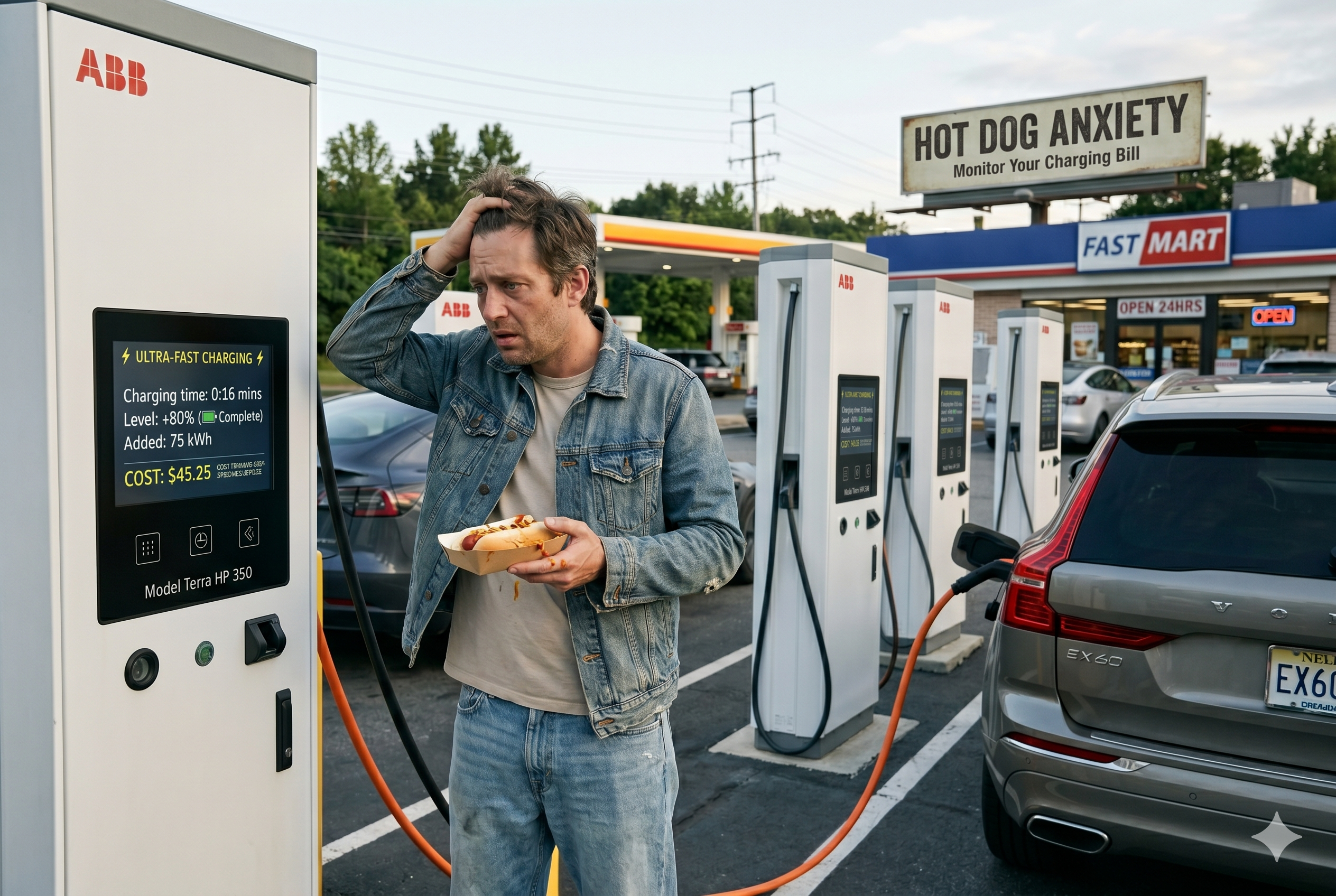
Ultra-fast EV charging is reducing traditional range anxiety, but some drivers may now be paying for more electricity than they actually need. As charging speeds continue improving, automakers say many EV owners are spending unnecessary time — and money — at public fast chargers.

Faster Charging Is Changing Driver Behavior
Electric vehicles have improved significantly in both range and charging performance over the past several years. Many newer EVs can now recover hundreds of miles of driving range during relatively short charging stops, especially when connected to high-powered DC fast chargers.
According to Volvo executives, this shift is creating a different type of problem. During the U.S. introduction of the upcoming Volvo EX60, the company’s engineering leadership described a growing tendency among drivers to remain plugged in longer than necessary while stopping for food or breaks during road trips.
Volvo referred to the behavior informally as “hot dog anxiety,” suggesting that some drivers are unintentionally overspending on charging simply because modern EVs recharge much faster than expected.
The idea reflects how quickly public charging technology has evolved.
Charging Speeds Are Increasing Rapidly
Several recently announced EVs can replenish battery capacity far faster than models released only a few years ago.
Volvo says the new EX60 can charge from 10% to 80% in around 16 minutes when connected to a 350-kilowatt fast charger. Meanwhile, the latest BMW iX3 reportedly supports charging speeds up to 400 kW, allowing the SUV to recover approximately 185 miles of range within 10 minutes under ideal conditions.
Mercedes-Benz has gone even further with its newly revealed electric AMG sedan, which the company says can briefly reach 600 kW charging speeds. According to Mercedes, that allows the vehicle to move from 10% to 80% battery capacity in roughly 11 minutes.
These charging times increasingly resemble traditional fuel stops rather than lengthy charging sessions.
As a result, automakers argue that drivers may need to rethink how much charging they actually require during daily use or road trips.
Many Drivers May Be Charging More Than Needed
For EV owners with reliable home charging access, public fast charging is often used only to complete longer journeys.
In many cases, a short charging session may provide enough energy to comfortably finish the remaining drive home. However, drivers accustomed to older EV charging habits may still continue charging toward 80% or higher, even when that additional energy is unnecessary.
Volvo executives suggested this can unintentionally increase charging costs, especially at premium DC fast chargers where pricing is often significantly higher than residential electricity rates.
For example, a driver stopping briefly for food during a road trip could return to discover the vehicle has accumulated far more energy — and a much larger charging bill — than originally intended.
The broader point is that improving charging performance may eventually change how drivers think about battery management entirely.
Not Every EV Driver Benefits Equally
The “hot dog anxiety” idea mainly applies to newer EVs with advanced charging systems and home charging access.
Vehicles built on 800-volt electrical platforms, such as the Hyundai Ioniq 5 and Kia EV6, already offer relatively short charging sessions compared to many mainstream EVs. Both models can typically move from 10% to 80% charge in roughly 20 minutes under ideal conditions.
However, many affordable EVs still require noticeably longer charging stops. Several Tesla models and other mass-market electric vehicles commonly need 30 to 40 minutes for a comparable charging session.
In addition, not all drivers have access to overnight charging at home. Apartment residents and urban EV owners often depend heavily on public charging infrastructure. Those users may prioritize maximizing range during each charging stop rather than minimizing time spent connected.
That means charging behavior still varies widely depending on vehicle type, charging availability, and ownership situation.
EV Infrastructure Is Entering a New Phase
Public fast-charging infrastructure in North America continues expanding rapidly, with higher-output stations becoming increasingly common along major travel corridors.
At the same time, automakers are pushing toward larger battery capacities, longer driving ranges, and charging systems capable of delivering hundreds of kilowatts continuously.
Industry trends suggest that future EV ownership may involve shorter and more strategic charging stops rather than long sessions aimed at filling the battery completely.
If charging speeds continue improving across both premium and mainstream segments, the traditional fear of running out of range could gradually become less important than managing charging efficiency and cost.

FAQ
What is “hot dog anxiety” in EV charging?
The term describes drivers staying at fast chargers longer than necessary while stopping for food or breaks. This can lead to higher charging costs than needed.
Why are EV charging times getting shorter?
Newer EVs use improved battery systems and higher-voltage architectures. Many modern vehicles now support charging speeds between 350 kW and 600 kW.
Which EVs currently support ultra-fast charging?
Models such as the Volvo EX60, BMW iX3, Hyundai Ioniq 5, and Kia EV6 support very fast DC charging under ideal conditions.
Do all EV drivers benefit from shorter charging stops?
No. Drivers without home charging access often rely heavily on public charging and may prefer charging to higher battery levels during each stop.
Is range anxiety becoming less important?
For many newer EVs, yes. Improved charging infrastructure and faster charging speeds are reducing concerns about long-distance travel in electric vehicles.
Recommend Reading: New ultra fast EV chargers coming to the US


Share:
Should You Wait for Rivian R2 Lidar?
Lucid Cosmos May Rival Tesla Model Y