





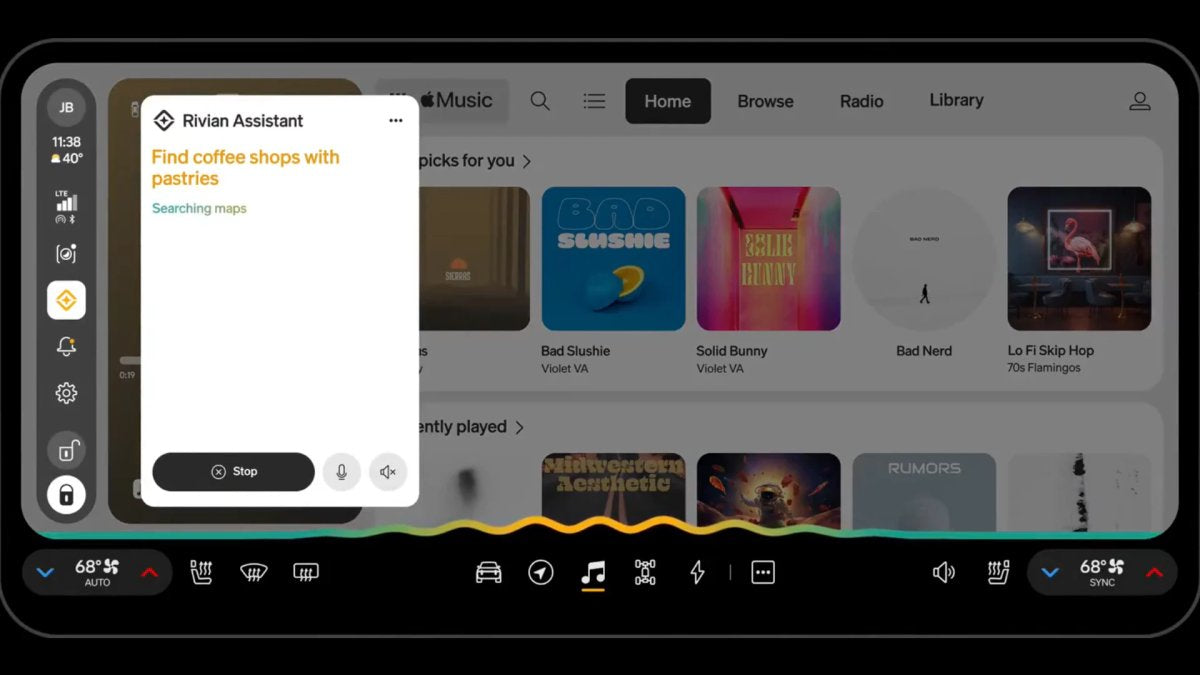
Rivian has officially begun deploying its new AI-powered voice assistant through an over-the-air software update. The system is designed to control vehicle functions, answer questions, and handle multi-step requests using more natural conversations than traditional in-car voice controls.
The rollout marks Rivian’s latest push into automotive artificial intelligence as carmakers increasingly compete to build smarter in-vehicle software ecosystems.

Rivian Expands Beyond Traditional Voice Commands
Unlike older automotive voice systems that rely on preset phrases, Rivian’s new assistant is intended to function more like a conversational AI platform.
Drivers can activate the feature by saying “Hey Rivian” or using a steering-wheel control button. Once enabled, the assistant can manage a broad range of vehicle operations, including navigation tasks, camera access, and driving mode adjustments.
Rivian says the system combines internally developed AI software with outside language models to improve flexibility and responsiveness.
The company positions the assistant as deeply integrated into the vehicle itself rather than acting as a smartphone extension. That distinction matters because many existing infotainment systems still depend heavily on phone mirroring platforms with limited access to core vehicle controls.
The Assistant Can Handle Multi-Step Requests
One of the key differences with Rivian’s platform is its ability to process more complicated requests in a single interaction.
Instead of giving isolated commands, owners can ask the assistant to perform connected tasks involving navigation, communication, and information retrieval. Rivian demonstrated examples such as recommending restaurants, sharing arrival times with contacts, and retrieving destination details during a single conversation.
The assistant is also designed to retain conversational context. That allows follow-up questions without forcing users to repeat previous instructions every time.
In addition to vehicle-specific tasks, the software can respond to broader informational questions similarly to consumer AI chatbots. Rivian says this capability turns the assistant into a general-purpose information tool rather than only a control interface.
Rivian Wants The Assistant To Replace The Owner’s Manual
Rivian is also using the assistant as a built-in knowledge resource for vehicle support.
Drivers can ask operational or maintenance questions directly through voice interaction instead of searching through manuals or touchscreen menus. Examples include guidance on changing a tire, understanding warning messages, or locating certain vehicle settings.
That approach reflects a broader trend among automakers attempting to simplify increasingly software-heavy vehicles. As electric vehicles gain more digital features, manufacturers are looking for ways to reduce friction for owners who may not want to navigate multiple menus while driving.
Google Calendar Is The First Major Integration
Rivian says the assistant’s capabilities will expand over time through additional service integrations.
The first announced connection is Google Calendar. Owners who link their Google accounts can use voice commands to manage appointments, navigate to upcoming meetings, and share scheduling details through text messaging while on the road.
This “agentic” functionality moves the assistant beyond passive voice recognition into task execution. Instead of simply answering questions, the software can coordinate actions across multiple applications and services.
Several automakers are now pursuing similar AI strategies. Companies including General Motors, Volvo, and Polestar recently announced future integration with Google Gemini, while newer Tesla vehicles have begun adding xAI’s Grok technology.
However, Rivian’s system focuses heavily on direct vehicle integration instead of acting primarily as an external chatbot layer.
Which Rivian Vehicles Will Receive The Feature?
The assistant is being released first on both Gen 1 and Gen 2 Rivian R1S and R1T models through a software update.
Rivian also confirmed that the upcoming R2 platform will support the assistant when customer deliveries begin in the near future.
To use the feature, owners must maintain an active connectivity subscription. The company has not yet detailed every future capability planned for the assistant, but executives previously suggested that additional integrations and expanded automation functions are already in development.
The rollout also highlights how software is becoming a major competitive differentiator in the EV market. Automakers are increasingly treating digital services and AI systems as long-term platforms rather than optional infotainment upgrades.

FAQ
What does the Rivian AI Assistant do?
The Rivian Assistant allows drivers to control vehicle functions using natural voice conversations. It can manage navigation, driving modes, cameras, calendar tasks, and informational questions.
Which Rivian vehicles support the assistant?
The feature is rolling out to Gen 1 and Gen 2 R1S and R1T vehicles. Rivian says the upcoming R2 will also include support at launch.
Does the Rivian Assistant require a subscription?
Yes. Rivian confirmed that owners need an active connectivity subscription to access the AI assistant and related online services.
How is Rivian’s assistant different from older voice systems?
Traditional voice systems usually rely on rigid commands with limited functionality. Rivian’s platform is designed to understand conversational requests, maintain context, and complete multi-step tasks.
Can the assistant interact with apps or external services?
Yes. The first announced integration is Google Calendar, allowing drivers to manage appointments and navigation through voice commands.
Does Rivian use external AI technology?
Rivian says the assistant combines internally developed AI systems with external language models to support different functions and conversational capabilities.
Recommend Reading: Rivian R2 vs Tesla Model Y: EPA Data Shows Efficiency Gap








Share:
Chinese EV Brands Begin Expanding Into Canada After Tariff Cuts
Android Auto Update Expands Across More Car Screens