


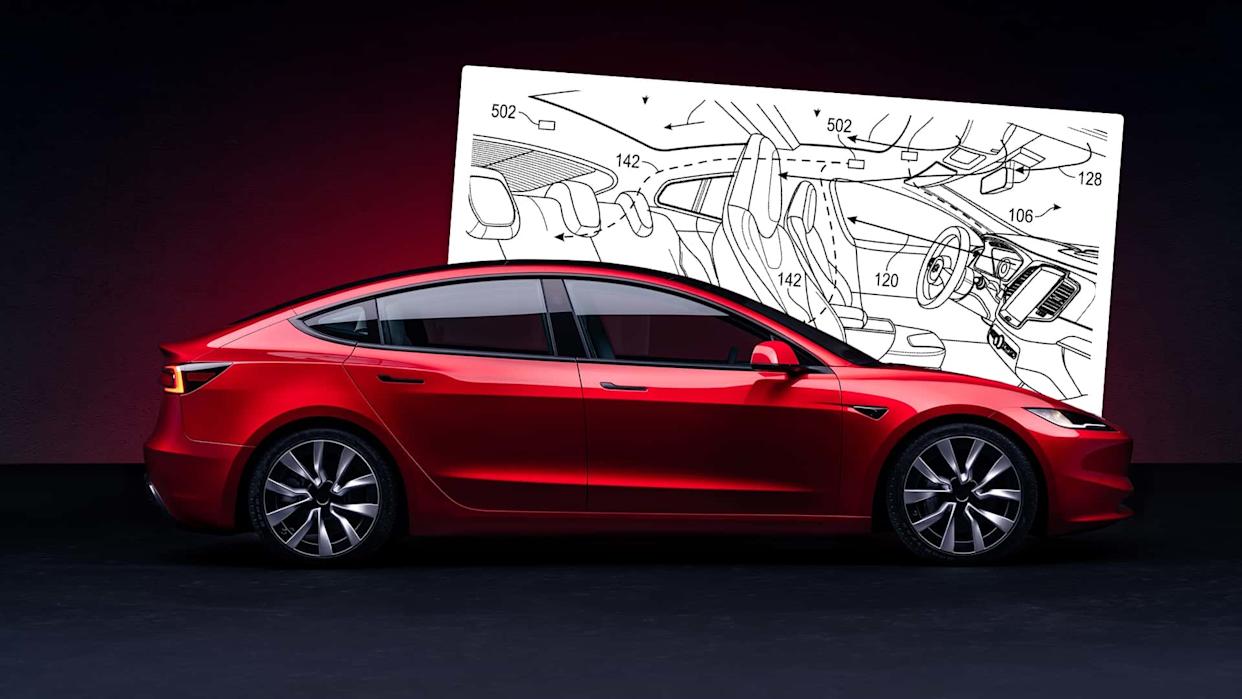
Tesla’s latest patent suggests that targeting concentrated hot air inside a vehicle cabin could reduce HVAC energy use and slightly extend driving range. The concept focuses on removing heat more efficiently rather than increasing battery size.

How Tesla’s New Cooling Idea Could Improve EV Range

A Different Approach to Cabin Cooling

Electric vehicles lose measurable driving range when climate systems work harder, especially in extreme heat. Tesla’s proposed solution addresses this issue by changing how air is managed inside the cabin.

Instead of cooling the entire interior uniformly, the system identifies areas where heat accumulates—often near glass surfaces or under direct sunlight—and removes that heat more directly. This method aims to reduce unnecessary energy use while maintaining comfort for occupants.


How the Suction-Based System Works

The patent outlines a system integrated into the vehicle’s HVAC architecture that uses controlled suction to extract hot air from specific zones. By creating localized negative pressure, the system pulls warmer air into the conditioning loop, where it is cooled and redistributed.

This approach contrasts with traditional systems that rely on circulating and cooling all cabin air evenly, regardless of temperature differences. By focusing only on hotter regions, the system can operate more efficiently.

Tesla also describes the ability to activate this feature selectively. Sensors would detect temperature variations within the cabin and trigger the suction function only where needed, avoiding unnecessary energy consumption.


Why Hot Air Pockets Matter

Uneven heating inside a vehicle is common, particularly in models with large glass areas. Sunlight passing through windows or panoramic roofs can create concentrated warm zones that standard air conditioning systems struggle to address quickly.

These localized heat buildups force the HVAC system to work harder overall, increasing power draw. Larger vehicles, with more interior volume and surface area, tend to experience this effect more strongly.

By directly targeting these hot spots, Tesla’s concept aims to stabilize cabin temperature more quickly and reduce the workload on the cooling system.


Potential Energy Savings and Range Impact

According to figures included in the patent, this targeted cooling method could reduce HVAC power consumption by up to 7.4% under high-temperature conditions. In one example, system demand drops from 1,720 watts to 1,593 watts, saving roughly 127 watts.

While that reduction may appear modest, it becomes more meaningful over longer drives or in consistently hot climates. Climate control is a known contributor to efficiency loss in electric vehicles, and even small improvements can translate into additional miles of usable range.

Independent data supports the importance of this issue. Studies indicate that air conditioning can reduce EV range by as much as 18% in extreme heat, highlighting why manufacturers are exploring alternative thermal management strategies.


Smarter Thermal Management Through Software

Beyond hardware changes, Tesla’s concept relies on intelligent control systems. The ability to monitor cabin conditions in real time and respond dynamically is central to its effectiveness.

By combining sensors, software logic, and targeted airflow control, the system aims to balance passenger comfort with energy efficiency. This reflects a broader trend in EV development, where software increasingly plays a role in optimizing performance without requiring major hardware upgrades.


Will This Technology Reach Production?

At this stage, the concept exists only as a patent filing, meaning there is no guarantee it will appear in future vehicles. Automakers often explore experimental ideas that never reach the market.

However, the underlying principle—improving efficiency through smarter thermal management—aligns with ongoing industry priorities. As battery improvements become more incremental, gains in areas like climate control are becoming more valuable.

If implemented, this type of system could offer a practical way to extend range and improve comfort without significant changes to vehicle architecture.

Tesla Model Y Remains America’s Best-Selling EV Despite Market Shifts

FAQ

How does Tesla’s new cooling concept work?

The system uses localized suction within the HVAC setup to pull hot air from specific areas. This air is then cooled and recirculated, reducing the need to condition the entire cabin equally.

Why does air conditioning reduce EV range?

Climate systems consume electrical energy from the battery. In hot weather, higher cooling demand can significantly increase power usage, reducing overall driving distance.

How much energy could this system save?

Tesla’s patent suggests a reduction of up to 7.4% in HVAC power consumption, which could translate into lower energy use during high-temperature driving conditions.

What are “hot air pockets” in a car?

These are localized areas where heat builds up, often caused by sunlight exposure through windows or roofs. They can make cooling less efficient if not addressed directly.

Is this technology available in Tesla vehicles today?

No. The concept is currently described in a patent and has not been confirmed for production models.

Recommend Reading: What Is Tesla Basecharger and How Is It Different From Superchargers?
FAQs - Tesla Model Y Comprehensive 2025 Edition

What is the Tesla Model Y and why is it so popular in the EV market?

The Tesla Model Y is a fully electric compact SUV launched in 2020 and quickly became Tesla’s best-selling vehicle worldwide. It combines long driving range, advanced Tesla Autopilot and Full Self-Driving (FSD) features, over-the-air software updates, and practical cargo space, making it ideal for families and commuters. Its balance between affordability, performance, and technology explains why it has surpassed sales of the Model 3 in many markets.

What are the key differences between the Tesla Model Y trims (Long Range, Performance, RWD)?
  • Model Y Rear-Wheel Drive (RWD): Entry-level, most affordable, suitable for city driving and shorter commutes.
  • Model Y Long Range (AWD): Dual-motor all-wheel drive, offering up to 330 miles of range, best balance for daily use and long trips.
  • Model Y Performance: Higher acceleration (0–60 mph in 3.5s), sportier handling, slightly shorter range (~303 miles).

Choosing between them depends on budget, driving habits, and whether you value maximum range or sporty performance.

How far can the Tesla Model Y go on a full charge?

As of 2025, the EPA-rated ranges are:

  • Model Y RWD: ~260 miles
  • Model Y Long Range: ~330 miles
  • Model Y Performance: ~303 miles

Real-world range may vary based on driving speed, weather, terrain, and vehicle load.

How does Tesla Model Y charging work at home and on the road?
  • Home Charging: Compatible with NACS (Tesla’s North American Charging Standard) and can also use J1772 adapters. A NEMA 14-50 outlet or Tesla Wall Connector is recommended for faster charging at home.
  • Public Charging: Model Y has seamless access to Tesla Superchargers (Level 3 DC Fast Charging), providing ~200 miles of range in ~15 minutes. In 2025, many CCS1 charging networks are also opening to Tesla via adapters.

Tip: For EV owners in North America, NACS is becoming the dominant charging connector, making Model Y future-proof.

How much does the Tesla Model Y cost in 2025?

Pricing may vary by market and incentives:

  • Model Y RWD: ~$44,000
  • Model Y Long Range: ~$49,000
  • Model Y Performance: ~$53,000+

Tax credits (such as the U.S. Federal EV tax credit) and state-level rebates can significantly reduce the effective cost.

What are the maintenance costs of a Tesla Model Y compared to gas cars?

Tesla Model Y requires lower maintenance than internal combustion engine (ICE) vehicles since it has fewer moving parts (no oil changes, no exhaust system, no fuel filters).

Typical costs include:

  • Tire rotations & replacements
  • Cabin air filter changes
  • Brake fluid inspection
  • Battery & motor cooling system checks

Battery warranty: 8 years or 120,000–150,000 miles (depending on trim).

What safety features does the Tesla Model Y include?

Tesla Model Y has received top safety ratings globally, featuring:

  • Autopilot (standard driver assistance system)
  • Optional Full Self-Driving (FSD) capability for advanced automation
  • Collision avoidance and automatic emergency braking
  • Over-the-air safety updates
  • High structural integrity with low rollover risk due to battery placement
How well is the Tesla Model Y selling in the U.S. and globally?

By 2025, the Tesla Model Y has become the world’s best-selling EV and one of the top-selling cars overall across all fuel types.

  • In 2023, it overtook Toyota Corolla in global sales.
  • In the U.S., Model Y continues to dominate EV sales with a strong market share, supported by expanding Tesla Supercharger access and competitive pricing.
What are the potential drawbacks or things to watch out for with the Tesla Model Y?
  • Build quality issues: Panel gaps and paint inconsistencies reported in early production, though improving.
  • Interior design: Minimalist dashboard not appealing to all drivers.
  • Charging infrastructure (non-Tesla): Although NACS is expanding, some third-party chargers may still require adapters.
  • Price fluctuations: Tesla frequently adjusts pricing, which may impact resale values.
What is the future outlook for the Tesla Model Y?
  • Solid-state or higher-density battery packs expected in future updates for improved range and durability.
  • Wider adoption of NACS charging will make road trips even more convenient across North America.
  • Autonomous driving improvements via AI and Dojo supercomputer may make FSD more capable.
  • Global dominance in EV sales likely to continue as Model Y remains Tesla’s most profitable and scalable model.
Lucid Gravity Update Adds Hands-Free Driving

Lucid Gravity Update Adds Hands-Free Driving

The Lucid Gravity receives a major OTA update featuring hands-free driving assistance, automatic lane changes, richer navigation data, and advanced battery preconditioning displays.

Plussur Lucid Gravity Update Adds Hands-Free Driving

Ford Bets on Smaller Electric Pickup Strategy

Ford Bets on Smaller Electric Pickup Strategy

After large electric trucks struggled in the U.S. market, Ford is pursuing a different strategy with a lower-cost midsize EV pickup focused on practicality, technology, and daily usability.

Plussur Ford Bets on Smaller Electric Pickup Strategy

Amazon EV Delivery Fleet Passes 50,000 Vehicles

Amazon EV Delivery Fleet Passes 50,000 Vehicles

Amazon now operates over 50,000 electric delivery vehicles globally, supported by extensive charging infrastructure and growing deployments of Rivian and Mercedes-Benz EVs.

Plussur Amazon EV Delivery Fleet Passes 50,000 Vehicles