





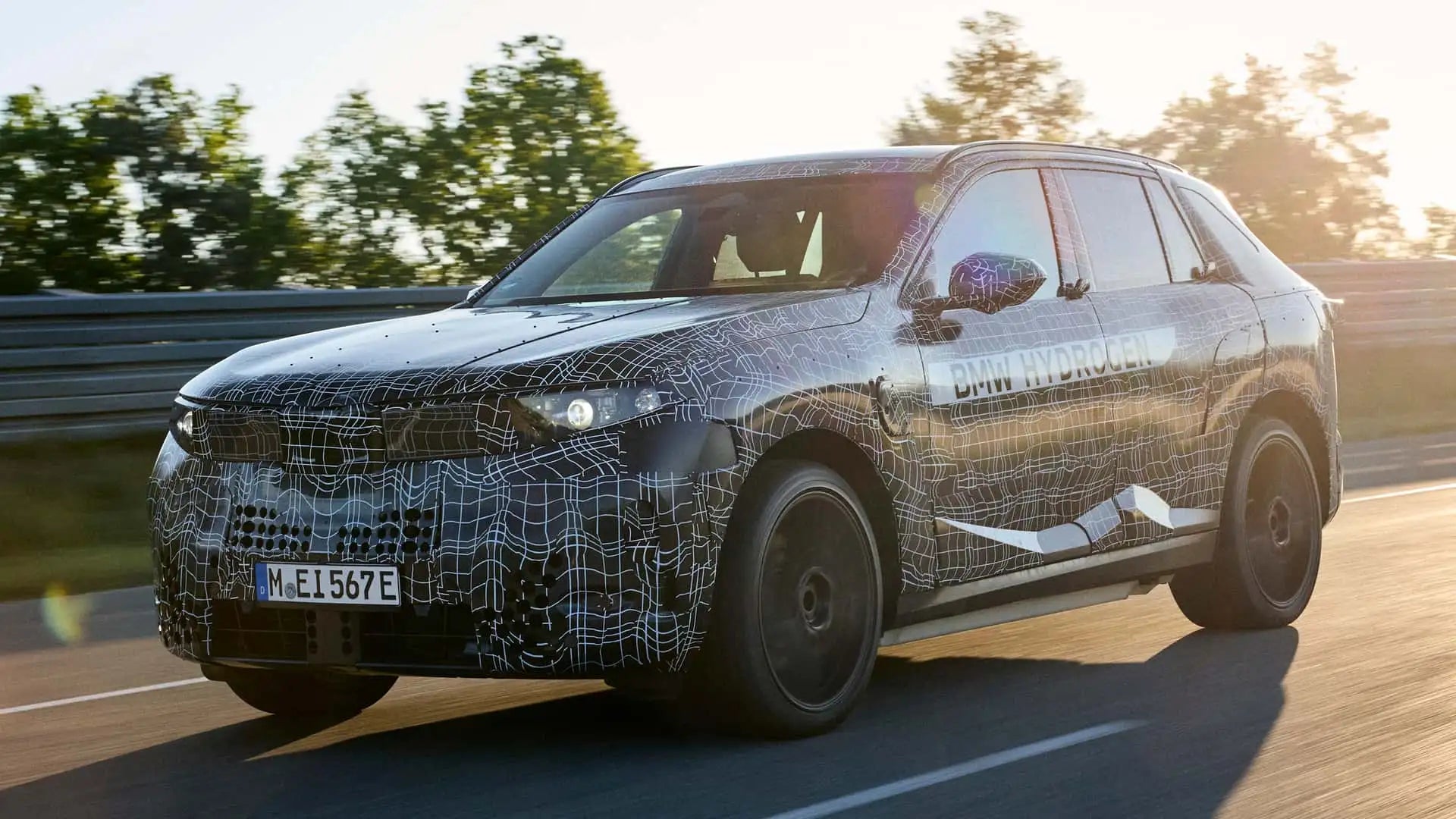
Hydrogen remains a niche technology for passenger vehicles, yet BMW continues to invest in fuel-cell mobility because it believes hydrogen could become an important complement to renewable energy and battery-electric vehicles. The company expects future growth in hydrogen production and energy storage to eventually support a broader refueling network, despite today's limited infrastructure.

BMW Expands the New X5 Lineup with a Hydrogen Version
BMW has confirmed that the next-generation X5 will be offered with one of the industry's widest selections of powertrains. Alongside gasoline, diesel, plug-in hybrid, and battery-electric variants, the company plans to introduce the hydrogen-powered iX5 in 2028.
Although BMW has not announced the markets where the vehicle will initially be sold, the decision reinforces its long-term commitment to fuel-cell technology at a time when most automakers are concentrating almost exclusively on battery-electric vehicles.
Unlike many experimental hydrogen projects from the past, BMW is positioning the iX5 as a production model designed to deliver familiar driving characteristics while offering rapid refueling.
Limited Infrastructure Remains the Biggest Challenge
The greatest obstacle facing hydrogen-powered passenger vehicles is not the technology itself, but the lack of fueling infrastructure.
Compared with the rapidly expanding network of EV charging stations, public hydrogen refueling locations remain scarce. In the United States, all 47 publicly accessible hydrogen stations are located in California. Globally, more than 80% of hydrogen fueling stations are concentrated in just China, Japan, South Korea, France, and Germany.
This limited availability has significantly restricted sales of existing fuel-cell vehicles. Models such as the Toyota Mirai, Honda CR-V e:FCEV, and Hyundai Nexo have demonstrated that the technology is technically viable, yet customer adoption has remained modest because refueling options are available in only a handful of regions.
BMW's Strategy Extends Beyond Passenger Cars
BMW argues that evaluating hydrogen solely as an automotive fuel overlooks its broader potential within future energy systems.
As renewable electricity generation from wind and solar continues to grow, energy suppliers face increasing challenges storing excess power produced during periods of low demand. While battery storage systems already perform much of this work today, BMW believes hydrogen could provide an additional long-duration storage solution.
The concept is relatively straightforward. Surplus renewable electricity can power electrolyzers that separate water into hydrogen and oxygen. The hydrogen can then be stored for extended periods before being converted back into electricity when demand rises or used directly in transportation and industrial applications.
According to BMW executives, wider adoption of hydrogen for grid-scale energy storage could naturally encourage investment in hydrogen production and fueling infrastructure. If that ecosystem develops, passenger vehicles like the iX5 could benefit without relying solely on demand from private car buyers.
The iX5 Combines Fuel Cells with Electric Driving
Rather than replacing electric propulsion, the BMW iX5 Hydrogen uses hydrogen to generate electricity on board.
Its fuel-cell system, developed in cooperation with Toyota, stores approximately 7 kilograms of hydrogen inside seven high-pressure tanks. During operation, hydrogen reacts with oxygen inside the fuel-cell stack, producing electricity that powers the vehicle's electric motors while emitting only water vapor.
BMW estimates the SUV will achieve a driving range of approximately 750 kilometers (WLTP)—roughly 400 miles under EPA-equivalent estimates—while requiring less than five minutes to refill its hydrogen tanks, offering a refueling experience similar to that of conventional gasoline vehicles.
Hydrogen Still Faces Significant Economic Hurdles
Despite its technical advantages, hydrogen vehicles continue to face several barriers that have slowed widespread adoption.
Vehicle pricing remains one of the largest concerns. While battery-electric vehicles have become increasingly affordable thanks to declining battery costs and growing production volumes, fuel-cell vehicles are generally more expensive to manufacture. BMW has not yet announced pricing for the iX5 Hydrogen, making it difficult to judge its competitiveness against conventional EVs.
Fuel production is another challenge. According to the U.S. Department of Energy, roughly 95% of hydrogen produced in the United States currently comes from fossil fuels, limiting its environmental benefits. Cleaner "green hydrogen," generated using renewable electricity through electrolysis, remains available only in limited quantities and at significantly higher costs.
Battery EVs Continue to Hold the Efficiency Advantage
Research suggests hydrogen and batteries may ultimately serve different roles instead of competing directly.
Battery energy storage systems achieve an estimated 80% to 90% round-trip efficiency, meaning most of the electricity used to charge them can later be recovered. Hydrogen systems, by comparison, typically return only 35% to 55% of the original energy after electricity is converted into hydrogen and then back into electricity.
However, hydrogen offers one important advantage: long-term storage. Batteries gradually lose energy over time and are best suited for frequent charging and discharging. Hydrogen can remain stored for months with minimal energy loss, making it attractive for seasonal renewable energy storage, emergency backup power, freight transportation, and industrial operations.
BMW believes these broader applications could eventually justify larger hydrogen production networks that also benefit passenger vehicles.
BMW Is Not the Only Company Investing in Fuel Cells
Although many manufacturers have shifted their primary focus toward battery-electric vehicles, several companies continue developing hydrogen technology.
BMW has already operated hydrogen-powered forklifts and logistics equipment at its Spartanburg manufacturing plant for more than a decade. Hyundai uses hydrogen-powered Xcient trucks in commercial logistics, while Toyota continues producing the Mirai despite relatively modest sales volumes. Honda has also entered the market with the CR-V e:FCEV, combining plug-in hybrid capability with hydrogen fuel-cell technology.
These projects suggest that major automakers still see long-term potential for hydrogen, particularly in commercial transportation and specialized applications where rapid refueling and extended driving range offer clear advantages.
Outlook
BMW's hydrogen strategy is based on a long-term vision rather than today's market conditions. The company expects future growth in renewable energy and hydrogen storage to gradually improve fueling infrastructure, making fuel-cell vehicles more practical over time.
Whether that vision becomes reality remains uncertain. Battery-electric vehicles currently benefit from stronger charging networks, lower operating costs, and a more mature supply chain. Even so, BMW believes hydrogen could eventually complement—not replace—battery technology by serving different transportation and energy-storage needs.
If hydrogen production becomes cleaner, less expensive, and more widely available, vehicles like the BMW iX5 Hydrogen could occupy a meaningful position alongside battery-electric models in the future mobility landscape.

FAQ
Why is BMW still investing in hydrogen vehicles?
BMW believes hydrogen can support both transportation and renewable energy storage. The company expects future expansion of the hydrogen economy to improve refueling infrastructure and make fuel-cell vehicles more practical.
When will the BMW iX5 Hydrogen be available?
BMW plans to launch the iX5 Hydrogen in 2028. The automaker has not yet confirmed which countries will receive the vehicle first.
What are the advantages of hydrogen cars over battery EVs?
Hydrogen vehicles can typically be refueled in under five minutes while offering driving ranges comparable to many battery-electric vehicles. They may also be well suited for long-distance and commercial applications.
What limits hydrogen vehicle adoption today?
The biggest challenges are the limited number of hydrogen refueling stations, higher vehicle costs, and the fact that most hydrogen is still produced using fossil fuels rather than renewable energy.
Can hydrogen replace battery-electric vehicles?
Most industry experts see hydrogen and batteries as complementary technologies. Battery EVs remain more efficient for everyday passenger transportation, while hydrogen may play a larger role in long-duration energy storage, heavy transport, and industrial applications.
Recommend Reading: BMW iX5 Battery Capacity Sets New Benchmark










Share:
What Is a NEMA 6-20 Plug? A Complete Guide for EV and Industrial Applications
NEMA 14-50 Outlet vs Hardwired EV Charger: Which Is the Better Choice?